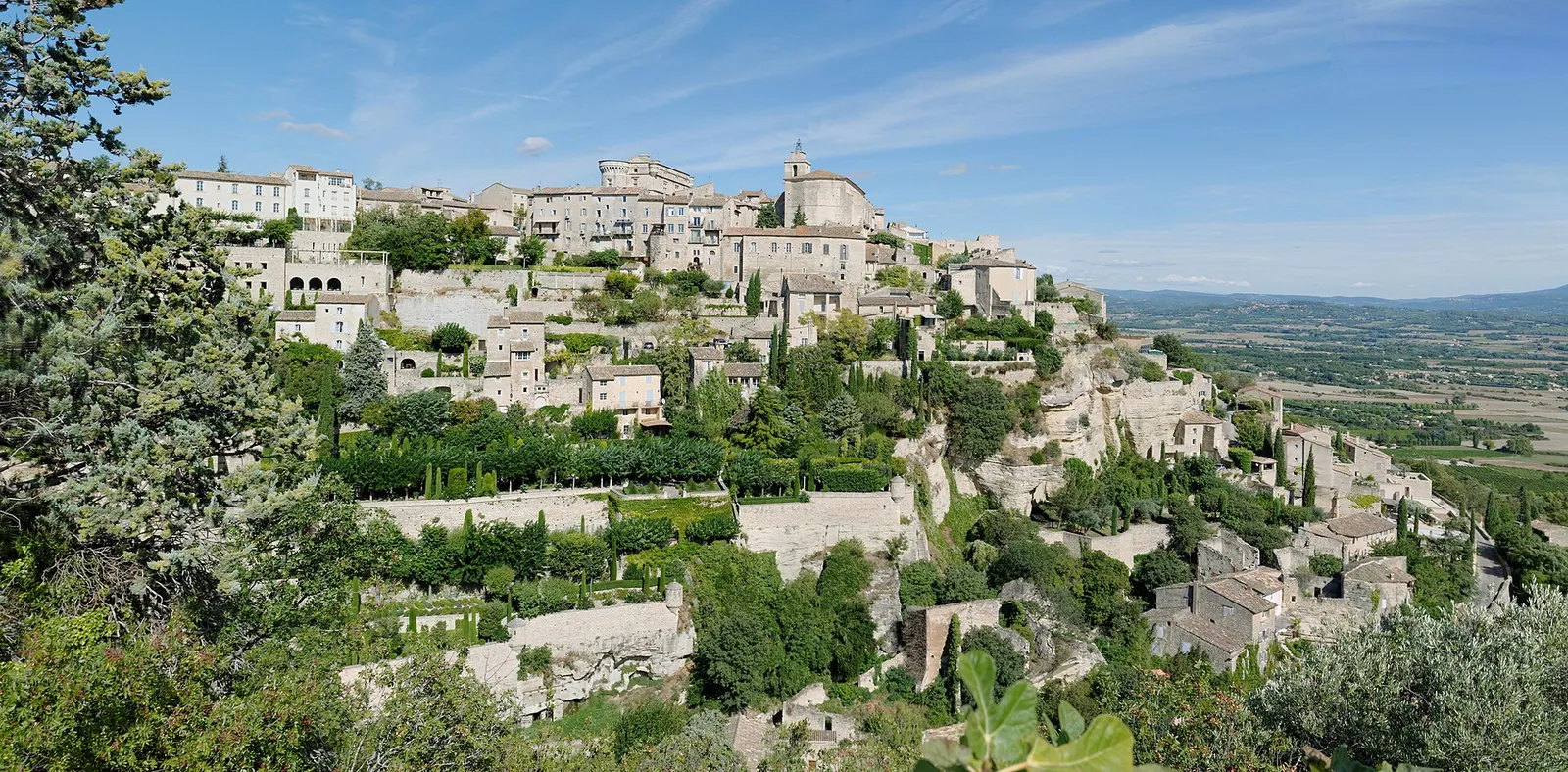
When our guests ask us what makes the Luberon so special, we always give the same answer: its hilltop villages. Clinging to the rock, perched on a ridge or hugging a hillside, they trace the valley's skyline like so many golden sentinels. From Le Clos de Manon, a ten-minute walk from Gordes, most of them are under thirty minutes away by car. Here, village by village, is our insider's guide to shaping your stay.
What the hilltop villages of the Luberon have in common
Before you set out to explore, it helps to understand what ties these villages together. They all share the same golden limestone that turns honey-coloured at sunset, stepped cobbled lanes known as calades, sweeping views over the valley and Mont Ventoux, and a medieval history written into their ramparts and châteaux.
- The “Most Beautiful Villages of France” label distinguishes several of them, including Gordes, Roussillon, Ménerbes and Lourmarin — a guarantee of preserved heritage and surroundings.
- A spectacular geology: the white stone of the Monts de Vaucluse to the north, the red and orange ochres to the east around Roussillon, which give each village its own colour.
- A rare concentration: you move from one village to the next in just a few minutes, making the Luberon one of the regions with the highest density of classified villages in all of France.
The ideal starting point remains Gordes, the most famous of them all: we have devoted a full guide to what to do in Gordes, the emblematic hilltop village, its 12th-century château, its calades and the nearby Sénanque Abbey.
The villages of the ochres and the Monts de Vaucluse
Roussillon, the red village
About twenty minutes from Gordes, Roussillon is arguably the most spectacular of them all. Built at the heart of one of the world's largest ochre deposits, the village runs through every shade of red, orange and crimson, from its façades to the famous Ochre Trail. For a full tour of the cliffs, the former quarries and the village, read our guide to visiting Roussillon, the red village of the Luberon.
Goult, the best-kept secret
Often overlooked by the usual tourist circuits, Goult is one of our favourites. You climb up to the restored Jérusalem windmill, wander among the dry-stone terraces and enjoy a calm that is rare in high season. Discover why we love it so much in our article on Goult and the Jérusalem windmill, the Luberon's secret.
The triangle of artists' villages
South of the Calavon valley, three neighbouring villages form a legendary trio, long cherished by painters, writers and art lovers.
Ménerbes
Perched on a rocky spur shaped like a ship, Ménerbes is listed among the Most Beautiful Villages of France. Peter Mayle settled here and made it the backdrop of A Year in Provence. You can visit the House of Truffles and Wine and take in striking panoramas over the Luberon. It is all in our dedicated guide to Ménerbes, one of the most beautiful villages of France.
Lacoste
Dominated by the ruins of the Marquis de Sade's château, now owned by Pierre Cardin, Lacoste hosts an opera festival each summer. Its stony lanes and art galleries give it a real sense of atmosphere. We tell its story in Lacoste: the Sade château and the artists' village.
Bonnieux
Bonnieux rises in tiers between cedars and vineyards, from the 12th-century upper church down to the lower village. The neighbouring cedar forest offers one of the loveliest walks in the Luberon. To plan your visit, see our guide to Bonnieux, a hilltop village between cedars and vineyards.
The villages of character, between history and silence
Oppède-le-Vieux
Abandoned in the 19th century and then brought back to life by artists, Oppède-le-Vieux is a ghost village of rare poetry, watched over by its ruined château and its collegiate church. You climb up on foot, in silence, as if walking through a dream. We have devoted a whole article to it: Oppède-le-Vieux, a ghost village reborn.
Saignon
Above Apt, Saignon crowns a rock from which the view takes in the whole of the greater Luberon. Its fountain, its flower-filled lanes and its panoramic rock make it a peaceful stop. Everything is detailed in our guide to Saignon, a hilltop village above Apt.
Venasque
At the gateway to Mont Ventoux, Venasque is also among the Most Beautiful Villages of France. Its Merovingian baptistery, one of the oldest religious monuments in France, and its medieval ramparts are worth the detour on their own. Discover it in Venasque, a medieval gem at the foot of Mont Ventoux.
Lourmarin and the southern gateway to the Luberon
Lourmarin
On the other side of the mountain, Lourmarin guards the passage to the south. The village of Albert Camus, who is buried here, it was also home to Henri Bosco. Its Renaissance château, its cafés and its Friday market make it a stop for food lovers and literary souls alike. We touch on it in Lourmarin, the village of Albert Camus.
Along the water: the Sorgue and its villages
Not all the villages of the Luberon are perched on the rock. To the north-west, the River Sorgue reveals another face of Provence, more watery and just as enchanting.
L'Isle-sur-la-Sorgue
Nicknamed the “Comtat Venice”, L'Isle-sur-la-Sorgue is crisscrossed by canals and paddle wheels. The capital of brocante and antiques, it comes alive every Sunday with a legendary floating market. So you don't miss a thing, read L'Isle-sur-la-Sorgue, the Comtat Venice and its antiques.
Fontaine-de-Vaucluse
A few kilometres upstream, the Sorgue surges from the most powerful spring in France, at the foot of a vertiginous cliff. The site, dear to Petrarch, is one of the most impressive in Provence. It is all in our article on Fontaine-de-Vaucluse and the source of the Sorgue.
When and how to visit?
The Luberon is best savoured away from the biggest crowds. We recommend that our guests choose spring (April to June) for the cherry trees and the first lavender, or September and October for the grape harvest and the golden light. In July and August, it is better to set out early in the morning to enjoy the villages before the tour groups arrive.
- Stick to two or three villages a day, never more: each one deserves time, lingering over lunch on a terrace and waiting for the late-afternoon light.
- Keep the car for getting around, but explore on foot: the old centres are pedestrian and the car parks lie just below.
- Plan your visits around market days — Tuesday in Gordes, Friday in Lourmarin, Sunday in L'Isle-sur-la-Sorgue — to experience the villages at the pace of the locals.
Exploring from Le Clos de Manon
The strength of our location is its centrality. From Le Clos de Manon, a ten-minute walk from Gordes, all of these hilltop villages are within reach without ever spending more than half an hour on the road. You set off in the morning towards Roussillon or Ménerbes, come back for lunch and a swim in the heated pool, then head out again for sunset at Bonnieux or Oppède. To experience the Luberon at this pace, the best approach is to plan a stay of five to seven nights and to check our availability for your dates. It is, by far, the loveliest way to discover the hilltop villages of the Luberon.