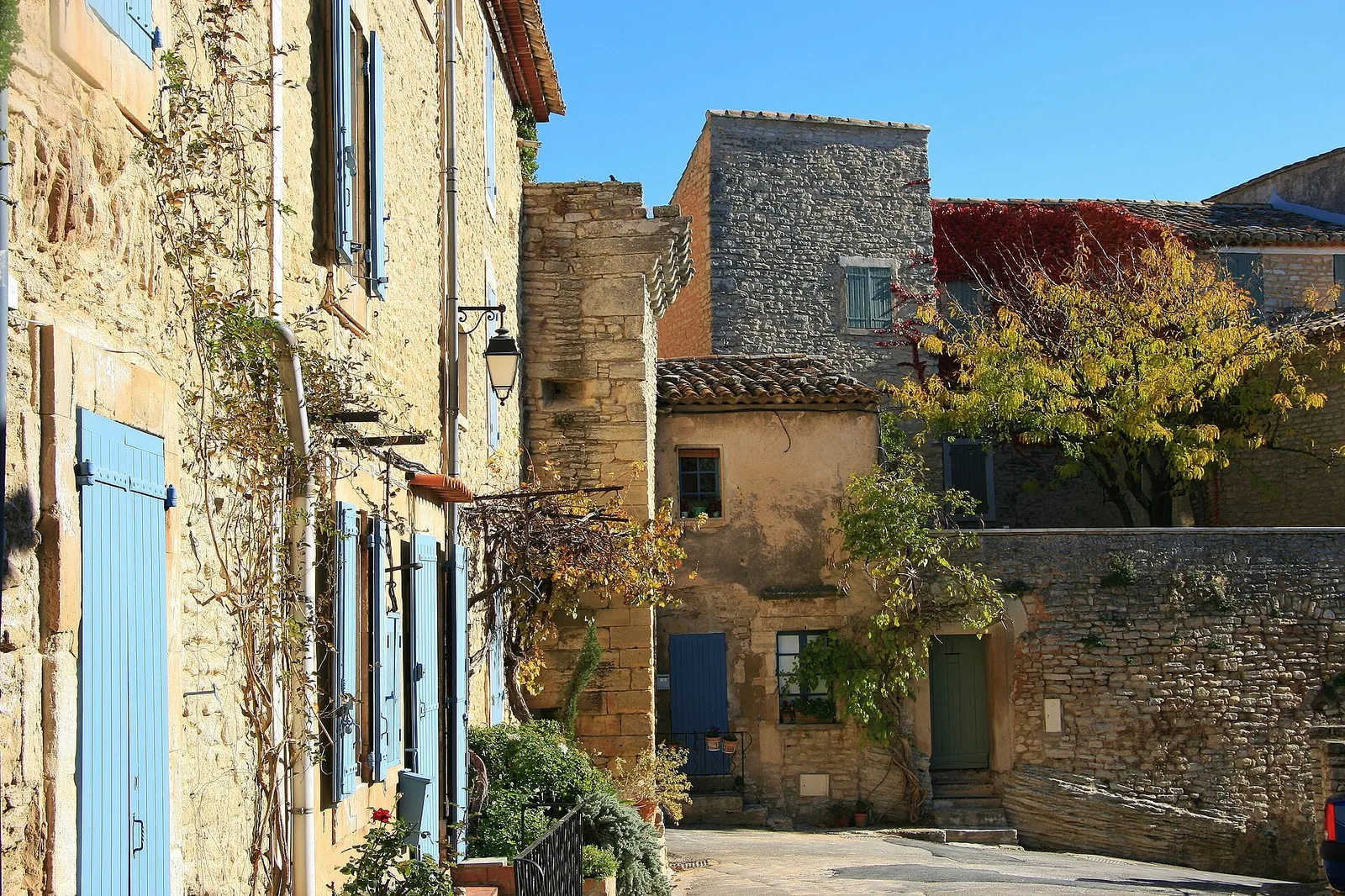
In the Luberon there are villages everyone knows, and others passed quietly from one regular to the next. Goult belongs to the second kind. About twenty minutes' drive from Le Clos de Manon, perched on a hill between Gordes and the far side of the Calavon valley, it offers everything we love about the Luberon — the golden stone, the sloping lanes, the sweeping views — without the tour buses or the crowds of the famous spots. When our guests ask us where to go to breathe, it is often towards Goult that we send them.
Goult, the village you keep to yourself
Goult was long left off the usual routes, and that is precisely what gives it its charm today. The village rises gently from its shaded square to the summit, along lanes lined with houses of pale golden limestone that catch fire in the late-afternoon sun. You'll meet more sleeping cats than hurried visitors, and you take the time to look up at the carved lintels, the vaulted passageways and the little squares where a fountain still runs.
- Unspoilt authenticity: Goult does not hold the "Plus Beaux Villages de France" label — all the better for those seeking peace and quiet; the village lives at its own pace, even in the height of summer.
- A central position: halfway between the Monts de Vaucluse to the north and the Luberon massif to the south, it makes an ideal base for exploring without ever driving far.
- A quiet but rich heritage: the Agoult-Simiane château, reworked over the centuries, the Romanesque church of Saint-Sébastien, medieval lanes and dry-stone terraces on the slopes of the hill.
If you love this kind of gem, know that Goult is not alone: we've gathered our favourites in our guide to the most beautiful perched villages of the Luberon, where the village naturally ranks among the most endearing.
The Jérusalem windmill, sentinel of the hill
At the highest point of the village stands the Jérusalem windmill, a 17th-century windmill that the residents have patiently restored. Long in ruins, it has regained its roof, its sails and its mechanism, and can now be visited during openings organised by the local association. Its name intrigues: it is said to come from the hamlet that crowns the hill, and we like to see in it a nod to the millers of old.
But even with its doors closed, the climb is well worth it. From the esplanade around the windmill, your gaze takes in the whole of the Calavon valley, the ochre cliffs of Roussillon in the distance and, on a clear day, the silhouette of Mont Ventoux. It is, without question, one of the finest viewpoints in the area, and one of the most peaceful. We recommend going up in late afternoon, when the stone and the plain take on their honeyed hues.
The conservatory of cultivation terraces
Goult's other treasure is its conservatory of cultivation terraces, an interpretive trail laid out on the slopes of the hill, around the windmill. The walk is short and accessible to all: allow a little under an hour for the loop, easy and effortless, ideal even with children.
Along the way you discover the restanques — those terraces held up by dry-stone walls — that allowed farmers to cultivate the slopes for centuries. Vines, olive and almond trees, drystone huts and apiers (bee niches hollowed into the walls) tell the story of a patient, ingenious form of farming, perfectly suited to the terrain and the Provençal climate. It is a walk we love to recommend to understand, as you go, how this landscape was shaped by human hands.
- An open, free trail, waymarked and dotted with information panels, walked at your own pace from the centre of the village.
- Beautiful views over the valley at every turn, and welcome shade beneath the oaks in the height of summer.
- A living introduction to dry-stone craft, a skill listed in UNESCO's intangible heritage and found everywhere across the Luberon.
The fine restaurants and the art of strolling
Goult may be quiet, but you eat remarkably well here. The village square and its surroundings are home to a handful of well-regarded restaurants, from local bistros to more gastronomic addresses, where Provençal cooking reinvents itself with produce from the market and from neighbouring growers. It is one of those villages you sometimes come to just for lunch, in the shade of a plane tree, before heading up to walk it off around the windmill.
The rest is savoured without a plan: a stop at the grocer's, a coffee on the little square, a detour by a gallery or a craftsman's workshop. Goult invites you to slow down, and that is surely its finest lesson. For lovers of food and markets, the village sits within a generous valley, between the vineyards of the Ventoux and the truffles of the Comtat.
Extending the walk around Goult
The beauty of Goult is that it is never visited on its own. A few minutes' drive is all it takes to string it together with other gems of the valley. To the south, you head down to Lourmarin, the village of Albert Camus, gourmet and literary, guarding the southern gateway to the Luberon. To the west, you reach L'Isle-sur-la-Sorgue, the Comtat Venice and its antiques, a treasure-hunter's paradise threaded with canals. And following the river upstream, you arrive at Fontaine-de-Vaucluse and the source of the Sorgue, one of the most powerful springs in Europe, at the foot of a dizzying cliff.
Making Goult a stop from Le Clos de Manon
From Le Clos de Manon, a ten-minute walk from Gordes, Goult is only about twenty minutes' drive away: just enough to treat yourself to a morning at the windmill and on the terraces trail, lunch on the square, then a return to the villa for a swim in the heated pool during the warm hours. It is exactly the kind of getaway our central position in the Luberon makes possible. To plan a stay at this unhurried pace, the best thing is to allow five to seven nights and to check our availability for your dates. Goult, then, will no longer be a secret to you either.