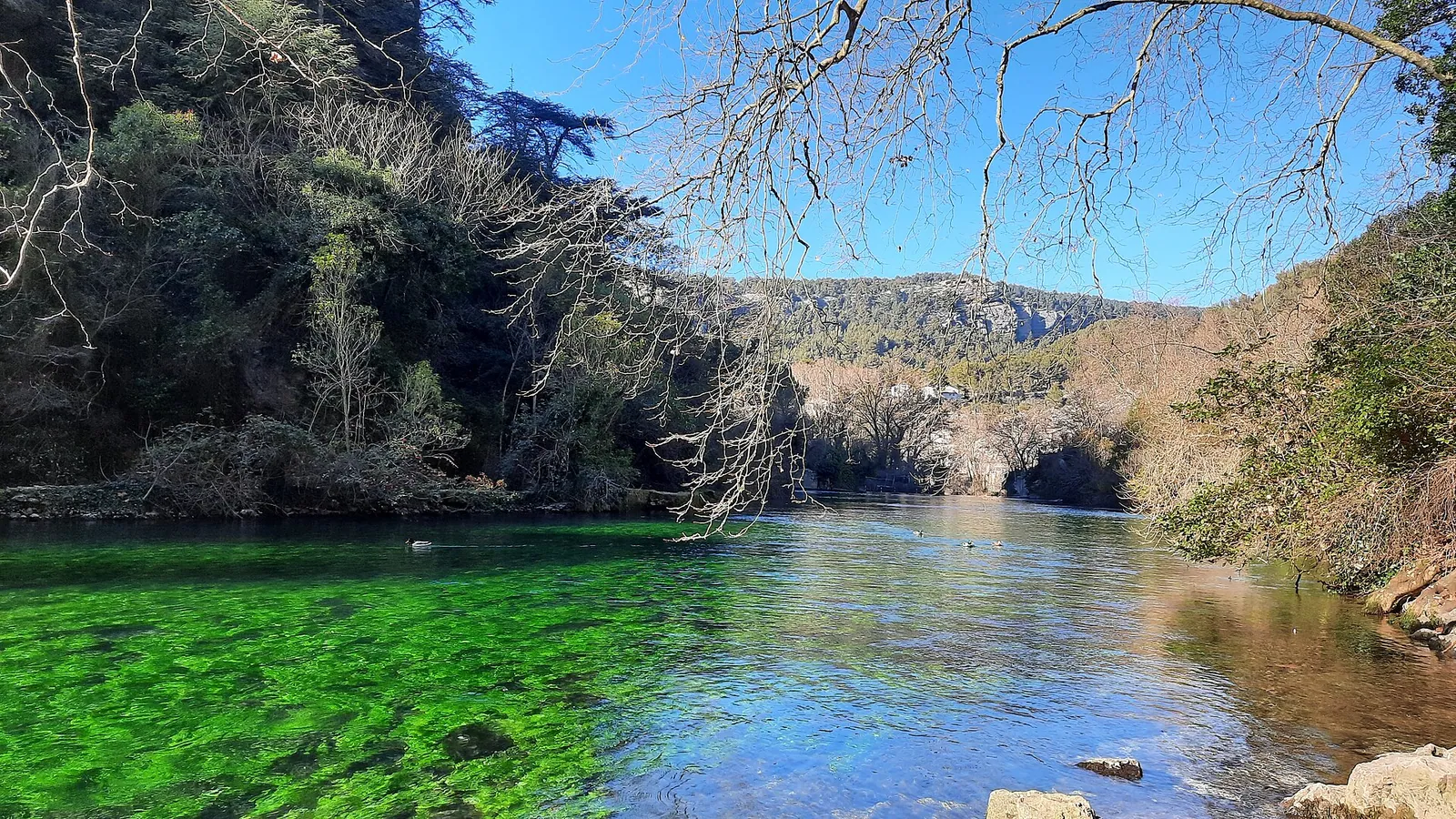
There are places in Provence where water becomes a character in its own right. Fontaine-de-Vaucluse is the most striking of them all. At the foot of a closed valley, hemmed in by high cliffs, deep green water surges from the rock and gives birth to the Sorgue, one of the loveliest rivers in the region. This is where the most powerful spring in Europe rises, in a setting nothing prepares you for. About twenty kilometres from our villa — roughly a 25-minute drive from Gordes — it's an outing we often suggest to our guests, especially in spring. Here's how to make the most of it.
The chasm and the source of the Sorgue
At the far end of the village, a shaded path follows the infant Sorgue and leads in about ten minutes to the foot of a cliff more than two hundred metres high. There, in the hollow of a rocky amphitheatre, opens the chasm of Fontaine-de-Vaucluse: a dark, dizzying pool from which water rises out of the depths of the earth.
The phenomenon has long been a puzzle for scientists. The spring drains rainwater that has seeped into a vast limestone plateau — including Mont Ventoux and the Montagne de Lure — before returning it here. Dives and explorations carried out over decades, notably by Commander Cousteau's team, only reached the bottom at more than three hundred metres down. No one has yet unravelled all its secrets.
- Come in spring for the spectacle. As the snow melts and after the rains, usually from March to May, the chasm overflows and water cascades up and over the pool. It's the great moment of the year.
- In summer, the level drops. The chasm then reveals itself as a simple, still green pool — quieter, but still impressive for its colour and its mineral setting.
- The path is easy, level or gently sloping, accessible to everyone, but the ground can be slippery near the water.
The memory of Petrarch and Laura
Fontaine-de-Vaucluse is not only a natural wonder: it is also a great landmark of European poetry. In the 14th century, the Italian poet Petrarch withdrew here for several years, in the calm of the closed valley — the vallis clausa that gave the Vaucluse its name. It was here that he composed part of his Canzoniere, those immortal verses addressed to Laura, the woman he loved and, so the story goes, first met in Avignon.
The village keeps this memory with care. A museum devoted to Petrarch, set beside the Sorgue, traces his stay and his work, while a column raised on the square recalls the fifth centenary of his birth. To wander here is to walk in the footsteps of one of the fathers of modern poetry, in a landscape that has barely changed since.
The Vallis Clausa paper mill
Heading back up towards the centre of the village, the force of the water long kept mills turning. One of them has been brought back to life: the Vallis Clausa paper mill carries on the craft of times past. There you can watch the great paddle wheel work the mallets that pound the pulp, then the sheet take shape on the screen, exactly as paper was made by hand centuries ago.
Entry to the workshop is free and the demonstration is well worth a look, especially with children: watching a sheet of paper form before your eyes has something magical about it. You'll also find paper adorned with dried flowers and petals — pretty souvenirs to bring home from a stay in Provence.
Strolling along the Sorgue
Once you've discovered the source and the mills, take the time to walk along the river. Here the Sorgue runs clear and cool, shaded by plane trees and dotted with terraces where it's a pleasure to sit down. The water stays cold all year round, which keeps its banks deliciously fresh during the hot hours of summer. It's the perfect spot for a lunch break after the walk up to the chasm.
Those who prefer livelier pursuits aren't left out: the Sorgue is one of the region's favourite rivers for kayakers. Paddling down by canoe, downstream from the neighbouring village of Fontaine, is a great classic of Provençal summers — best booked in the warm season.
Fontaine-de-Vaucluse on a day out in the Luberon
The location of Fontaine-de-Vaucluse makes it an easy stop to combine with others. Just nearby, L'Isle-sur-la-Sorgue and its famous antiques market deserve a half-day of their own, while the perched villages of the northern slope are all within easy reach by road from Gordes.
We love to suggest that our guests pair this outing with other gems nearby, each less than three quarters of an hour away: Venasque, a medieval jewel at the foot of Mont Ventoux, Saignon, a village perched above Apt, or Roussillon, the red village of the Luberon for a striking contrast between green water and ochre earth. To build your own loop, we've gathered the essentials in our guide to the most beautiful perched villages of the Luberon.
Practical tips for visiting Fontaine-de-Vaucluse
- When to come. Spring remains the best time: the spring is in full flow and the valley is at its most radiant. Off-season, the site is more peaceful and the light magnificent.
- Early in the morning. The village gets very busy in summer; arriving before mid-morning gives you the chasm and the path in peace, and easier parking.
- Wear the right shoes. The path up to the chasm is easy, but the stones can be damp and slippery near the water.
- Allow half a day to take in the source, the Petrarch museum, the paper mill and a terrace beside the Sorgue.
Your ideal base a stone's throw from the Sorgue
The beauty of a stay in Gordes is being able to set off early towards the source while it's still deserted, then come back for a swim in the heated pool during the warm hours of the afternoon. From Le Clos de Manon, Fontaine-de-Vaucluse is just twenty-five minutes away — and it's only one outing among so many right from your doorstep. If the idea of a week roaming the Luberon, at the gentle pace of Provence, appeals to you, check our availability and book your stay: the Sorgue will be waiting for you, emerald green, in the hollow of its closed valley.