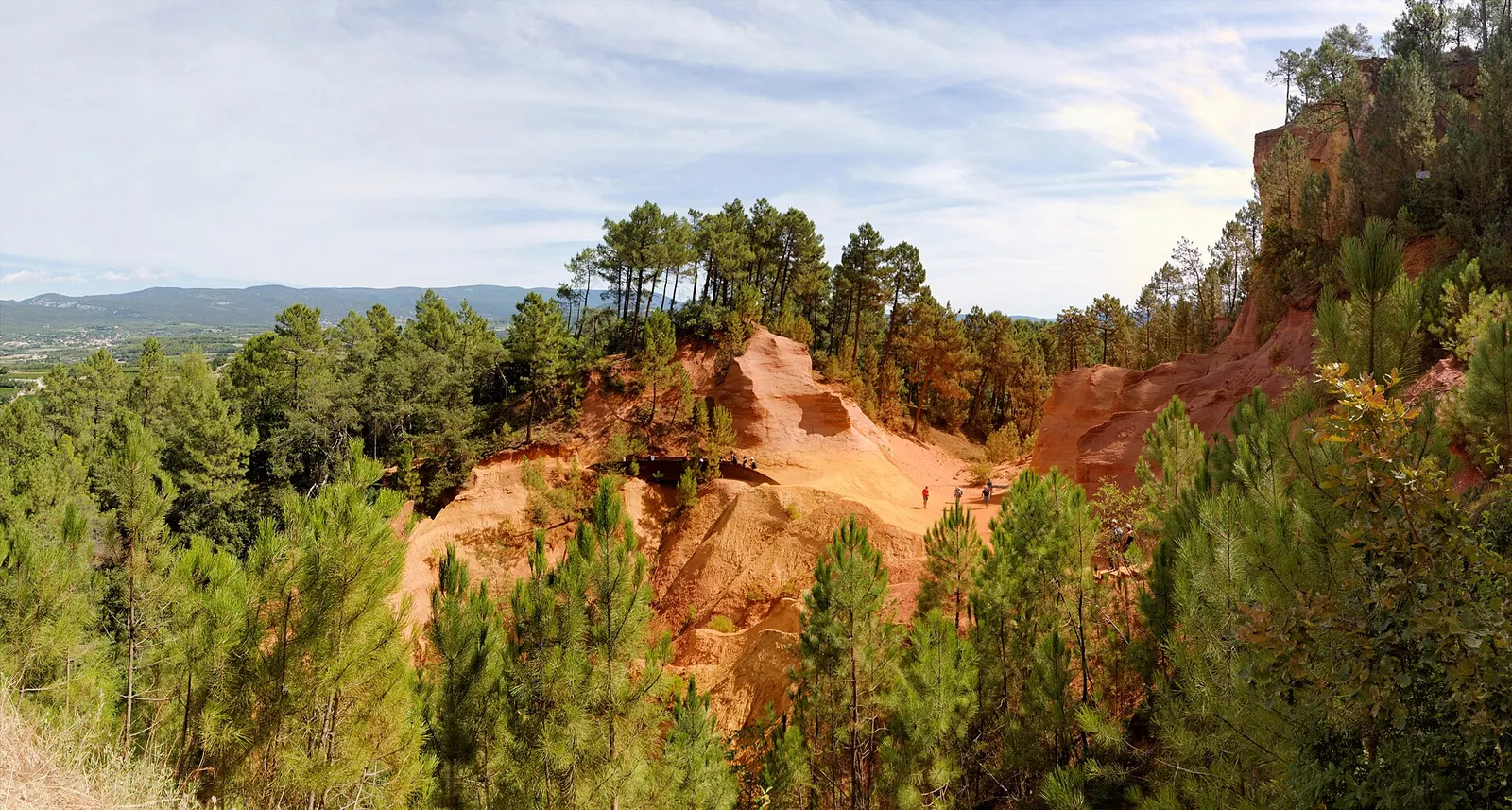
In the Luberon, there are villages you come to see for their golden stone and their perched silhouette. And then there is Roussillon, which looks like nowhere else. Here, everything is red, orange, saffron, oxblood: the façades, the shutters, the very earth beneath your feet. It is one of the rare places in Provence where the ground itself becomes a spectacle. Barely ten kilometres from our villa — about a 15-minute drive from Gordes — Roussillon is one of the day trips we recommend most readily to our guests. Here is how to make the most of it without falling into the tourist traps.
Why Roussillon is so red
Roussillon sits on one of the world's largest ochre deposits. For centuries, these coloured earths were quarried here to make pigments that were exported far beyond Provence. Industrial extraction ended in the mid-twentieth century, but it left behind a spectacular landscape: cliffs sculpted by erosion and by human hands, where as many as twenty shades of red and orange unfold.
The village, listed among the most beautiful villages in France, grew from this same earth. Its houses are rendered with the local ochres, which explains the extraordinary harmony of its lanes: from straw yellow to deep red, with every ochre in between. No other village in the Luberon plays with colour quite like this.
The Ochre Trail, the must-see
This is the great reason to come. The Ochre Trail is a laid-out path through the heart of the old quarries, on the edge of the village. You walk between fairy chimneys, needles and blazing cliffs, on ground that crunches underfoot and colours your soles.
- Two possible loops: a short circuit of about 30 minutes and a fuller one of around 50 minutes. Both are suitable for the whole family, with a few steps and gently sloping sections.
- Wear the right shoes: ochre leaves lasting stains. Avoid white trainers and any light-coloured clothes you want to keep pristine.
- There is an admission fee, and the trail can close in rain or strong wind, as the ochre becomes slippery. Check on the morning itself.
Our tip as hosts: come early in the morning or late in the day. The low, raking light literally sets the cliffs ablaze, the colours turn unreal, and you avoid the midday crowds, which are particularly dense in July and August.
The Giants' Causeway
If you want to extend the experience, the Giants' Causeway (Chaussée des Géants) is a natural ochre site just below the edge of the village. Wilder columns and cliffs, far less frequented than the Ochre Trail, well worth the detour for those who love photography and walking.
Wandering through the village
Once your shoes are dusted with ochre, take the time to climb back up to the heart of the village. Roussillon is best explored on foot, with your eyes lifted to the façades.
- The castrum and the viewpoint. At the top of the village, the esplanade offers a magnificent panorama over the valley, Mont Ventoux in the distance and the colourful undulations of the plateau. It is one of the finest belvederes in the Luberon.
- The Place de la Mairie and the belfry. The lively centre of the village, with its shaded terraces, ideal for a pause at aperitif time.
- The studios and galleries. Roussillon has always drawn artists and craftspeople. You will find shops selling pigments, ceramics and local creations, perfect for bringing home an authentic keepsake.
Understanding ochre at the former Conservatory
For the curious, the former Mathieu factory, now a place devoted to ochre and colour (often known as Okhra), lets you understand the whole process, from extraction to finished pigment. It runs visits and workshops centred on the coloured earths. It is a lovely way to give meaning to what you have seen on the trail, especially with children.
Roussillon as part of a day in the Luberon
Roussillon is rarely savoured on its own: its closeness to Gordes makes it an ideal stop on a loop through the perched villages. From our villa, you can easily string together several gems in a single day.
We love to suggest that our guests pair Roussillon with other villages on the southern slope, all less than thirty minutes away: Ménerbes, one of the most beautiful villages in France, Lacoste: Sade's château and the artists' village, and Bonnieux, a perched village among cedars and vines. For an overview and to build your own itinerary, we have gathered the essentials in our guide to the most beautiful perched villages of the Luberon.
Practical tips for visiting Roussillon
- When to come. Spring and early autumn offer the loveliest light and the fewest crowds. In summer, aim for the very start of the morning.
- Parking. The village is discovered on foot. Park in the designated car parks at the entrance and stroll up at your own pace: the lanes are narrow and pedestrian.
- Bring water and a hat. On the Ochre Trail, shade is scarce and the heat reflected by the cliffs can take you by surprise.
- Allow half a day to combine the trail, the village and a terrace, more if you add an ochre workshop.
Your ideal base a stone's throw from Roussillon
Roussillon's great good fortune is its closeness to Gordes. From Le Clos de Manon, you can be on the Ochre Trail within a quarter of an hour, which gives you the luxury of setting off early to enjoy the morning light, then heading back for a swim in the private heated pool during the hottest hours. This gentle, unhurried rhythm is exactly what a stay with us makes possible. If the idea of a week exploring the Luberon appeals to you, check our availability and book your stay: Roussillon will be just one stop among many right from your doorstep.