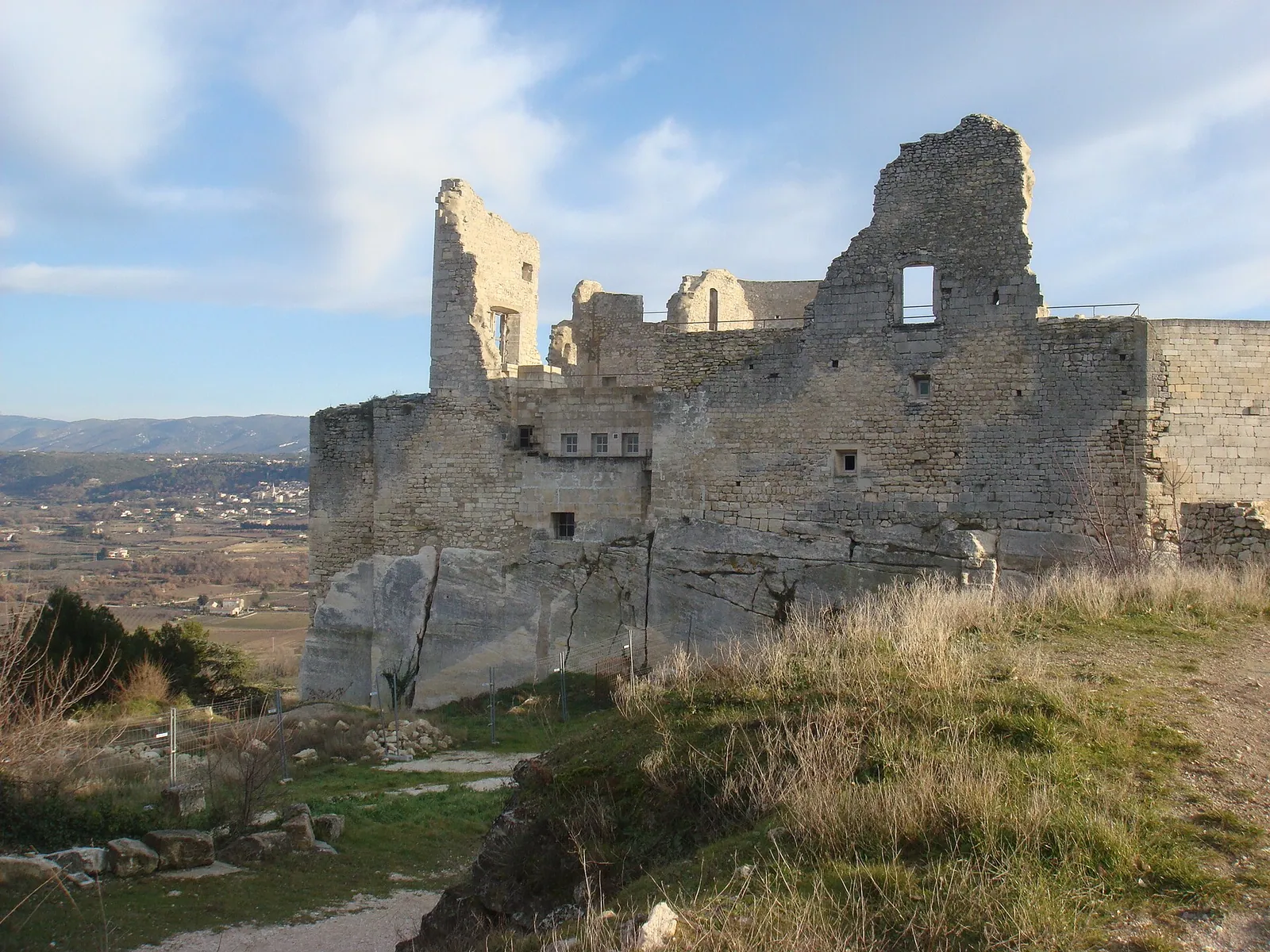
There are villages you simply pass through, and others you never quite leave the same. Lacoste belongs to the second kind. Clinging to a spur of rock facing Bonnieux, this stony, silent village carries a singular story, at once scandalous and luminous: that of a château tied to the Marquis de Sade, brought back to life by fashion designer Pierre Cardin, and that of an artists' village where you now meet students from all over the world. From Le Clos de Manon, a ten-minute walk from Gordes, Lacoste is about a twenty-minute drive away, just long enough to follow the Calavon valley and watch the château grow larger on its ridge.
Climbing up to Lacoste: a village built entirely of stone
Lacoste has to be earned on foot. You leave the car in the parking areas below and climb up through cobbled lanes, those sloping streets paved with stones set on edge and polished by the centuries. Here almost everything is stone: the houses, the low walls, the steps and the ground all seem cut from the same golden material, quarried from the surrounding hills. The village has barely a few hundred inhabitants, and that restraint is part of its charm. No cascade of shops or noisy terraces, but a suspended atmosphere, almost out of time, where the sound of your own footsteps becomes the only thing you hear.
Lacoste is naturally part of our selection of villages to discover: to place it in context, browse our guide to the most beautiful perched villages of the Luberon, which sets it among its most famous neighbours.
The Marquis de Sade's château
At the top of the village stand the remains of the Château de Lacoste, a former medieval fortress reworked over the centuries. It was here, in this family home, that the Marquis Donatien Alphonse François de Sade stayed on several occasions during the 18th century. The writer's scandals and legal troubles left a lasting mark on the place, and the château was largely dismantled after the Revolution, its stones long serving as a quarry for the village.
Left in ruins for nearly two centuries, the château found a second life from 2001, when fashion designer Pierre Cardin acquired it and set about restoring it. Having fallen in love with Lacoste, the designer also bought up many houses in the village to turn them into studios, galleries and performance spaces. We owe him the site's revival, but also a certain local debate over the balance between a living heritage and a museum-village. Today the château can be visited at certain times of year, and its restored silhouette once again dominates the valley.
The Lacoste festival, summer set to music
Every summer, the château and its neighbouring quarries host a festival of opera and live performance created by Pierre Cardin. Opera, dance, concerts and theatre take place under the stars, in the raw setting of the stone. It is one of those rare moments when the Luberon reveals itself differently, after nightfall, as the coolness rises from the valley. The dates and programme vary from one year to the next: we advise our guests to check the line-up before their stay if they would like to attend.
A village of artists and students
Lacoste is not merely a historic backdrop. It has long been a land of artists too. The village is home to a campus of the Savannah College of Art and Design (SCAD), an American art school that welcomes students for immersive study here for part of the year. This presence gives Lacoste a quiet but very real life: open studios, galleries, temporary exhibitions and an international youth that mingles with the residents.
- The galleries and studios line the lanes: you push open a door, discover an exhibition, exchange a few words with an artist. It is a visit that happens as you wander, with no set itinerary.
- The old stone quarries, on the edge of the village, offer a striking spectacle: tall walls carved by human hands, today reclaimed by art and summer performances.
- The viewpoints over the valley and over Bonnieux, the neighbouring village perched on its own hill, are among the finest face-to-face vistas in the Luberon.
The view of Bonnieux and the neighbouring villages
One of the pleasures of Lacoste lies in its position: from the village, the gaze drops down towards the valley and rises again at once towards Bonnieux, facing it across the little vale. This dialogue between two perched villages is a regional classic, magnificent in the late-afternoon light. To continue the walk on the Bonnieux side, between hilltop church, cedars and vines, read our guide to Bonnieux, a perched village among cedars and vines.
Lacoste also forms a natural trio with two other gems close at hand. A few minutes away, Oppède-le-Vieux, a ghost village reborn, draws lovers of abandoned atmospheres and silent climbs up to its collegiate church. And for a more secluded stop, still spared by the crowds, we love to push on to Goult and the Jerusalem windmill, the Luberon's secret. Together these villages make up an ideal day, as long as you don't try to see it all at once.
Our tips for visiting Lacoste
Lacoste reveals itself slowly, and that is precisely what makes it so precious. Here is what we recommend to our guests to make the most of it.
- Come early in the morning or late in the day: the light is softer on the stone, and the village settles back into calm once the midday visitors have left.
- Wear proper shoes: the cobbled lanes are steep and slippery in wet weather. Good soles are worth more than pretty sandals.
- Allow one to two hours for the village and the château, more if you linger in the galleries or wander out to the quarries.
- Pair Lacoste with Bonnieux and Ménerbes over the same half-day: the three villages almost touch and offer complementary panoramas.
Lacoste from Le Clos de Manon
From our place, a ten-minute walk from Gordes, Lacoste is only about a twenty-minute drive away, along a lovely route that crosses the heart of the Luberon. That is the whole appeal of our location: you set off in the morning to explore the château and the artists' lanes, come back for lunch and a swim in the heated pool, then head out again for sunset facing Bonnieux. To experience the region at this pace, without ever spending more than half an hour on the road, the best plan is to book a stay of several nights and to check our availability for your dates. Lacoste then becomes far more than a visit: a fragment of that stony, inspired Luberon you carry with you long afterwards.