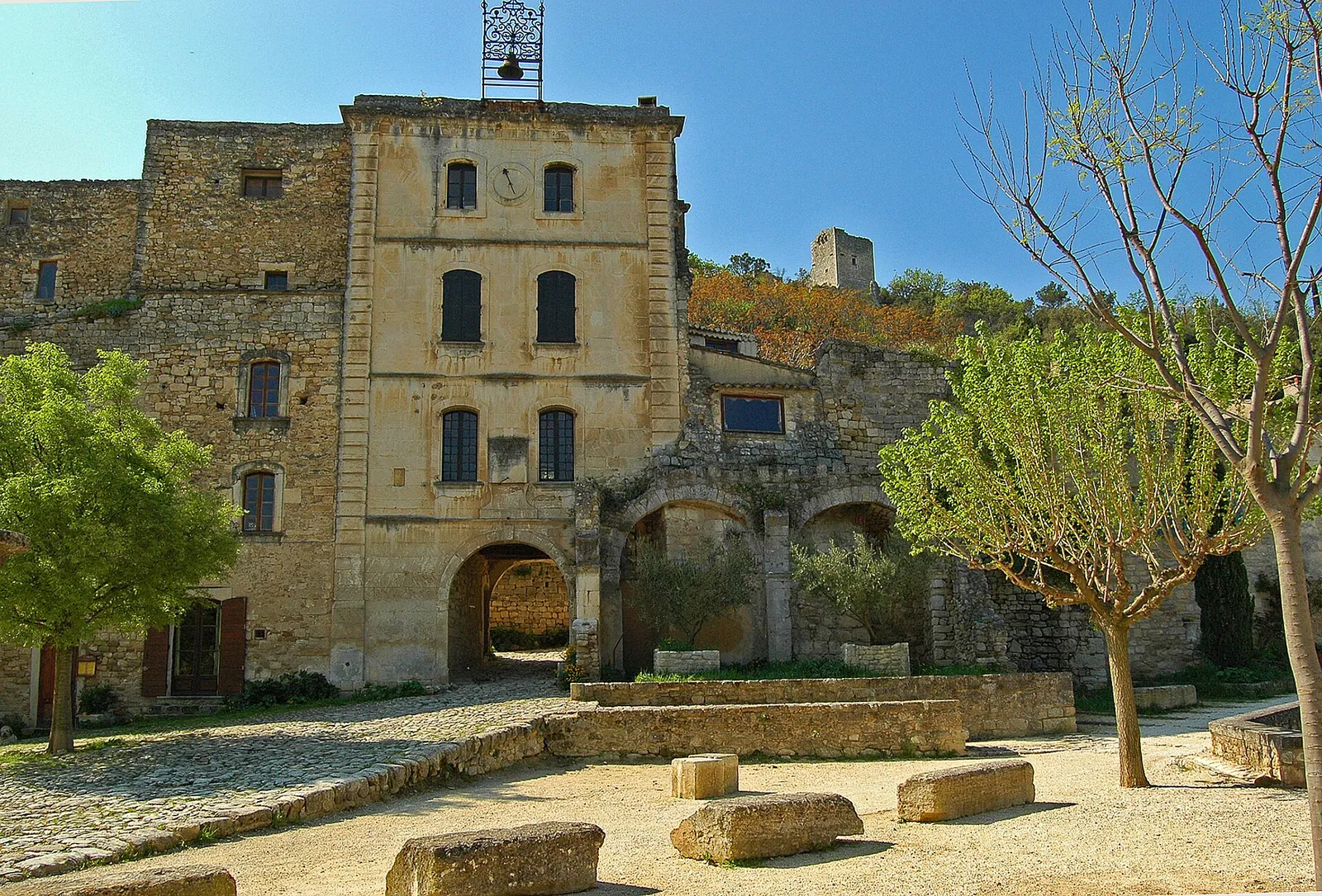
Some villages you visit, and others you walk through as you would step into a dream. Oppède-le-Vieux is one of the latter. When our guests return to Le Clos de Manon after discovering it, they often tell us about the silence, that feeling of having travelled back in time, those façades half-swallowed by ivy and light. A twenty-five-minute drive from Gordes, clinging to the northern flank of the Petit Luberon, it is one of the most moving places in the whole valley. Here is our insider's guide to experiencing it as it deserves.
A village born twice
Oppède-le-Vieux carries its whole history in its name. The "Vieux" ("Old") sets it apart from Oppède-les-Poulivets, the new village built lower down on the plain. For this is where one of Provence's most beautiful stories unfolds: that of a medieval village slowly deserted, then reborn.
Perched on its rocky spur since the Middle Ages, Oppède was long a stronghold, dominated by the sinister figure of Jean Maynier d'Oppède, the baron who in the 16th century ordered the massacre of the Luberon's Waldensians. But it was later that the village's fate took its turn.
- In the 19th century, the inhabitants gradually left the steep, unwelcoming hill to settle on the plain, more fertile and more convenient. The town hall moved in 1909, and the old village emptied almost entirely.
- In the 1940s, a group of artists, writers and architects rediscovered the ruins and settled there, drawn by their abandoned beauty. Consuelo de Saint-Exupéry, wife of the author of The Little Prince, was one of this handful of pioneers.
- Today, Oppède-le-Vieux is inhabited once more, restored with infinite care, yet never losing that patina of a rediscovered village.
It is this tension, between the ruin and the life returning to it, that gives the place its unique atmosphere. Oppède naturally features prominently in our guide to the most beautiful perched villages of the Luberon, among the villages of character where history surfaces in every stone.
The climb to the church and the castle
It all begins on the little village square, lower down, where you leave the car. From there, you set off on foot into the cobbled lanes that climb gently between restored houses, flower-filled terraces and vaulted passageways. The walk to the top takes around twenty minutes, with no real difficulty, but bring good shoes: the paving is uneven and slippery after rain.
Notre-Dame-d'Alidon
Halfway up stands the collegiate church of Notre-Dame-d'Alidon (or Dalidon), built from the 13th century onwards and later reworked during the Renaissance. Long abandoned, it has since been restored and remains one of the highlights of the visit. Set against the rock, its apse overlooks the Calavon plain; from the forecourt, the view plunges over an ocean of vineyards, orchards and cypresses, with Mont Ventoux in the distance on a clear day. It is here, more than anywhere else, that you understand why people once settled so high up.
The castle ruins
Above the church, the path grows wilder and leads to the ruins of the seigneurial castle, set at the highest point of the spur. They are little more than stretches of wall, gaping windows open to the sky and broken towers, yet the whole is striking. You can wander freely there, with care, and take in a spectacular 360-degree panorama: the plain to the north, the wooded mass of the Petit Luberon to the south, and that Provençal light that shifts from hour to hour. It is the village's natural belvedere, and one of our favourite spots in the entire valley.
Wandering the rediscovered village
Oppède-le-Vieux is more than just its climb. Much of the pleasure lies in wandering, with no set route, following the lanes at random. Along the way you come across discreet art galleries, a few studios, and the houses of writers and artists who made the village their refuge. The little square shaded by plane trees, down below, has a café and a table or two where you can sit in the shade, away from the summer heat.
A few tips we always share with our guests:
- Come early in the morning or at the end of the day, especially in July and August. The low light is superb, and the village finds its silence again once the midday visitors have left.
- Allow half a day on site: the climb, the castle, the wandering and a pause on a terrace make for a perfect interlude.
- Parking is below the village, which is entirely pedestrian. It's best to arrive early in high season, as the small car park fills up quickly.
Oppède within a day of villages
The beauty of the Luberon lies in this rare density of villages just minutes from one another. Oppède-le-Vieux fits perfectly into a loop among the artists' villages of the southern valley. To the east, you reach Ménerbes and Lacoste within a few minutes; towards the northwest, you can push on to Goult and the Jerusalem windmill, the Luberon's best-kept secret, one of our favourite villages for its peace and quiet.
If you love villages steeped in literary history, continue south to Lourmarin, the village of Albert Camus, on the other side of the mountain, or follow the water down to L'Isle-sur-la-Sorgue, the Comtat's Venice and its antiques, a completely different face of Provence, made of canals and antique dealers.
Exploring from Le Clos de Manon
From Le Clos de Manon, a ten-minute walk from Gordes, Oppède-le-Vieux is just about twenty minutes away by road. You set off in the morning to climb its lanes, linger at the foot of the castle ruins, then return for lunch and a swim in the heated pool before heading off again, late in the afternoon, towards another perched village. To our eyes, this is the finest way to experience the Luberon: at your own pace, taking your time. To plan a stay that leaves room for such wanderings, the best approach is to allow five to seven nights and to check our availability for your dates. You don't simply visit Oppède-le-Vieux: you let it surprise you.