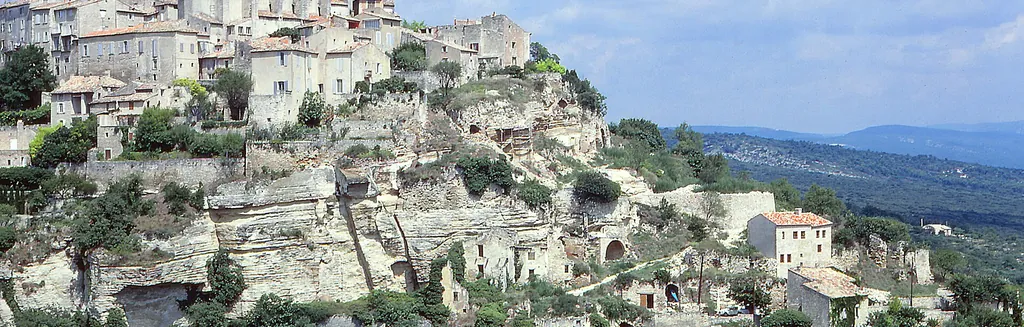
There are few regions in France where, in a single day, you can photograph a golden-stone village clinging to the rock, rows of lavender running towards a medieval abbey, and ochre cliffs that look as though they belong in Arizona. The Luberon is one of them. From Le Clos de Manon, a ten-minute walk from Gordes, our guests set off each morning with a camera or a phone, and come back in the evening with a full memory card. Over the seasons, we have learned which places are worth the detour, what time of day they look their best, and how to avoid the crowds that can ruin a shot.
This guide brings together our favourite photo spots, the ones we point our guests towards when they want to come home with magazine-cover images. For each place, we give the distance from Gordes, the ideal hour, the best angle and our insider tips. Whether you are a seasoned photographer or simply love beautiful Instagram souvenirs, you will find everything here to build an itinerary in the light of the South.
The Luberon, a paradise for photographers
What makes the Luberon so photogenic is a rare combination: a spectacular geology, intense Mediterranean light and a dry-stone heritage that melts into the landscape. The hilltop villages were built from the local rock, so that at certain hours they seem to rise straight out of the hillside. Add the red and orange ochres, the lavender fields in summer, the vines and the olive trees, and you have a palette of colours that shifts from one hour to the next.
The area is also protected, which explains why these landscapes have survived. The Luberon Regional Nature Park covers nearly 185,000 hectares and looks after the balance between tourism, farming and nature. This unspoilt scenery is exactly what photographers are looking for: few pylons, little modern development, and vistas that have barely changed in centuries.
Before we go through each spot in detail, keep in mind three principles we repeat to our guests: light matters more than gear, the hour matters more than the place, and patience matters more than anything else. The same village photographed at midday in high summer or at sunrise in April is simply not the same picture. To set these places within a wider stay, our guide to outdoor activities in the Luberon gives a full overview of the walks, markets and strolls that go hand in hand with your photo sessions.
The Gordes belvedere at sunrise
If there were just one spot to remember, it would be this one. The Gordes belvedere is probably the most photographed viewpoint in Provence, and with good reason: the village tumbles down from its Renaissance château, its pale stone houses stacked across a rocky spur. The official viewpoint is on the D15 road, about a kilometre out of the village towards Cavaillon. A car park and a purpose-built platform face the village, due east.
The orientation is key: because the visible façade looks east, it is at sunrise that it lights up with a golden, raking glow. In summer, plan to be there around 6.15 a.m.; in spring and autumn, more like 7.30 a.m. At that hour you will often have it to yourself, whereas by the middle of the day dozens of cars pull in. From Le Clos de Manon, the belvedere is less than five minutes away by car: one of the great privileges of staying so close to Gordes.
- Suggested angle: landscape format to take in the whole village, or a tight portrait crop with a telephoto lens on the château and the church;
- Best season: April–May and September–October, when the greenery is fresh and the light is soft;
- Mist bonus: after a cool night, a sea of fog can fill the valley and leave the village floating above it.
Don't overlook the village streets themselves either: once you have the iconic shot in the bag, park up and climb on foot. The calades (cobbled lanes), vaulted passages and little squares offer more intimate compositions, perfect at the end of the day when the stone turns to amber.
Sénanque abbey and the lavender
About ten minutes north of Gordes, tucked into the hollow of a small valley, the abbey of Notre-Dame de Sénanque offers one of the most recognisable images in France: the Romanesque silhouette of the Cistercian monastery set behind perfectly aligned rows of lavender. Founded in 1148, the abbey is still home to a community of monks, and it is they who tend these famous fields.
The photograph is taken from the road and the surrounding area, with no need to go inside. The lavender flowers here from mid-June to mid-July; that is the only window in which you get the much-sought-after purple-and-stone contrast. Arrive early, ideally before 8 a.m.: the light is gentle, the car park still empty, and the hum of the bees more discreet. To understand the history of the place and plan a visit inside, read our dedicated article on Sénanque abbey.
A word about respect, which is essential: Sénanque is not a film set but a working monastery. Stay behind the ropes, never step into the rows of lavender, and keep your voice down. The monks tolerate photographers as long as everyone keeps to their place. To take the theme further, our guide to the lavender fields around Gordes lists other accessible plots, often far less crowded.
Roussillon and the Ochre Trail
A complete change of palette about twenty minutes from Gordes: Roussillon is built on one of the largest ochre deposits in the world, and its houses show every shade from straw yellow to blood red. The contrast between these warm façades and the blue Provençal sky is striking, especially in late afternoon when the low sun saturates the colours.
At the heart of the village, the Ochre Trail winds through former quarries of eroded shapes, a kind of orange fairy chimneys ringed by green pines. Reckon on around €3.50 for entry and 30 minutes to an hour of walking depending on the route you choose. The light of the golden hour, just before sunset, is simply magical here. Our article on Roussillon and its ochres sets out the opening times and the route.
- Clothing: avoid white and light-coloured shoes, as the ochre stains for good;
- Timing: opening around 9.30 a.m. or late afternoon for the best light;
- Composition: play on the contrast of ochre / green pines / blue sky, which is very graphic.
The Provençal Colorado in Rustrel
Less well known than Roussillon but even more spectacular, the Provençal Colorado in Rustrel lies about 35 minutes from Gordes, to the east. This vast site of former ochre quarries unfolds fairy chimneys, red cliffs and settling ponds that take on unreal hues. The nickname is well earned: it feels like the canyons of the American West, Provençal style.
Parking costs €5 to €6 per car and gives access to two marked trails (roughly 2.5 km and 4 km). The great photographic appeal lies in the variety: the Sahara, a stretch of ochre sand; the Cirque de Barriès and its cliffs; or the pools of the Cirque de Bouvène. Our full guide to the Rustrel Ochre Trail will help you choose your route.
For photography, mid-morning or late-afternoon light avoids the harsh shadows of midday. After a shower of rain, the ochres become even more vivid. Bring water, a hat and good shoes: the site is less developed than Roussillon and, in return, offers framings almost untouched by crowds.
The lavender fields (Valensole, Sault)
Lavender is the emblem of Provence, and the Luberon is just one gateway to the greatest plateaus. For the rows stretching as far as the eye can see that grace magazine covers, two destinations stand out beyond Sénanque: the Valensole plateau and the heights of Sault. The first, around 1 hour 15 minutes' drive away, rolls out immense fields dotted with isolated farmhouses and lone trees; the second, about an hour away, flowers later because of its altitude.
The flowering window is precious. Here is a simple guide by area:
| Spot | Distance from Gordes | Full bloom | Best hour |
|---|---|---|---|
| Sénanque abbey | ~10 min | mid-June to mid-July | before 8 a.m. |
| Valensole plateau | ~1 hr 15 | late June to mid-July | sunrise / 7 p.m. |
| Sault plateau | ~1 hr | mid-July to early August | sunrise / 7 p.m. |
| Fields around Gordes | 5–20 min | late June to mid-July | early morning |
A few framing tips: use a tree, a farmhouse or a cabanon as a focal point at the end of a row; get down low so the rows converge towards the horizon; and make the most of the golden light of morning or evening, when the purple takes on a pink tinge. To plan a proper circuit, see our lavender routes, which link the finest plateaus between the Vaucluse and the Alpes-de-Haute-Provence.
Hilltop villages and narrow streets
Beyond the great panoramas, the Luberon is full of more intimate scenes: an old doorway smothered in wisteria, a cobbled stairway bathed in sunlight, a cat asleep on a windowsill. It is often these details that make the most beautiful Instagram photos, because they tell a mood rather than a monument.
Among our favourite villages for this kind of image: Ménerbes and its rocky spur, Bonnieux and its stairway up to the upper church, Lacoste watched over by the Marquis de Sade's château, or Oppède-le-Vieux, almost unreal with its ruins reclaimed by greenery. The Provence-Alpes-Côte d'Azur region lists these villages on its official tourism website, useful for checking markets and opening times.
- Golden hour: early morning for empty streets, late in the day for golden stone;
- Details: doorways, blue shutters, fountains, wisteria, washhouses, bicycles leaning against a wall;
- Height: always climb up to the church or the orientation table for the panorama.
Light, golden hours and weather
In landscape photography, the hour counts for more than the place. The two prime windows are the golden hour (the first hour after sunrise and the last before sunset), when the light is warm and raking, and the blue hour, that brief moment of dusk when the sky turns a deep blue that is perfect for lit-up villages.
In Provence, the mistral is your best ally: after a gust of wind, the sky clears and the air becomes wonderfully transparent, perfect for sweeping panoramas. Conversely, beware the blazing sun of July and August in the middle of the day, which flattens the relief and washes out the colours. Here are a few seasonal pointers to help you plan:
| Season | Photographic mood | What to focus on |
|---|---|---|
| Spring (Apr–May) | Greenery, soft light, changing skies | Villages, the Gordes belvedere |
| Summer (Jun–Jul) | Lavender in bloom, intense light | Sénanque, Valensole, Sault early/late |
| Autumn (Sep–Oct) | Reddening vines, golden light | Ochres, vineyards, narrow streets |
| Winter (Dec–Feb) | Morning mists, low light | Belvederes, seas of cloud |
A lightweight tripod works wonders for the blue hour and the morning mists; a polarising filter deepens the blue of the sky and brings out the ochres. But the essential thing remains getting up early: our most dedicated guests invariably bring back the best images.
Respecting the places and the crops
To photograph the Luberon is also to protect it. The popularity of certain spots, amplified by social media, has sometimes caused damage: trampled fields, reckless parking, plants pulled up for a selfie. We always stress a few simple, common-sense rules to our guests.
- Never step into cultivated fields: the lavender of Sénanque and Valensole belongs to farmers or to monks;
- Stay on the marked trails in the ochre sites, which are fragile and prone to erosion;
- Park in the designated car parks, without blocking the farm tracks;
- Take your litter with you and respect the quiet of inhabited places, such as the monasteries.
This respect ensures that these landscapes will stay photogenic for tomorrow's visitors. It is also, quite simply, the best way to enjoy the Provençal calm that our guests come here to find.
Photographing the Luberon from Le Clos de Manon
The advantage of a stay at Le Clos de Manon is being right next to the finest spots. The Gordes belvedere and Sénanque abbey are less than ten minutes away; Roussillon, Ménerbes and the lavender fields of Gordes a quarter of an hour; Rustrel and the great plateaus less than an hour. You can set off before dawn for the golden hour, come back for breakfast beside the heated pool, then head out again in the evening for a different light.
For a true week of photography, we recommend five to seven nights, so you have time to wait for the right weather and to vary the hours. If the idea of a photography stay in Provence appeals to you, you can check our availability at Le Clos de Manon right now and start planning your escape. We will be delighted to share our addresses and our insider timings so you can bring back the most beautiful images of the Luberon.