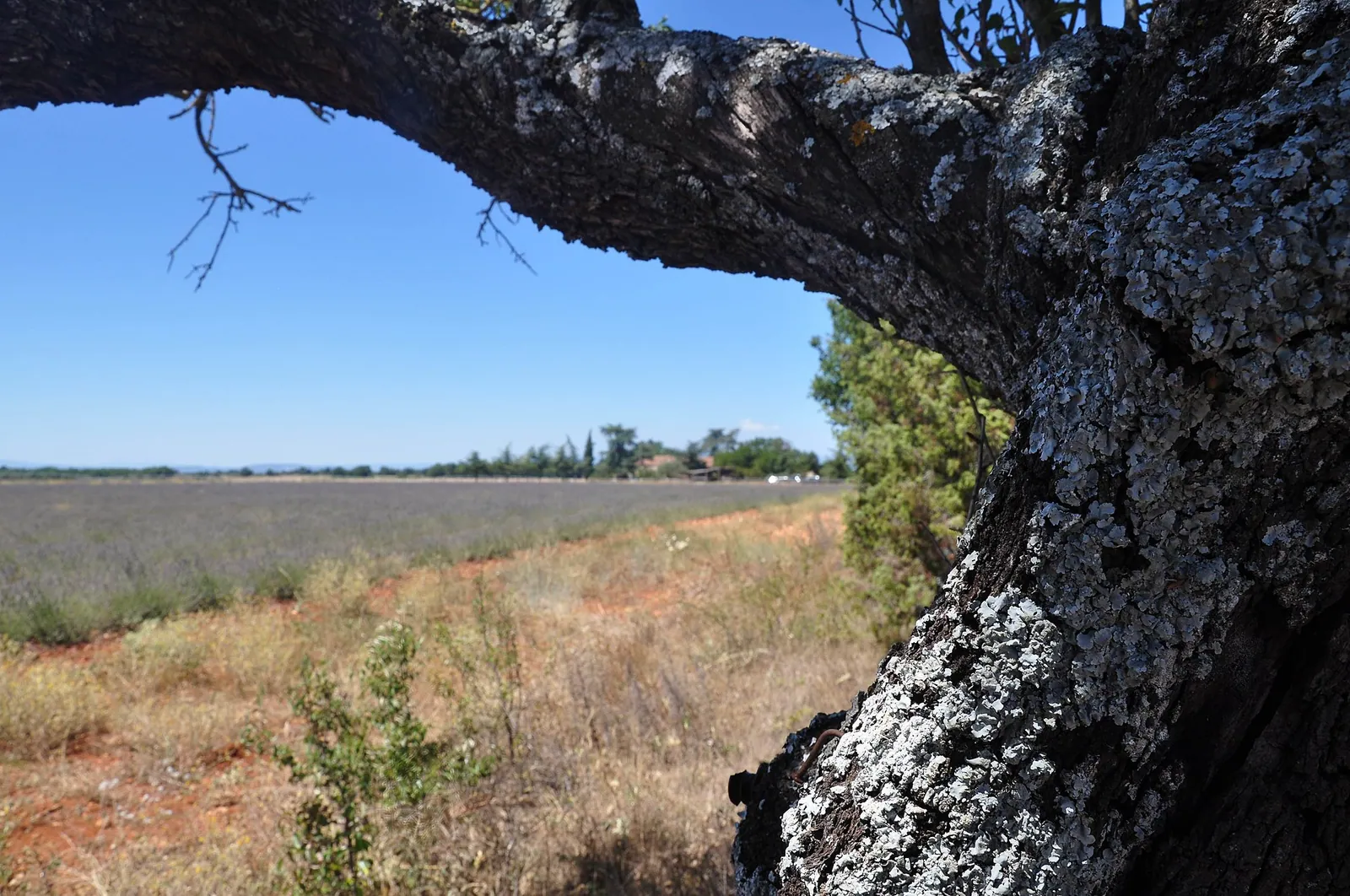
Every summer, the same small miracle unfolds outside our windows: Provence begins to breathe purple. For a few weeks, the plateaus of the Vaucluse and the Alpes-de-Haute-Provence are covered in long, fragrant lines that ripple all the way to the horizon. It is one of the sights our guests look forward to most, and one of the questions we hear most often the moment they arrive at the villa: "Where can we see the lavender, and above all when?" Here is our host's notebook for following the lavender routes from Gordes, without getting the dates or the directions wrong.
Lavender or lavandin: don't confuse the two
Before you set off, an insider's note that changes everything. What people photograph most often — those vast rows of dense, even mauve — is usually lavandin, a hybrid grown in the lowlands, lush and very photogenic. Fine lavender (or true lavender), on the other hand, grows at altitude, forms more irregular clumps and yields a far more precious essential oil. Both are magnificent; it is simply that lavandin blooms a little later and stays beautiful longer, which is why the most spectacular fields are still on show in early July.
When does lavender bloom? The calendar
The bloom depends above all on altitude and on the year's weather, but here are the markers we give our guests to get the timing right.
- Mid-June to early July: the first fields take on their colour in the lowest, earliest areas, notably around the Valensole plateau.
- Late June to mid-July: this is usually the peak, full colour across most of the plateaus, lavender and lavandin alike.
- Mid-July to early August: the high plateaus such as Sault prolong the show, when the lowlands are already being harvested.
Our tip: if you can only come on a single date, aim for the first two weeks of July, which offer the best chance of finding fields in full colour, whatever the altitude. And bear in mind that the harvest begins as early as mid-July: a field that is superb one morning may be cut the next day. To plan your stay around the right window, we set out the region's rhythms in our guide to the seasons in Provence.
Sénanque Abbey, a stone's throw from the villa
There is no need to go far for the most famous postcard in Provence. Notre-Dame de Sénanque Abbey, a 12th-century Cistercian abbey still home to a community of monks, nestles in the hollow of a small valley about 4 km from Gordes, less than 10 minutes by car from Le Clos de Manon. In front of its honey-coloured stone façade, the monks cultivate a lavender field that, in July, forms one of the most reproduced images in the world.
- Come very early. The little road down to the abbey fills up quickly by mid-morning. At 8 a.m., you will have the soft light and the site almost to yourself.
- Respect the place. This is a working monastery: stay discreet, don't step into the field, and visit the abbey quietly.
- Pair it with Gordes. On the way back up, the famous viewpoint over the hilltop village is just a few minutes away; the morning light there is superb.
The Sault plateau, the realm of fine lavender
About an hour's drive from Gordes, at the foot of Mont Ventoux, the Sault plateau is the homeland of high-altitude fine lavender. Here there are no perfect checkerboards stretching to infinity, but fields interwoven with golden wheat and stone villages, in a wilder, fresher landscape. It is also the plateau that blooms latest: when the lowlands have been harvested, Sault still offers its mauve undulations until mid-August.
It is our recommendation for anyone who wants to escape the crowds and understand the real lavender of Provence, the kind the distillers work with. Every summer the region holds festivals around the harvest, and you will find the best addresses there for coming home with an authentic essential oil. If the subject fascinates you, we explain how to visit a lavender distillery near Gordes and watch the stems being turned into blue gold.
The Valensole plateau, the sea of lavender
If you were to keep just one image of sheer scale, it would be this one. The Valensole plateau, in the Alpes-de-Haute-Provence, about 1 hr 15 from Gordes, unrolls fields of lavandin that seem never to end, punctuated by stone cabins and a few solitary almond trees. It is the archetypal photo of Provence, those mauve lines running straight towards a horizon of hills.
- The road between Valensole and Manosque and the routes that radiate around the village hold the finest panoramas. Drive slowly, windows down: the scent is striking.
- The light of early morning and late afternoon gives the mauves all their depth; at midday the colours flatten and the heat crushes everything.
- Set aside a whole day for it. With the drive, this is not a half-day outing: pack a picnic and make it a proper excursion. We devote a whole article to it, the Valensole plateau: the sea of lavender, with our favourite spots.
Building your three-plateau itinerary
Should you do them all? No — and that is in fact our advice. Sénanque can be visited on one quiet morning from the villa. Sault and Valensole, on the other hand, lie in opposite directions: you choose one or the other depending on your mood, the altitude (and therefore the date) and how much time you want to spend in the car. Over a week's stay, the ideal is to combine Sénanque at daybreak with a single great plateau excursion, keeping some days for the hilltop villages and the pool.
Photographing and respecting the fields
The lavender fields are, for the most part, private crops: behind every row lies a farmer's work and livelihood. A few simple gestures make all the difference, and they matter to us.
- Don't trample the rows. Photograph from the edge or from the paths; a broken stem will not grow back during the season.
- Watch out for bees. In full bloom, the fields literally hum. Stay calm, avoid sweet perfumes, and all will be well.
- Park without getting in the way. The roadsides are narrow; pull over tidily, without blocking a farm access.
- Favour early morning. Better light, cool air, fewer people and bees still barely active: everything is better for it.
Lavender, after all, is just one face of a generous season: if you come before the great mauve of July, the Luberon in spring offers poppies, cherry trees and the first warm days, another way to love the region.
Your perfect base for following the lavender
The great luck of staying at Le Clos de Manon is being able to catch the lavender at Sénanque at daybreak, ten minutes from the villa, then come back for a swim in the heated pool before the heat sets in, and set off another day towards Sault or Valensole with a light heart. It is this rhythm — that of a true base in the heart of the Luberon — that turns a simple visit into a memory. If you dream of July in Provence, as close as possible to the purple fields, check our availability and book your stay before the best weeks of the bloom are taken.