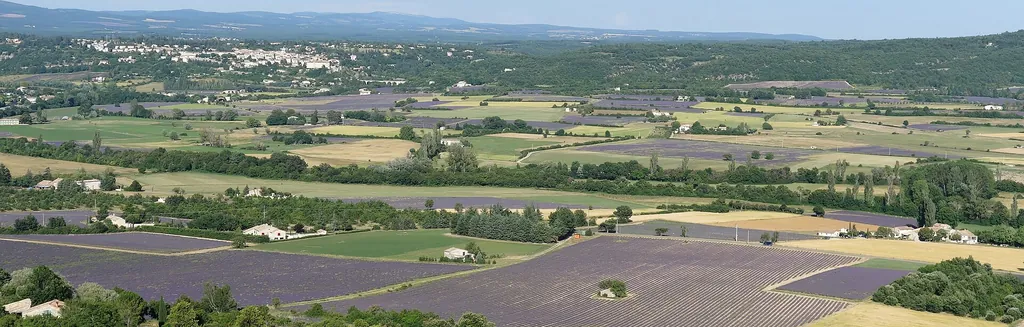
There are a handful of places in Provence where lavender becomes an entire horizon rather than simply a backdrop. Sault is one of them. Perched at nearly 800 metres above sea level, at the foot of the southern slopes of Mont Ventoux, this large Vaucluse village overlooks a rolling plateau that rows of lavender and lavandin turn, every summer, into a mauve sea. It is one of the region's most iconic landscapes, and yet one of the least known to our travellers, who tend to think of Valensole long before they think of Sault.
From Le Clos de Manon, a ten-minute walk from Gordes, we regularly take our guests there — especially those who arrive in late July or August and worry they may have "missed" the lavender. Because Sault has one decisive advantage: it is the latest-blooming plateau in Provence. When the fields of the Luberon or Valensole have already been cut, those at Sault are still at the peak of their flowering. Here's how, and when, we suggest you discover it.
Sault, a balcony over Ventoux and the lavender
Sault holds a rare position in Provence: a rocky spur looking down over the Albion plateau and the Nesque valley, facing the giant of Provence. From the village's panoramic terrace, your gaze takes in, on one side, the rows of lavender running towards the horizon, and on the other the limestone mass of Mont Ventoux, its bare summit glaring white in the sun. This double presence — the flower and the mountain — is what makes the place so singular.
The village itself is worth a stroll. Its medieval lanes, its Romanesque church of Saint-Sauveur, its ramparts and shaded little squares preserve the atmosphere of a Provençal mountain town, rougher and more authentic than the chic villages of the Luberon. You'll still find food shops, nougat makers and a Wednesday-morning market with nothing staged about it. To place Sault within the history and geography of the Vaucluse, the encyclopaedic entry on Sault details its altitude, its mid-mountain climate and its long lavender-growing tradition.
It is also an excellent base for exploring the Nesque Gorges, one of the most beautiful canyons in Provence, which wind below for almost twenty kilometres. The cliff road that overlooks them is a spectacular drive, ideal on the way back from a morning among the lavender.
Why the lavender blooms later here (mid-July to mid-August)
The question comes up endlessly with our travellers: "Will it be too late for the lavender?" At Sault, the answer is almost always reassuring. It all comes down to altitude. The plateau rises to around 800 metres, far higher than Valensole (about 600 m) or the plains of the Luberon. And the higher you climb, the later the bloom: the lavender at Sault gets going just as the lavender on the plains is already beginning to fade.
In practical terms, here is the window we give our guests:
- Early July: the first rows take on their colour, and the bloom builds in intensity;
- Mid-July to mid-August: full bloom, the best time for Sault, with fields still untouched where elsewhere the harvest is already done;
- Late August: the harvest is in full swing, some fields are cut, but the scent of distillation hangs over the whole plateau.
This seasonality makes Sault a haven for latecomers and August travellers. To understand how lavender fits into the wider rhythm of the region, we always point to our pillar guide, "When to visit Provence? A guide to the seasons", which sets out month by month what you can see and experience. And to build a true flower-lined itinerary, our article on the lavender routes connects the main plateaux together.
A useful little botanical note for the field: what you most often see at Sault is not only true lavender (the genuine mountain lavender, rarer and more prized) but also lavandin, a hardier hybrid with larger spikes and a deeper blue. Sault is precisely a champion of its fine mountain lavender, to which it devotes its great summer festival.
The finest viewpoints over the fields
At Sault, you don't have to go looking for the lavender: it is everywhere. But a few viewpoints are really worth stopping for, camera in hand or simply to soak up the landscape.
- The village's panoramic terrace, along the ramparts: the sweeping view down over the chequerboard of lavender, with Ventoux behind, is the definitive Sault postcard;
- The road to Saint-Trinit and Saint-Christol, on the Albion plateau: long, dead-straight rows, perfect at sunrise;
- The descent towards Aurel, a small neighbouring hilltop village, which offers a different angle on the mauve-and-gold mosaic of fields;
- The areas around the distilleries, where the cultivated fields often come right up to the edge of the road.
Our insider tip: come at daybreak, between 6.30 and 9 am. The light is low and golden, the bees aren't yet at work, and the plateau is almost deserted. At the end of the day the light is just as lovely, but the colours shift more towards a deep violet. Avoid the middle of the day, when the sun flattens the contrasts and the heat, at altitude as much as anywhere, becomes oppressive.
The lavender festival on 15 August
If you can, time your visit to coincide with the Sault Lavender Festival, traditionally held on 15 August. It is one of the most authentic lavender gatherings in Provence, quite unlike the purely touristy events you find elsewhere. The day celebrates fine mountain lavender and the know-how of local growers.
On the programme, depending on the year:
- a lavender hand-cutting competition with sickles, a spectacular ancestral skill;
- traditional steam distillation demonstrations;
- a large producers' market (essential oils, lavender honey, nougat, soaps);
- parades in Provençal costume, music and a country feast in a festive village atmosphere.
It is a very popular day: if you're staying with us at that time, it's best to set off early and arrange your parking in advance. For lovers of living heritage, it is also a chance to grasp that lavender is more than a backdrop: it is a genuine farming sector, supported in particular by the Luberon Regional Nature Park and the Ventoux community, who work to preserve these cultivated landscapes.
Distilleries and Sault nougat
The lavender at Sault is not only to be admired — it can be smelled and tasted. The plateau has lived on lavender for generations, and distillation is its beating heart. From mid-July to the end of August, during the harvest, several distilleries in the area open their doors to visitors. You'll discover the still, the steam passing through the spikes, the essence separating from the floral water — a simple, fascinating spectacle, and an unforgettable scent.
Here is what we suggest bringing home:
- fine lavender essential oil, the most precious, to be distinguished from the cheaper lavandin;
- lavender floral water (hydrosol), gentle and soothing;
- lavender honey from the plateau, delicate and pale;
- Sault nougat, the village's historic speciality.
Sault nougat deserves a word. Made since the 19th century from local lavender honey and Provençal almonds, it is soft, fragrant, and the gourmet souvenir par excellence. The village nougat makers can be visited and happily offer a tasting. Along with a bottle of essential oil, it is what our travellers most often tuck into their suitcases.
Sault, Valensole, Gordes: where to see lavender and when
The big question of any summer stay in Provence: where to go so you don't miss the lavender? It all depends on your dates. To help you decide at a glance, here is a summary table of the main plateaux we recommend to our guests at Le Clos de Manon.
| Site | Altitude | Full bloom | Distance from Gordes | Main draw |
|---|---|---|---|---|
| Sault | ~800 m | Mid-July to mid-August | ~50 km / 1 hr | The latest, few crowds, Ventoux behind |
| Valensole | ~600 m | Late June to mid-July | ~85 km / 1 hr 30 | Vast fields, the most spectacular |
| Sénanque Abbey | ~380 m | Late June to mid-July | ~6 km / 12 min | The postcard shot, right next to Gordes |
| Claparèdes plateau (Luberon) | ~700 m | Early to mid-July | ~30 km / 45 min | Rolling fields, an intimate feel |
In short: if you're coming in late June or early July, head for nearby Sénanque Abbey and the Valensole plateau. If you arrive in late July or August, make for Sault, which will very likely be the only one still offering fields in full flower. Many of our travellers in fact combine Sénanque at the start of their stay and Sault at the end, to stretch the lavender season as far as it will go.
Photography tips and respecting the crops
The fields of Sault are irresistible for photography, but above all they are private farmland, the livelihood of grower families. A few simple rules let you enjoy them without doing harm:
- Don't step into the rows without permission: walking between the plants damages them and compacts the soil;
- Photograph from the edges and the paths, where the perspective of the rows is the most beautiful anyway;
- Watch out for bees: in full bloom the fields hum with them; stay calm and keep your distance;
- Don't pick the spikes: a cut stem is one less for the distillation and the harvest;
- Park properly, without blocking farm access or machinery.
On the technical side, the light of daybreak and evening brings out the violets; a lightly clouded sky gives superb moods. Try to include a vanishing point — a row, a stone hut, a cypress, Ventoux — to give the image depth. And above all, take the time to set the camera down: the scent and the humming are as much a part of the memory as the photograph.
Getting to Sault from Gordes
From Le Clos de Manon, allow about 50 kilometres and an hour's drive to reach Sault. The most pleasant route runs along the Monts de Vaucluse through Saint-Saturnin-lès-Apt and Villes-sur-Auzon, crossing a landscape of garrigue scrub, fields and hilltop villages. It's a country road, winding in places, but with nothing difficult about it.
Our practical recommendations for a successful day:
- Set off early (before 8 am in July and August): better light, cooler air and easier parking;
- Bring water and a hat: at 800 m the sun is intense and shade is scarce in the fields;
- Combine it with the Nesque Gorges on the way back, or with a climb up Mont Ventoux via the Sault side if you love grand panoramas;
- Book around the 15 August festival well ahead if that's the day you're aiming for.
Sault also lends itself perfectly to a wider loop along the lavender routes, linking the Albion plateau, the villages of Aurel and Montbrun-les-Bains, and the descent towards Ventoux. A full day, but an unforgettable one.
Making Sault a day out from Le Clos de Manon
What we love to offer our guests is a central, peaceful starting point from which it's easy to roam. A ten-minute walk from Gordes, Le Clos de Manon places you equidistant from the nearby lavender of Sénanque and the more distant great plateaux of Sault and Valensole. In a single week, you can follow the lavender from plateau to plateau, from the earliest to the latest, and watch it bloom across almost the whole summer.
After a morning in the mauve fields of Sault, there's nothing like coming back to cool off in the villa's private heated pool, in the shade of the cypresses. To set your stay around the best lavender window, take a look at our guide to the seasons in Provence, then don't hesitate to check our availability at Le Clos de Manon. We'll be delighted to tell you, almost to the day, where the lavender will be at its most beautiful during your stay.