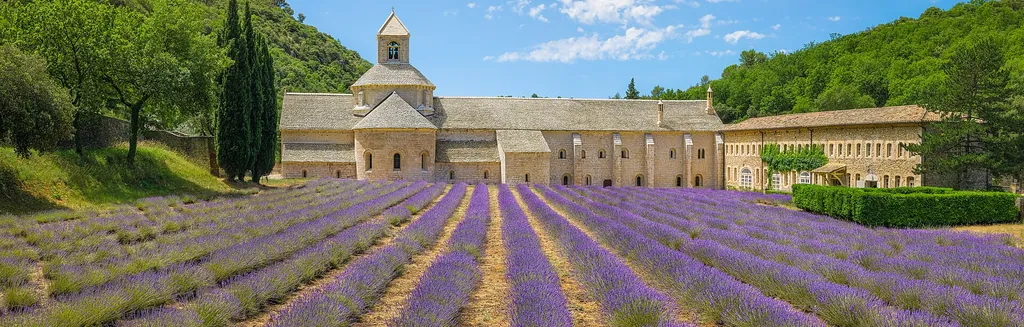
There is one image everyone has already seen, even without knowing its name: a long abbey of golden stone, lying in the hollow of a valley, before rows of lavender that ripple right up to its walls. That image is Sénanque. It appears on thousands of postcards, guidebook covers and screensavers, to the point of becoming the very symbol of Provence. And yet, when you discover it for real, just ten minutes from our house, you realise that no photograph could have prepared you for the silence of the place.
Because Sénanque is not a backdrop. It is a 12th-century Cistercian abbey, still home to a community of monks who pray, work and grow the famous lavender there. From Le Clos de Manon, we regularly take our guests to see it, advising them on the hour, the season and the frame of mind that turn a simple visit into a suspended moment. Here is everything you need to know to discover Sénanque as it deserves.
Sénanque, the icon of Provence
If a single picture had to sum up Provence, it would probably be this one. Sénanque Abbey gathers everything you look for in this region: the golden stone, the purple of the lavender, the dark green of the oaks, and a light that shifts from hour to hour. The contrast between the monastic austerity of the walls and the exuberance of the flowers creates an almost unreal composition, one that photographers from all over the world come to capture every summer.
What makes Sénanque unique is its preserved isolation. The abbey nestles at the foot of a narrow valley, the Sénancole valley, well away from the main roads. You do not stumble upon it by chance: you have to drive down a small switchback road from Gordes, and it is precisely this difficulty of access that has protected the site from development. When you finally emerge into the hollow of the valley, the abbey appears all at once, alone in the midst of nature, exactly as the monks intended it nearly nine centuries ago.
Sénanque belongs to the great family of the Luberon's emblematic sites, alongside the perched villages we describe in our guide to the most beautiful perched villages of the Luberon (2026). But where those villages celebrate life, trade and the Provençal art of living, Sénanque embodies the opposite: withdrawal, prayer and bareness. It is this tension between spectacular beauty and absolute silence that gives the place all its power.
A 12th-century Cistercian abbey still alive today
The Abbey of Notre-Dame de Sénanque was founded on 23 June 1148 by Cistercian monks who came from the abbey of Mazan, in the Ardèche. It became an abbey in its own right in 1150, when a local lord ceded the land of the valley to the community. Sénanque is one of the "three Provençal sisters", together with Le Thoronet and Silvacane: three Cistercian abbeys that beautifully embody the order's ideal of poverty, manual labour and beauty born of simplicity.
The Cistercian order, reformed in the 12th century in the wake of Saint Bernard of Clairvaux, called for a return to the Rule of Saint Benedict in its strictest form. No ornament, no figurative stained glass, no superfluous sculpture: only the beauty of proportion and light was admitted. Sénanque is the purest expression of this philosophy. Everything is calculated to encourage contemplation.
The history of the place has not, however, been a long quiet river. Prosperous in the Middle Ages, the abbey then declined, was sacked in the 16th century during the Wars of Religion, and finally sold off as national property during the Revolution. It was bought back and repopulated by monks in the 19th century, before facing further interruptions. Today, a small community of a handful of monks from the Cistercian Congregation of the Immaculate Conception lives there once again. That is what makes Sénanque a rare place: not a frozen monument, but an abbey still alive, where you hear the bells mark the rhythm of the offices.
Architecture: church, cloister, dormitory and chapter house
The monastic complex unfolds on the guided tour and lays out, almost intact, the classic plan of a Cistercian abbey. The abbey church, built between the late 12th and early 13th century, strikes you with its bareness. Built of carefully dressed limestone in a Romanesque style of great sobriety, it ends in a semicircular apse topped by a modest square bell tower. No decoration distracts the eye: only the light, sliding over the stone as the hours pass, brings the space to life.
The cloister, at the heart of the abbey, is without doubt the most moving spot. Its vaulted galleries, supported by slender columns with capitals discreetly carved with foliage, frame a peaceful garden. This is where the monks moved in silence between the various buildings. Around this cloister are arranged the essential rooms of monastic life, which the tour lets you walk through:
- the chapter house, where the community gathered each day to read a chapter of the Rule of Saint Benedict and settle the affairs of communal life;
- the warming room (or calefactory), the only heated room in the abbey, where the manuscripts were copied;
- the monks' dormitory, a vast vaulted hall on the upper floor, where the community once slept fully clothed, on simple straw mattresses;
- the passages and galleries that connect these spaces, designed to preserve the silence and allow discreet movement.
The whole ensemble is listed as a Historic Monument and stands as one of the best-preserved testaments to Cistercian art in France. As you walk through it, you understand that the beauty of Sénanque comes not from accumulation but from restraint: it is an architecture that seeks less to dazzle than to soothe.
When does the lavender bloom in front of the abbey?
This is the question we are asked most often. The lavender field at Sénanque, which stretches right in front of the abbey's façade, is cultivated by the monks themselves: it is a source of income, turned into essential oil and honey sold in the shop. Its flowering follows the rhythm of nature, and the dates vary each year depending on the mildness of the spring.
As a rule, the lavender at Sénanque blooms from mid-June to mid-July, with peak colour around early July. It is at that precise moment that the iconic image takes on its full meaning. Be warned, though: the harvest generally takes place around mid-July, and as soon as the field is cut, the picture disappears until the following year. So it is worth timing your stay carefully if the lavender is your main goal.
| Period | State of the field in front of Sénanque |
|---|---|
| May – early June | Green lavender, still in bud, barely coloured |
| Mid-June | First purples, colour rising |
| Late June – early July | Full bloom, maximum colour (ideal for photos) |
| Mid-July | Bloom fading, then harvest of the field |
| Late July – August | Field cut, no more lavender picture |
Note that this is true lavender, the genuine high-altitude Lavandula angustifolia, and not the lavandin found on the great plateaus. If you would like to extend the experience beyond Sénanque, we cover all the best spots and the nuances of the bloom in our article on lavender around Gordes, as well as in our guide to the lavender routes. For the most spectacular fields, you need to climb higher, towards the plateau of Sault, capital of lavender, where the later bloom lasts until mid-August.
Visiting the abbey: hours, prices and rules
The exterior of the abbey and the lavender field are open and free of charge: you can walk up to them, stroll around on foot and photograph the façade from the roadside. But to discover the interior (church, cloister, chapter house, dormitory), you must take a guided tour, since the abbey remains a place of monastic life, closed to the public outside these supervised time slots.
The hours vary with the seasons and the religious offices, and tours are booked online, which we strongly recommend in summer when slots go quickly. Here is a rough guide, to be checked before your visit on the official Sénanque Abbey website:
| Item | Details |
|---|---|
| Exterior + lavender field | Open and free of charge |
| Guided tour of the interior | Around €8 to €9 per adult (indicative price) |
| Length of the guided tour | About 1 hour |
| Booking | Online, strongly advised in summer |
| Monastic shop | Monday–Saturday 9.30 a.m. – 7 p.m., Sunday 11 a.m. – 7 p.m. |
A few rules apply, dictated by the sacred character of the place: modest dress is required (shoulders and knees covered), silence is expected inside, and photography is forbidden during the offices. The shop offers the monks' own produce, in particular lavender essential oil, honey and liqueur, along with a fine selection of books. For non-French-speaking visitors, a HistoPad (a visitor tablet) is available. To place Sénanque within its natural setting, you can also consult the website of the Luberon Regional Nature Park, which protects the entire valley.
Capturing your photo of Sénanque without the crowds
Let's be honest: in July, at midday, the roadside in front of the abbey looks like a parade. To bring home THE photo, the one you had in mind, you have to be clever. Here are the tried-and-tested tips we pass on to our guests, season after season:
- Arrive at opening time, around 9 a.m., or come at the very end of the day: the low light is softer and the visitors far fewer;
- Absolutely avoid the 11 a.m. – 4 p.m. window in peak season, as well as weekends;
- Favour a slightly hazy sky: it saturates the purples and avoids the harsh midday shadows;
- Stay on the roadside or on the paths: it is strictly forbidden to step into the lavender field, which belongs to the monks and is harvested;
- Look for the slight rise of the bank on the car park side to line up the rows of lavender with the façade.
One last word of common sense: the influx of visitors has a cost for this fragile place. The monks regularly remind people that the field is not a photo studio and that trampling damages the plants. The most beautiful shot is the one that respects the place. In this, Sénanque joins another nearby gem of dry stone, the Bories Village of Gordes, where the same discretion is called for in the face of a vulnerable heritage.
Ten minutes from Gordes: combine it with the village
One of Sénanque's great assets is its closeness to Gordes. From the perched village, you simply take the D177 and drive down for about ten minutes into the valley: roughly 4 kilometres of small winding road, lined with oaks and garrigue scrub. From Le Clos de Manon, a ten-minute walk from Gordes, it is therefore an ideal morning getaway, to be done even before breakfast for anyone who wants the lavender with no one around.
The great classic is to pair the two sites in the same half-day: Sénanque early in the morning, for the coolness and the light, then back up to Gordes to wander its lanes, have a coffee on the Château square and enjoy the viewpoint that overlooks the valley. Here is a rough guide to the distances around the abbey:
| From Sénanque Abbey | Distance | Driving time |
|---|---|---|
| Gordes | ~ 4 km | ~ 10 min |
| Bories Village | ~ 7 km | ~ 15 min |
| Roussillon | ~ 14 km | ~ 25 min |
| Fontaine-de-Vaucluse | ~ 18 km | ~ 30 min |
In just a few extra minutes, you can extend the morning towards the Bories Village, those dry-stone huts that converse so strangely with the austerity of the abbey. The Sénanque – Bories – Gordes loop is, in our opinion, one of the finest introductions to the Luberon you can offer in a single morning.
Respecting a place of prayer that is still lived in
Faced with so much beauty, it is easy to forget the essential: Sénanque is not a museum, it is a home. Monks live there all year round, dividing their days between prayer, the work of the lavender and welcoming retreatants. When you cross the threshold of the abbey, you are entering their home. That awareness changes everything in the way you visit.
In practice, this means respecting the silence, lowering your voice, switching off your ringtone, not trying to photograph the monks, and never venturing into the enclosed areas reserved for the community. The offices, on the other hand, are open to the public: attending a sung office, in Gregorian chant, in the half-light of the church, is surely the most beautiful way to understand what Sénanque is. There you hear what nine centuries have not erased.
This spiritual dimension, far from reserving the place for believers alone, makes it a universal experience. You leave Sénanque calmed, slowed down, tuned to a tempo other than that of our screens. It may well be the most beautiful memory you can bring back from Provence.
Making Sénanque a getaway from Le Clos de Manon
Everything in our house is designed for living a morning like this: a central, peaceful starting point, a ten-minute walk from Gordes, from which you can roam without ever spending long back on the road. Setting off at dawn towards Sénanque, returning for breakfast beside the heated pool, then heading out again in the afternoon to a perched village: that is the ideal rhythm of a successful stay in the Luberon.
To enjoy the lavender in the best conditions, we suggest aiming for the last week of June or the first week of July, and booking well in advance, as it is high season. If the idea appeals to you, you can check our availability at Le Clos de Manon right now and plan your visit to coincide with the bloom. And to build your whole itinerary, keep our guide to the most beautiful perched villages of the Luberon close at hand: Sénanque is simply its most contemplative stop.