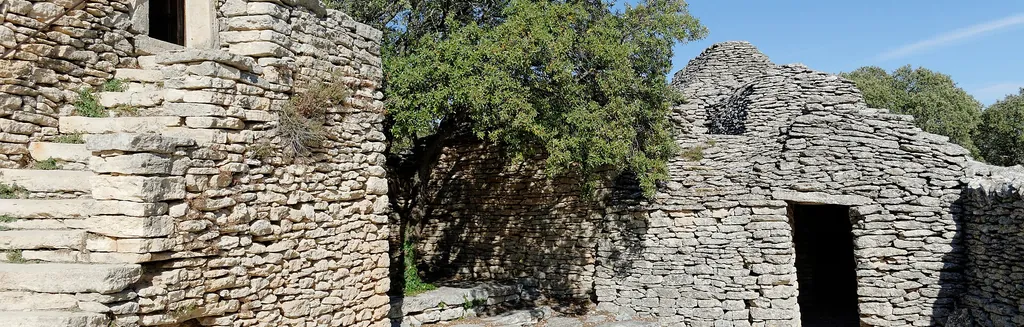
A few minutes from the perched village of Gordes, hidden in a fold of garrigue planted with holm oaks and olive trees, lies one of the most singular sites in Provence. You cannot see it from the main road: you have to turn onto a narrow little lane, round one last bend, and suddenly the scene changes. Some twenty dry-stone huts with rounded roofs rise into view, huddled against one another like a flock turned to stone. This is the Village des Bories, listed as a historic monument since 1977 — a hamlet built entirely without mortar by generations of Provençal farmers.
From Le Clos de Manon, we often send our guests here on their very first morning: it is a short visit, just a stone's throw from the villa, that tells the story of the hard, ingenious life of the old countryside better than any museum could. You come away seeing the stone walls that criss-cross the whole Luberon with fresh eyes. Here is everything you need to make the most of it, from the history of these curious huts to very practical tips on opening hours, prices and access.
The Village des Bories, a treasure right beside Gordes
The Village des Bories sits about 1.5 km west of Gordes, just below the famous perched village. From Le Clos de Manon, allow only around ten minutes by car: you leave Gordes on the D2 towards Cavaillon, then follow the small signposted road that drops down to the site. A free car park welcomes visitors at the entrance, from where a short path leads to the ticket office and the hamlet itself.
What strikes you straight away is the silence. Far from the bustle of the lanes of Gordes, the site offers a timeless interlude. The huts, all of white limestone weathered by the centuries, are arranged around courtyards, alleys and enclosures, linked by low dry-stone walls. Together they form a miniature farming village, complete with dwellings, sheepfolds, a bread oven, wine vats and even a pig enclosure.
The hamlet was once called Les Savournins, or simply Les Cabanes (the huts). Abandoned in the early twentieth century, it fell into ruin before being patiently restored from the 1960s onwards by Pierre Viala, who turned it into an open-air museum. Today it is one of the finest dry-stone ensembles in Europe, and an essential stop for anyone wanting to grasp the soul of the Luberon, well beyond the most beautiful perched villages of the Luberon.
What is a borie?
The word borie refers to a dry-stone hut — that is, one built without any mortar, simply by stacking and carefully fitting flat limestone slabs known as lauses. The term, popularised in the nineteenth century, probably comes from Provençal and originally referred to a tenant farm or a farmstead. Today, in everyday speech, it describes these round or vaulted shelters that you come across by the hundred all over the Vaucluse.
Contrary to a stubborn misconception, the bories are not prehistoric or Gaulish dwellings. Specialists agree in dating most of them to the eighteenth and nineteenth centuries, even though the building technique itself is age-old. They were not permanent homes, but utilitarian structures tied to working the land.
A borie served many purposes, depending on its size and location:
- a temporary shelter for the farmer working far from his village;
- a tool store and a place to keep farm equipment;
- a sheepfold or stable to house the flock and livestock;
- a cellar to keep harvests, wine and provisions cool;
- a bread oven or dovecote in the most complete ensembles.
The most emblematic form in Gordes is what is known as the nef gordoise (the Gordes nave): a rectangular hut with a vault shaped like an upturned ship's hull. It is this elegant silhouette that recurs throughout the hamlet, making the site a unique case study in vernacular architecture.
The dry-stone technique
Building a borie calls for demanding craftsmanship, now recognised and celebrated. In 2018, the art of dry-stone walling was indeed added to UNESCO's list of intangible cultural heritage of humanity, proof of the importance of this tradition shared by many Mediterranean countries. The principle is deceptively simple: no cement, no lime, nothing but stones assembled in such a way that their weight alone ensures the stability of the whole.
The secret lies in the corbelled vault. Each course of stones juts slightly inward compared with the one below, until the two sides meet at the top, closed off by a capping slab. The stones are laid with a very slight outward tilt, so that rainwater runs off and never seeps inside. A well-built borie stays dry and cool in all weathers.
This architecture offers several virtues that can still be appreciated today:
- excellent thermal mass: cool in summer, protection from frost in winter;
- remarkable durability, with some huts having survived two centuries intact;
- perfect blending into the landscape, the stone being drawn from the surrounding ground;
- a clever use of field clearing, the stones removed from the fields serving to build.
For that is the origin of it all: to make the land workable, the farmers first had to rid it of its stones. Rather than throw them away, they stacked them to raise low walls, terraces and huts. The borie was therefore born of an economy of necessity, in which nothing was wasted. You find this same genius for stone walls in the terraced restanques of nearby villages, as at Joucas and Murs.
The history and use of this hamlet
The Bories hamlet of Gordes is a special case: it is not an isolated hut, but a true organised village ensemble. Its development dates back to a royal edict of 1766 that expressly authorised the clearing of new land. Families then gained permission to cultivate these arid hills, and put up stone structures there in which to work and store their harvests.
For nearly two centuries, the hamlet lived to the rhythm of the farming seasons. Silkworms were raised here in the magnaneries (silkworm houses), vines, wheat and olives were grown, and sheep and goats were kept. The largest buildings could even serve as seasonal lodging during the heavy work. Then, with the rural exodus and the modernisation of farming, the place was gradually deserted, until it sank into oblivion and ruin.
Its rebirth owes everything to one man's passion. From 1968 onwards, the hamlet was meticulously restored, stone by stone, in keeping with the original techniques. Its listing as a historic monument in 1977 crowned this effort and protected the site for good. Today, visitors wander through an authentic setting, where each hut has recovered its original function, illustrated by displays of tools, ceramics and everyday objects from the eighteenth and nineteenth centuries.
What to see during your visit
The route, signposted and open to all, winds between the huts along a marked direction of visit. Allow around an hour to an hour and a half to take it all in at a gentle pace, explanatory panels included. Here are the highlights not to miss:
- the farmer's house, with its hearth, bread oven and period utensils;
- the sheepfolds and stables, which recall the importance of sheep farming;
- the wine vats and the press, witnesses to local winemaking;
- a small ethnographic display on dry-stone building around the world, from Italy to Ireland;
- the viewpoints over the Monts de Vaucluse and, in clear weather, the Luberon in the distance.
Take the time to study the construction details: the regularity of the courses, the fineness of the lintels above the low doorways, the skill of the corners. Slip inside one of the huts: the coolness is striking, even in high summer, and the silence almost total. It is one of the spots our keen photographers love most, especially at the end of the day when the low light sculpts every stone.
The site lends itself particularly well to a family visit: children love slipping into the low huts and imagining life in days gone by. Just bring sturdy shoes, as the ground is stony, and a hat in summer, since shade is scarce between the walls. To fit this visit into a complete stay, you can check our availability at Le Clos de Manon and build your programme to suit you.
Opening hours, prices and practical tips
The Village des Bories is open all year round, every day, usually from 9 a.m. until sunset. The hours therefore vary with the season, and the site may close exceptionally in snowy or icy weather, when the stones become slippery. As this information changes, we recommend you always check with the office and resources of the Luberon Regional Nature Park or the Gordes tourist office before setting off.
Here is a practical summary to plan your visit, with indicative prices noted in 2026:
| Information | Indicative detail (2026) |
|---|---|
| Distance from Gordes | ≈ 1.5 km (5 min by car) |
| Distance from Le Clos de Manon | ≈ 10 min by car |
| Adult admission | ≈ €6 |
| Reduced rate | ≈ €4 |
| Children (young) | Free |
| Length of visit | 1 hr to 1 hr 30 |
| Parking | Free, at the site entrance |
| Access | On foot only, stony ground |
For the best time to come, we recommend spring (April to June) and autumn (September to October), when the heat is gentle and the crowds modest. In high summer, favour the morning opening or the late afternoon to avoid the heat and enjoy a finer light. The table below sums up the mood by season:
| Season | Mood & tip |
|---|---|
| Spring | Garrigue in bloom, soft light — the ideal time |
| Summer | Hot and bright — come early or in the evening |
| Autumn | Warm colours, regained calm — an excellent compromise |
| Winter | Peaceful site, sometimes closed by frost or snow |
Sadly the site is not accessible to pushchairs or suited to people with reduced mobility, owing to the uneven ground and narrow passages. Remember too to bring water, as there is no refreshment stand on site.
Bories elsewhere in the Luberon
The Gordes hamlet is the most spectacular, but it is far from the only one. The Luberon and the Monts de Vaucluse are home to several thousand bories scattered through the garrigue, the vineyards and the woods. Once your eye is trained at the Village des Bories, you will spot them everywhere on your walks: standing alone in the corner of a field, built into a terrace wall, or grouped in small forgotten hamlets.
A few ideas to take the discovery further around the villa:
- the walking trails around Gordes, dotted with isolated huts and dry-stone walls;
- the Claparèdes plateau, towards Bonnieux and Saignon, strewn with bories among the lavender fields;
- the area around Saint-Saturnin-lès-Apt and Murs, where dry-stone building is especially dense;
- the enclosures and aiguiers (cisterns carved into the rock), another facet of country folk's hydraulic genius.
For those who love to walk, these huts become the waymarks of a reading of the landscape: they tell the story of a land won stone by stone. It is an excellent complement to discovering the perched villages, and a more intimate way to understand the region. Do not hesitate to ask us for our favourite routes: we know a few well-kept loops starting from Gordes.
Combining it with Gordes and Sénanque
The great advantage of the Village des Bories is its location. In a single morning or afternoon, you can pair it with the two other must-sees of the immediate area, without ever spending long on the road. Here is the itinerary we most often suggest to our guests:
- Early in the morning, head up to Gordes to admire the perched village and stroll its lanes before the crowds. Our guide to things to do in Gordes will give you all the best addresses;
- Mid-morning, go down to the Village des Bories for an hour's visit in the calm of the dry stone;
- Late morning, carry on to Sénanque Abbey and its famous lavender fields, ten minutes away, at their most sublime from mid-June to mid-July.
This triptych — perched village, dry-stone hamlet, Cistercian abbey — sums up on its own everything that makes the Gordes area so magical: the mineral and the green, the spiritual and the rural, the monumental and the humble. To place these stops within a wider discovery of the region, see our pillar guide, The most beautiful perched villages of the Luberon (2026). And if you would like to dig deeper into the subject of this article, the Wikipedia page devoted to the Village des Bories offers a reliable documentary complement.
The Village des Bories from Le Clos de Manon
If we so love recommending the Village des Bories to our guests, it is because it perfectly embodies the spirit of our corner of Provence: authentic, peaceful and right nearby. Just ten minutes or so from the villa, it is the ideal escape for a morning with no fixed plan, before coming back to enjoy the heated pool during the warm hours of the afternoon. You go at your own pace, and come back with your head full of images and a fresh understanding of the stone walls that shape the whole landscape around.
Le Clos de Manon, a ten-minute walk from Gordes, is the perfect base from which to roam freely towards all these treasures of the Luberon. To plan your stay and experience this immersion in Provençal dry stone for yourself, you can check our availability at Le Clos de Manon right now. We would be delighted to share with you our favourite addresses and itineraries around Gordes.