You can see it from everywhere. From the terrace, from the Luberon vineyards, from the hilltop lanes of Gordes: on the northern horizon, a pale silhouette stands out, capped in white even at the height of summer. It is not snow but bare limestone, scoured by the wind. This is Mont Ventoux, the lone summit of 1909 metres that dominates the whole of Provence and that the old folk already called the "bald mountain". From Le Clos de Manon, our guests glance at it every morning without always realising it sits barely an hour away by road.
Ventoux is no ordinary summit. It is at once a sporting legend, a natural sanctuary and a viewpoint like no other over the South of France. You can drive to the very last marker, climb it under your own steam like the champions of the Tour de France, or simply hike its wooded slopes. Here, as insiders, is how we suggest our guests get to know this giant.
Ventoux, the sacred mountain of Provence
Isolated, with no real neighbour to match its height, Mont Ventoux seems to rise straight out of the landscape. This remarkable position makes it visible for dozens of kilometres around and explains its reputation as the "giant of Provence". Its bare summit, a scree of moon-white limestone, gives the massif the look of a mineral desert suspended above the orchards and vineyards.
The mountain made its mark long before modern tourism. The poet Petrarch is said to have climbed it as early as 1336, an episode often cited as one of the first accounts of an ascent made "for the pleasure of the view". Ever since, Ventoux has drawn naturalists, pilgrims and athletes alike. The Sainte-Croix chapel keeps watch at the summit, a modest witness to this almost sacred dimension.
The massif is also a treasure trove of biodiversity. Listed as a UNESCO biosphere reserve and the heart of a regional nature park, it shelters a rare mosaic of habitats that rise from a Mediterranean climate at the bottom to almost alpine vegetation near the top. More than a thousand plant species are recorded here, alongside remarkable wildlife from birds of prey to reintroduced chamois. To grasp this richness, the Mont Ventoux page on Wikipedia offers a well-documented overview of its geology and ecosystems.
The three climbing roads: Bedoin, Malaucene, Sault
One feature makes Ventoux truly singular: you can reach the summit from three different sides, each with its own character. Whether you drive or cycle, the road you choose changes the experience entirely. Here is how we describe them to our guests.
- The Bedoin side (south): the historic and most demanding route. It cuts through a long forest of oaks and cedars before opening onto the famous stone desert. This is the road used by the Tour de France.
- The Malaucene side (north-west): shadier and wilder, with very steep stretches but also a few flatter sections to catch your breath. On the north face, the summit sometimes keeps its snow late into the season.
- The Sault side (east): the longest but the gentlest. It winds through lavender fields and pine forests before joining the Bedoin road at the Chalet Reynard.
All three roads converge over the final six kilometres, above the Chalet Reynard, to form the closing climb through the lunar landscape everyone pictures. Here is a summary of the distances and profiles to help you get your bearings:
| Side | Distance | Ascent | Average gradient | Profile |
|---|---|---|---|---|
| Bedoin (south) | 21.5 km | ~1610 m | 7.5% | Hard, forest then desert |
| Malaucene (north) | 21 km | ~1570 m | 7.5% | Uneven, shaded |
| Sault (east) | 26 km | ~1210 m | 4.7% | The most accessible |
Driving to the summit: what you need to know
Good news for those without a racer's legs: you can reach the summit of Ventoux by car, on a paved road that runs to the very last marker. It is one of the day trips we recommend most often from Gordes, because it offers a complete change of scene in half a day. The climb itself, a series of steady hairpins, is an experience in its own right: in just a few kilometres you pass through the equivalent of several climate zones.
A few practical points to keep in mind before you take the wheel:
- Opening season: the summit road is usually cleared and open only from mid-May to mid-November. In winter, the pass is closed to traffic.
- Crowds: in July and August, the summit car park fills up fast. Set off early in the morning to enjoy the light and the cool air.
- The mistral: even in summer, the wind can blow hard up there. Pack a jacket, as it can be 15°C colder than down in the plain.
- The cyclists: the road is shared with hundreds of cyclists. Overtake carefully and patiently, for this is common ground for everyone who loves the giant.
To prepare your outing, the official site of the Luberon Regional Nature Park and the local tourist offices regularly publish the state of the roads and driving conditions at the summit. A quick look before you leave saves any nasty surprises.
Ventoux by bike: the legend of the Tour de France
You cannot talk about Ventoux without talking about cycling. For cyclists the world over, climbing the "giant of Provence" is a rite of passage, almost a pilgrimage. The ascent from Bedoin, with its 21.5 kilometres and 1610 metres of climbing, has entered the legend of the Tour de France, the stage for heroic battles and, in 1967, for the tragic death of Tom Simpson, whose memorial still marks the spot a kilometre and a half from the top.
What makes the Bedoin climb so fearsome is its relentless steadiness: after the hamlet of Saint-Esteve, the road tips up and never lets go, with long stretches at 10% in the forest, no respite and no bend to ease the legs. Then, at the Chalet Reynard, the forest opens abruptly onto the desert of stones and the final, wind-exposed kilometres that lead to the observatory tower.
Every level has its place on Ventoux. Seasoned climbers aim for the triple ascent — all three sides in a single day, which opens the doors of the famous "Club des Cinglés du Ventoux". Others will wisely choose the Sault side, which climbs more gradually. If you love riding in Provence, Ventoux is the high point of a whole region to explore on two wheels, as we describe in our guide to the Luberon by bike. Remember to hire a good bike in Bedoin or Sault, and to set off at first light to avoid the heat and the traffic.
The summit panorama and the observatory
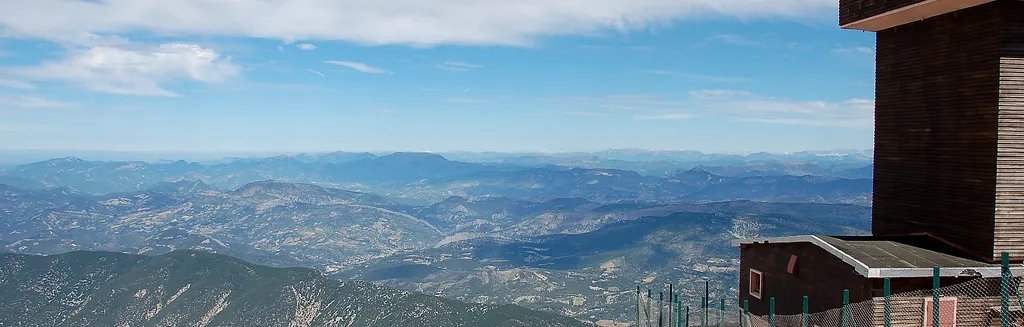
Whichever way you choose to climb, the reward is the same: a 360° panorama with no equal in the South. On a clear day, the eye reaches as far as the Alps to the east, the Mont Lozère to the west, the Rhône valley, the Camargue and sometimes, they say, all the way to the Mediterranean and the Pyrenean Canigou. At your feet stretches the whole of Provence: the Luberon, the Dentelles de Montmirail, the Comtat plain.
The summit is crowned by a silhouette recognisable among all others: the weather observatory tower, bristling with its red-and-white antenna, rising above the stone desert. Around it stand the Sainte-Croix chapel, the Tom Simpson memorial, an orientation table and a few souvenir shops. It is a lively crossroads in summer, where drivers, motorcyclists and exhausted but beaming cyclists all meet.
Our insider tip: if you can, come up for sunrise or sunset. The low light sets the white stones ablaze and the plain fills with a golden haze. It is a sight our guests still talk about long after their stay.
Hikes and forests on the slopes
Ventoux is not just for engines and pedals. Its slopes hold a dense network of hiking trails that let you discover the mountain differently, on a human scale and at walking pace. The contrast between the shady forests at the bottom and the mineral summit makes it a wonderfully varied playground.
Among the options we love to share:
- The climb from the Chalet Reynard: a walk of about two hours across the stone desert to reach the summit without all the effort from the base.
- The cedar forests of the south side: a magnificent cedar grove planted in the 19th century, cool and fragrant, perfect on scorching days.
- The GR4 and GR9: these long-distance trails cross the massif and offer long escapes for experienced walkers.
At altitude, the vegetation turns low and alpine, dotted with rare species such as the Greenland poppy, a relic of the ice ages. Nature lovers will find far wilder terrain here than on the hills of the Luberon. To stay closer to home, take a look too at our hiking routes in the Luberon, more accessible and every bit as beautiful.
Bedoin, Sault and the lavender at the foot of the giant
A trip to Ventoux is never just about the summit road. The villages at the foot of the giant are well worth lingering in, and they turn the outing into a true Provencal day. Bedoin, to the south, is a charming wine-growing village of stepped lanes and the starting point of the legendary climb. Its Monday morning market, one of the liveliest in the Vaucluse, is a feast for the senses.
To the east, on its plateau at 760 metres of altitude, Sault is the capital of lavender. From late June to mid-August, the fields turn purple as far as the eye can see and scent the air. It is one of the finest reasons to climb Ventoux from this side in summer. We have devoted a whole guide to it: Sault, the capital of lavender, well worth reading before you plan your visit for the right season.
Here, in a single table, is how to time your village visits according to the time of year:
| Village | Not to be missed | Best time |
|---|---|---|
| Bedoin | Monday market, AOC Ventoux vineyards | All year round |
| Sault | Lavender fields, artisan nougat | Late June to mid-August |
| Malaucene | Old village, fountains, northern starting point | Spring and autumn |
Weather, wind and the best season
The very name of the mountain says it all: Ventoux evokes the wind (vent), and the name is well earned. The summit is one of the windiest places in France, where the mistral has been recorded at more than 300 km/h. Even in fine weather down in the plain, it can blow violently up there and send the feels-like temperature plummeting. It is the first thing we warn our guests about.
To help you plan across the seasons, here is a summary of conditions at the summit:
| Season | Summit road | Summit temperatures | Our take |
|---|---|---|---|
| Winter (Dec–Mar) | Often closed (snow) | -5 to 5°C | Cross-country skiing at Mont Serein, summit unreachable by car |
| Spring (Apr–May) | Gradual opening | 5 to 12°C | Green slopes, summit sometimes still snowy |
| Summer (Jun–Aug) | Open, very busy | 15 to 25°C | Lavender at Sault, climb early in the morning |
| Autumn (Sep–Oct) | Open, quieter | 8 to 18°C | Golden light, our favourite season |
Our recommendation: aim for June, September or early October to combine an open road, clear skies and reasonable crowds. Always check the weather and the state of the pass on the morning itself, as conditions change quickly. And whatever the season, pack a warm layer and a windbreaker: the summit often holds a few thermal surprises.
Getting there from Gordes
From Le Clos de Manon, Ventoux is an easy escape to organise. Allow about an hour by road to reach Bedoin or Sault at the foot of the climb, roughly fifty kilometres depending on the side. From Gordes, you head north across the Monts de Vaucluse and the lovely countryside of the Comtat Venaissin: the drive is already part of the journey.
For a successful day, we suggest our guests set off early, climb to the summit first thing, then come back down for lunch in a village at the foot of the giant before a walk or a wine tasting. Ventoux also pairs beautifully with other outings north of Gordes: find all our ideas in our pillar guide, Day trips from Gordes: 12 escapes in Provence.
Making Ventoux a day out from Le Clos de Manon
Mont Ventoux sums up on its own what we love to offer our guests: a great open space of freedom, within easy reach by road, from a peaceful home. You leave in the morning, you touch the clouds at 1909 metres, you cross the lavender fields of Sault, and you come home in the evening to the villa for a dip in the heated pool, your head full of images. It is this alternation between adventure and calm that makes the magic of a stay here.
The giant of Provence is just one of the wonders within easy reach of Gordes. If the idea of exploring Provence from a central, peaceful base appeals to you, you can check our availability at Le Clos de Manon right now and prepare your ascent of Ventoux in the best possible conditions.