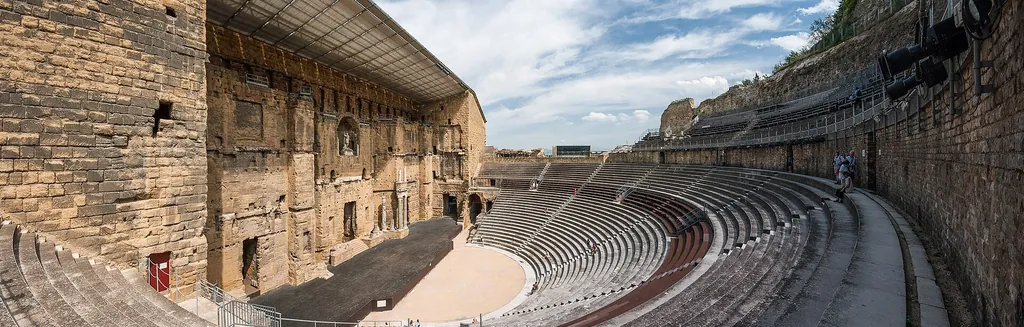
Some days sum up Provence all on their own: a morning in the vineyards, a glass of grenache in hand, and an afternoon spent on the stone tiers of a theatre two thousand years old. That is exactly what we suggest to our guests when they ask us to venture a little beyond the Luberon: head north-west, towards the Rhône Valley, where Châteauneuf-du-Pape and Orange answer one another a few kilometres apart. On one side, one of the most prestigious vineyards in the world; on the other, the best-preserved Roman theatre in Europe, listed as a UNESCO World Heritage Site.
This escape has everything going for it: it weaves together the art of living and history, the palate and the eye, without ever growing tiresome. From Le Clos de Manon, a ten-minute walk from Gordes, you should allow about 50 minutes by road to reach Châteauneuf-du-Pape, and another ten minutes or so for Orange. Here is how we suggest planning the day, from the first cellar right through to the evening return, beneath the plane trees of the villa.
From Gordes to the Rhône Valley
The drive is already part of the pleasure. Leaving Gordes, you descend towards the plain, skirt Coustellet and its markets, then make for Avignon before turning north. The road crosses landscapes that shift almost imperceptibly: the dry-stone terraces of the Luberon give way to the great expanses of vines on the left bank of the Rhône, more open, more mineral. It is another face of Provence, that of the rolled pebbles and the mistral that sculpts the rows of vines.
For anyone who likes to drive at a gentle pace, the simplest route follows the A7 motorway to the Orange exit, but we often prefer the country roads that wind between Avignon and Châteauneuf: you come across isolated estates, chapels and those famous pebbles that carpet the soils and, at night, give back the heat stored up during the day. If you would like to get to know the region before setting off, our guide to day trips from Gordes: 12 escapes in Provence sets this day within the full range of outings possible from the villa.
A few markers for distances and times, from Le Clos de Manon, to help you plan your day:
| Destination | Distance from Gordes | Driving time |
|---|---|---|
| Châteauneuf-du-Pape | ≈ 45 km | ≈ 50 min |
| Orange (ancient theatre) | ≈ 55 km | ≈ 1 hr |
| Châteauneuf → Orange | ≈ 11 km | ≈ 15 min |
| Avignon (on the way) | ≈ 38 km | ≈ 45 min |
Châteauneuf-du-Pape: the history of the popes and the vineyard
The name says it all. In the 14th century, when the papacy settled in Avignon, the popes sought a country retreat. John XXII, the second Avignon pope, had a fortified residence built in the early 1300s on the hill overlooking the village: this would be the "new castle of the pope", the one that gave the commune its name. It was also under his impetus that the vineyard flourished, the pope encouraging the planting of vines and the arrival of winemakers to supply the papal court.
From that era dates a winegrowing vocation that has never wavered. But the modern history of the appellation rests on another, more recent episode. In the early 20th century, the winemakers of Châteauneuf, led by Baron Pierre Le Roy de Boiseaumarié, laid down the first strict rules of production to protect their wine from fraud. In 1936, Châteauneuf-du-Pape became one of the very first appellations d'origine contrôlée in France, a model that would go on to inspire the entire AOC system. The village is, in a sense, the cradle of the French art of protecting its terroirs — a story we also love to tell about our own local wines in our article on the AOC wines of the Luberon and Ventoux.
Today the appellation covers around 3,200 hectares spread across five communes, and counts some three hundred estates. Winegrowing families have passed down their plots there for generations, and you will find renowned houses alongside small, confidential producers. To understand this terroir in detail, the encyclopaedic entry on Châteauneuf-du-Pape makes a good starting point before your visit.
Understanding the appellation and its thirteen grape varieties
What makes Châteauneuf-du-Pape so singular is, first of all, this mosaic of thirteen permitted grape varieties, an almost unique case in France. Where many appellations rely on one or two dominant grapes, here the winemaker composes like a perfumer, blending according to terroir and taste. Grenache is the backbone of the reds, bringing roundness, ripe fruit and warmth; syrah and mourvèdre add structure, spice and ageing potential; cinsault, counoise and vaccarèse refine the blends.
The whites, rarer (about a tenth of production), are no less remarkable. They are born of roussanne, clairette, bourboulenc or white grenache, and yield wines that are ample, floral, sometimes honeyed, perfect with poultry or a fresh goat's cheese from the Provençal markets. Here, in short, are the main grape varieties you will encounter:
| Grape variety | Colour | What it brings to the wine |
|---|---|---|
| Grenache noir | Red | Ripe fruit, roundness, warmth |
| Syrah | Red | Spice, colour, structure |
| Mourvèdre | Red | Tannins, ageing, depth |
| Cinsault | Red | Finesse, freshness |
| Roussanne | White | Body, florals, elegance |
| Clairette | White | Freshness, liveliness |
Another feature visible the moment you step into the vines: the famous rolled pebbles, those large stones polished by the ancient Rhône that cover part of the soils. They store up the heat of the day and release it at night, encouraging the grapes to ripen perfectly. It is one of the secrets behind the power of the village's wines, often compared, in principle, to the work of the terroirs we describe in our tour of the Luberon wine route.
Visiting a cellar and tasting (in moderation)
The heart of the day is, of course, the tasting. At Châteauneuf-du-Pape, two options are open to you. The simplest is to push open the door of the village cellars: the main street has several, open all year round, often without an appointment, where you can taste a selection of cuvées free of charge or for a few euros. The second, which we prefer for its authenticity, is the estate visit out among the vines: you meet the winemaker, tour the cellar, and the tasting takes on a whole new dimension when it is talked through by the person who made the wine.
A few practical tips we always share with our guests:
- Book estate visits in advance, especially from July to September and during the harvest;
- Appoint a sober driver or hire a chauffeur: you taste, you don't drink, and you happily spit;
- Bring water and a snack: tasting on an empty stomach quickly tires the palate;
- Limit yourself to two estates in the morning, to keep your sense of taste fresh and the pleasure intact.
For those who would like to extend the experience closer to the villa, the Luberon too is full of fine addresses: we detail them in our guide to wine tourism and tasting in the Luberon. To plan your visit to Châteauneuf in concrete terms, the tourist information for the Orange and Vaucluse region also lists many cellars and wine events across the Rhône Valley.
The village and the ruins of the popes' castle
Before or after the tasting, take time to wander through the village itself. Châteauneuf-du-Pape lacks the dramatic silhouette of the Luberon's hilltop villages, but it has a peaceful charm, with its lanes lined with winemakers' shops, wine merchants and small restaurants. The central square, shaded by plane trees, is perfect for lunch: a Provençal platter, a well-chilled glass of white, and you set off again with a light step.
Above all, climb up to the ruins of the popes' castle, perched at the top of the village. Of the imposing fortress built by John XXII, only a single section of wall remains, raised towards the sky — the rest was destroyed over the centuries, and the keep dynamited by the German army in 1944. But this solitary remnant, standing out against the sunset, has become the emblem of the village.
The panorama, for its part, is intact and grand. From the orientation table, the eye takes in:
- the Rhône Valley and the ribbon of the river below;
- the Mont Ventoux to the east, a limestone giant often snow-capped into spring;
- the Dentelles de Montmirail and, in the distance, the first foothills of the Alps;
- the sea of vines stretching out as far as the eye can see around the village.
Orange: the ancient theatre, the best preserved in Europe
About fifteen minutes to the north, Orange shifts register completely. Here it is no longer wine that holds sway, but Rome. The town, founded as a Roman colony under the name Arausio, preserves one of the most extraordinary testimonies of antiquity in France: its ancient theatre, a UNESCO World Heritage Site since 1981, is considered the best preserved in Europe.
What strikes you first is the stage wall, that gigantic sheet of stone 37 metres high and 103 metres long, the only one still standing in the entire western Roman world. Louis XIV called it "the finest wall in my kingdom". At its centre stands a restored statue of Emperor Augustus, watching over the tiers. Built in the 1st century AD, the theatre could hold nearly 9,000 spectators, seated according to their social rank, from the notables to the most humble right at the top.
The visit, with an audio guide included in the ticket, brings back to life the perfect acoustics devised by Roman engineers: from the stage, a voice carried to the very back rows effortlessly. Even today, the theatre lives on: every summer, the Chorégies d'Orange, one of the oldest opera festivals in France, stages operas under the stars, in a setting that two millennia have not dimmed. To plan your visit, opening times and tickets are available on the official site of the ancient theatre of Orange.
The triumphal arch and the centre of Orange
The theatre is not Orange's only ancient treasure. At the northern entrance to the town stands a magnificent triumphal arch, also listed as a UNESCO World Heritage Site. Built around the start of the 1st century, it celebrates the victories of the Roman legion and is adorned with bas-reliefs of remarkable finesse: trophies of arms, naval battle scenes, Gaulish captives. It is one of the best preserved and most richly decorated Roman arches you can see outside Italy.
The ancient theatre ticket usually includes access to the art and history museum just opposite, which sheds light on the history of the ancient town and displays, in particular, remarkable Roman land registers engraved in marble, unique in the world. Take time too to stroll through the old centre of Orange, around the Place de la République and its terraces, where you find the Provençal atmosphere of markets and cafés.
If history and old stones are your passion, know that this day pairs perfectly with other heritage escapes from the villa, from the art towns to the great ancient sites of the region, which we round up in our complete guide to day trips from Gordes. The region, crossed by the Rhône and partly protected by the Luberon Regional Nature Park, never runs short of reasons for new days out.
Tasting tips and the return to Gordes
To make the most of this day of wine and Roman stones, here is the framework we recommend to our guests. Leave Le Clos de Manon around 9 a.m., giving yourself time to reach Châteauneuf-du-Pape as the cellars open. Devote the morning to one or two tastings, then enjoy a leisurely lunch in the village. In the afternoon, set off for Orange to visit the ancient theatre and the triumphal arch, when the golden light of late day brings the stone to life.
A few practical recommendations that make all the difference:
- Buy your wine at the end of the day, never first thing in the morning, so the bottles don't heat up in the car;
- Take a soft cooler bag: it will protect your purchases on the way home;
- Avoid Mondays, a common closing day for estates and some museums;
- In summer, visit Orange in late afternoon: the theatre empties and the heat eases;
- Keep a bottle for the villa: there's nothing like a Châteauneuf by the pool come evening.
The drive back to Gordes at dusk is one of our favourite moments: the Ventoux turns pink, the vineyards darken, and you come home with a few bottles and a head full of ancient images. This is precisely what we love to offer our guests: a calm, central base, a ten-minute walk from Gordes, from which you can roam across all of Provence without ever giving up the comfort of the return.
Making this escape a moment at Le Clos de Manon
Châteauneuf-du-Pape and Orange make for one of the finest days you can experience from the Luberon: an interlude where the pleasure of wine meets the emotion of heritage. To enjoy it without rushing, we recommend a stay of five to seven nights, leaving time to alternate these great escapes with gentler wanderings, through the hilltop villages and along the markets.
If this day appeals to you, you can check our availability at Le Clos de Manon right now and imagine your next Provençal stay, between the heated pool, the calm of the cypresses and the great wines of the Rhône Valley. We would be delighted to share our favourite addresses with you and to help you put together the ideal itinerary.