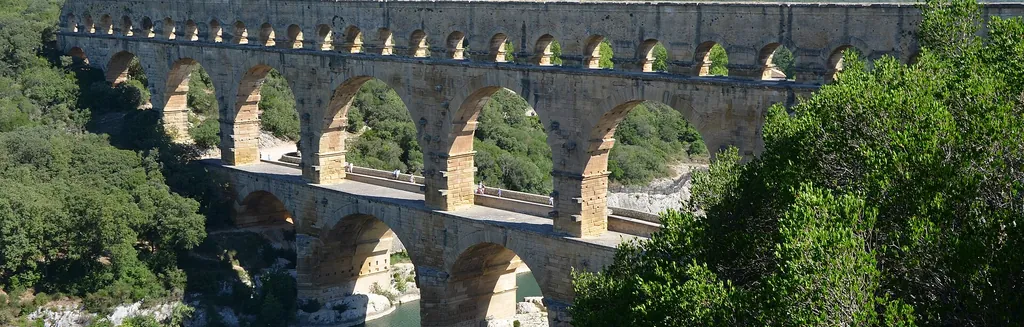
There are monuments that photographs never quite prepare you for. The Pont du Gard is one of them. You think you know it, you've seen it a thousand times on postcards and on the old five-euro note, and yet, as you round a bend in the path and its three tiers of golden arches rise above the Gardon, you stop in your tracks. Forty-nine metres tall, nearly two thousand years old, and not a drop of mortar in the colossal blocks of the lower level: the feeling is immediate. It's one of the sites we recommend without hesitation to guests looking for a great day out beyond the Luberon.
From Le Clos de Manon, a ten-minute walk from Gordes, the Pont du Gard is a day trip worth planning with a little care so you can make the most of it: an early start, a picnic by the water, a swim in the Gardon in summer, and perhaps a stop in Uzès or Avignon on the way back. Here is our practical, first-hand guide to visiting this jewel of Roman engineering, with prices, opening hours, access and our tips for beating the heat.
The Pont du Gard, a feat of antiquity
The Pont du Gard is not a bridge in the way we think of one today: it's an aqueduct bridge, built to carry a water channel across the steep-sided Gardon valley. At 49 metres tall, it is the highest Roman aqueduct bridge to have survived, and one of the best preserved in the world. Three rows of stacked arches make up its silhouette: six great arches on the lower level, eleven on the middle level, and thirty-five small arches at the top, which carried the water conduit, the specus.
What strikes you on site is the sheer scale. The limestone blocks of the lower level, quarried nearby, weigh up to six tonnes and were set in place without mortar, held by interlocking and friction alone. The protruding stones you can still see served as supports for the scaffolding and timber centring during construction. It's a life-size manual of Roman architecture, set down in the open garrigue, and you understand why it ranks among the masterpieces of antiquity alongside the Colosseum and the Pantheon.
A UNESCO World Heritage Site since 1985 and a listed Grand Site de France, the Pont du Gard now draws more than a million visitors a year. To grasp the achievement, keep one dizzying figure in mind: across the whole aqueduct, the water dropped just a few centimetres per kilometre. Clockmaker's precision on the scale of an entire landscape.
History: the Nîmes aqueduct in the 1st century
The Pont du Gard only makes sense once you place it within the vast structure it forms a single link in: the Roman aqueduct of Nîmes. Most likely built in the middle of the 1st century AD, under the Julio-Claudian emperors, this aqueduct captured water from the Eure spring near Uzès and carried it to the Roman colony of Nemausus, present-day Nîmes.
The route of the structure is a marvel of surveying. To cover the 50 kilometres between the spring and the city, the Roman engineers worked with a total drop of barely a dozen metres. The average gradient is around 25 centimetres per kilometre, making it one of the shallowest known for an ancient structure. At its destination, the aqueduct supplied the fountains, baths and houses of Nîmes with several tens of thousands of cubic metres of water a day.
The structure worked for around five centuries before being gradually abandoned, undone by mineral build-up in the conduit and the decline of the Empire. In the Middle Ages the bridge remained standing and long served as a road crossing, at the cost of a few alterations that sometimes weakened it. Its restoration began in earnest in the 18th century, then in the 19th under the impetus of Prosper Mérimée. Those with a curious eye for history can dig deeper in the detailed Pont du Gard entry on Wikipedia, especially well documented on the ancient construction and the restoration campaigns.
What to see on site: the two banks and the viewpoints
The site is explored from two banks, each with its own entrance and car park. The left bank holds the main building, the large museum, the Ludo area, the restaurant and the ticket office. The right bank, wilder, opens onto the pebble beaches and the garrigue trails. The two banks are linked by the bridge itself, which you cross on foot via the old roadway built against the lower level.
Our advice for really taking in the monument is to walk all the way around it, because each viewpoint tells a different story:
- the crossing of the bridge, right alongside the great arches, to grasp the thickness of the piers and the golden colour of the limestone;
- the right-bank belvedere, set slightly higher up, which gives the postcard view, the three tiers framed in the valley;
- the pebble beaches downstream, from where you take in the bridge from the riverbed, the best angle for photographers;
- the garrigue trails (the Mémoires de garrigue walk), a loop of around 1.4 km through olive trees, holm oaks and dry-stone terraces, dotted with interpretive panels.
Bring good shoes: the paths are stony and the garrigue offers little shade. The full walk, museum included, fills a half-day very pleasantly. If you enjoy this kind of grand outing from the villa, we've gathered them in our guide Day trips from Gordes: 12 escapes in Provence, which places the Pont du Gard among the region's must-sees.
The museum and the Ludo area for families
Many visitors head straight for the bridge and skip the museum, which is a mistake. Set on the left bank, it unfolds across nearly 2,500 m² in a modern, immersive layout that tells the story of water in antiquity: the capture at the spring, the digging of the galleries, the construction techniques, daily life in Nîmes. Models, full-scale reconstructions and short films make the visit accessible to everyone, even those who aren't keen on archaeology.
For families, the site has thought of the children with the Ludo area, a playful, hands-on 600 m² trail designed for 5- to 12-year-olds. Through games and things to handle, children discover the role of water, the animals of the garrigue and the gestures of the Roman builders, all while having fun. It's the trump card for turning a heritage visit into a successful family day out.
The site also offers a cinema, temporary exhibitions and, in high season, events and evening shows. A barefoot trail, shaded picnic areas and several places to eat round out what's on offer. For lovers of freshwater swimming, the Pont du Gard joins our favourites listed in our guide to the finest swimming spots in the Luberon and beyond.
Swimming and canoeing on the Gardon
In summer, the Pont du Gard is also enjoyed with your feet in the water. Swimming in the Gardon is permitted and it's one of the great pleasures of the site: you settle on the pebble beaches downstream of the monument, cool off in the river, and gaze up at the golden arches from the water. The experience is unforgettable, as long as you follow a few sensible precautions.
- The river is not supervised: keep children within reach, especially after spring rain when the current strengthens;
- The water stays cool even at the height of summer, it's a true garrigue river;
- Bring water shoes, as the pebbles are slippery, and a parasol, since shade is scarce;
- Favour the start or end of the day: the water is calmer and there are fewer people.
For a more active adventure, several rental bases offer canoe or kayak trips down the Gardon, usually setting off from Collias, a few kilometres upstream. The classic route, around 8 km, ends by passing beneath the arches of the Pont du Gard: one of the most beautiful finishes there is, best booked in spring or early summer when the water level is high enough. Allow two to three hours of paddling at a gentle pace, swims included.
Prices, hours and access from Gordes
The site is paid, but the ticket works like a single pass covering everything: parking, access to the bridge, the museums, the Ludo area and the outdoor spaces. As a guide for 2026, expect around €9.50 per adult, with free entry for under-18s and, in high season, free access to the site in the evening after 7 pm. The exact prices and conditions should be checked on the official Pont du Gard website, where booking online is strongly recommended in summer to secure a parking space.
The site is open all year, with hours that vary by season: broadly 9 am to 6 pm in winter, and until 10 pm or midnight in summer during evening events. The bridge itself stays accessible continuously, but the museums and services close earlier. Here's a summary to help you plan your day from Gordes:
| Information | Indicative detail (2026) |
|---|---|
| Distance from Gordes | ≈ 65 km |
| Driving time | ≈ 1 hr (N100 + A7/A9, Remoulins exit) |
| Adult ticket | ≈ €9.50 (parking included) |
| Under 18s | Free |
| Recommended visit length | Half a day to a full day |
| Online booking | Recommended in summer |
As for driving from Le Clos de Manon, the easiest route is to join the motorway via the N100 towards Avignon, then follow the A7 and A9 to the Remoulins exit. Two entrances are possible: the left bank (Vers-Pont-du-Gard), the more complete one, and the right bank (Remoulins). The site's UNESCO status and its history are set out in detail in the encyclopedia entry on the monument if you'd like to prepare for your visit in advance.
Best time to go and tips for beating the heat
The Pont du Gard can be visited all year, but the experience changes dramatically with the season. Spring (April to June) and early autumn (September, October) are our favourite times: the light is beautiful, the garrigue smells of thyme and rosemary, and the crowds stay reasonable. Summer brings swimming and evening events, but the heat can be overwhelming in the middle of the day, with not a scrap of shade on the trails.
| Season | Mood | Average afternoon temperature |
|---|---|---|
| Spring | Garrigue in bloom, cool water | 18–24 °C |
| Summer | Swimming, canoeing, evenings | 30–36 °C |
| Autumn | Golden light, calm | 18–25 °C |
| Winter | Clear site, reduced prices | 8–13 °C |
If you come in summer, a few simple habits make all the difference. Arrive at opening, around 9 am, or in the late afternoon after 5 pm, to avoid the peak of heat and crowds. Bring a water bottle per person, a hat, sunscreen and closed shoes for the garrigue. Save the swim and the picnic for the hot hours, in the shade of the few trees along the Gardon. The Regional Nature Park that watches over these garrigue landscapes offers valuable advice on responsible discovery: you'll find it on the Luberon Regional Nature Park website, guardian of the Provençal environment close by.
Combining the Pont du Gard with Nîmes, Uzès or Avignon
The great advantage of the Pont du Gard is its central position among several jewels of the region's heritage. Rather than making the round trip from Gordes for the monument alone, we suggest our guests build a day-long loop that pairs the aqueduct with a neighbouring town. Three itineraries stand out.
- Uzès, just 15 minutes away: France's first duchy, a town of golden stone with superb arcades, home to the Eure spring where the aqueduct began. The most natural pairing with the Pont du Gard;
- Nîmes, 25 minutes away: the French Rome, with its spectacular arena, the Maison Carrée and the Jardins de la Fontaine. This is the city the aqueduct supplied: the historical loop is perfect;
- Avignon, 30 minutes away: the Palais des Papes, the Saint-Bénézet bridge and the ramparts, on the way back to Gordes.
This idea of grand outings radiating out from the villa is exactly the spirit of our guide to 12 escapes in Provence from Gordes. And if Roman, wild Provence appeals to you, carry on westward with Arles, Van Gogh and the Camargue, another great day of heritage and nature within reach of the Luberon.
Making the Pont du Gard an escape from Le Clos de Manon
From Gordes, the Pont du Gard is the day trip par excellence: you set off in the morning with a picnic and swimwear, marvel at the aqueduct, swim in the Gardon, visit Uzès along the way, and come home in the evening, your head full of golden arches and cicadas. This is exactly what we love to offer our guests: a peaceful house, a ten-minute walk from Gordes, from which you can reach the finest sites in Provence without ever straying too far from the heated pool.
To combine the Luberon, its hilltop villages and the great escapes like the Pont du Gard, we recommend a stay of five to seven nights. If the adventure tempts you, you can check our availability at Le Clos de Manon right now and put together your bespoke Provençal programme.