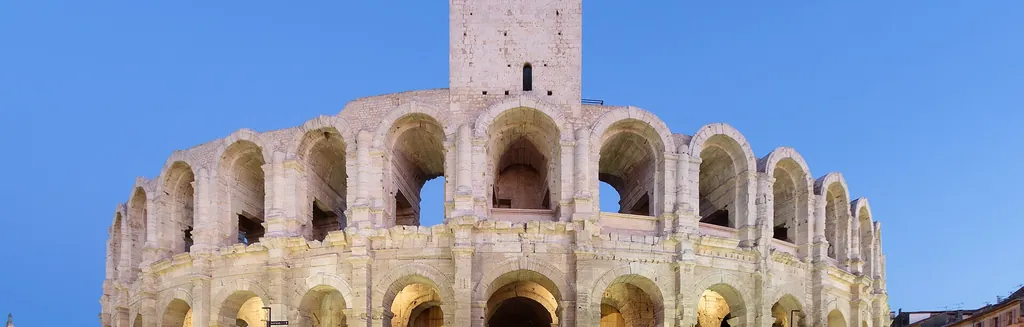
Some days seem to distil all the diversity of Provence into a single outing. Setting off from Gordes in the morning, crossing the Luberon and the Durance valley, then seeing the tightly packed rooftops of Arles and its Roman arena rise up around a bend in the road: this is one of the day trips we most love to suggest to our guests. In just an hour on the road, you leave behind the hilltop villages of golden stone and step into another story altogether — that of Rome, of Van Gogh, and then of the wild, wide-open expanses of the Camargue.
Arles and the Camargue make an unlikely yet perfectly coherent pair: the town, dense and laden with twenty centuries of history, opens onto an immense delta where white horses, black bulls and pink flamingos share the lagoons. It is a day of contrasts, one you can experience from Le Clos de Manon without ever feeling rushed. Here is how we suggest our guests plan it, step by step, with our markers for timing, season and budget.
Arles, two thousand years of history
Arles is not a town you pass through: it is a town you sink into. Founded by the Greeks and later made a Roman colony under Julius Caesar, it was, in the 1st century, one of the most prosperous cities in Gaul — a river port on the Rhône and a crossroads of the routes towards Spain and Italy. That ancient wealth left an exceptional legacy, so much so that the town and its Roman and Romanesque monuments have been a UNESCO World Heritage Site since 1981.
Yet Arles has never frozen in its past. It is a lively, southern town, sometimes noisy, washed in the light that so fascinated the painters. You come across ochre, whitewashed façades, squares shaded by plane trees, café terraces where time slows down. It is also the capital of a certain idea of Provence: that of the Rencontres de la Photographie every summer, the Arlésienne costumes worn at the festivals, and a cuisine nourished by rice and the produce of the delta.
To really get a feel for the town, we suggest starting in the historic heart, on foot. Parking in the centre proves tricky: better to aim for one of the car parks on the outskirts, along the boulevards, and reach the monuments in a few minutes' walk. You'll find all the practical information, maps and opening hours on the Arles tourist office website, which we recommend checking before you set off.
The UNESCO-listed Roman monuments: arena and ancient theatre
The symbol of Arles is its amphitheatre, which the locals simply call "the arena". Built around 90 AD, it could hold more than 20,000 spectators who came to watch the gladiatorial combats. At 136 metres long, it is one of the best-preserved Roman amphitheatres in the world. In the Middle Ages it was turned into a fortified village in its own right, with houses and two chapels inside; the remains of these were cleared away in the 19th century to restore the monument's ancient silhouette.
Today you can still climb the tiers and ascend the medieval towers for a magnificent view over the town's rooftops and the Rhône. The arena is far more than a museum piece: it still hosts courses camarguaises and, during the great ferias, corridas. Right next door, the ancient theatre, older still (late 1st century BC), preserves two solitary columns nicknamed "the two widows" — moving remnants of a once-sumptuous stage wall.
For those who want to dig deeper, several other sites round out the Roman picture:
- the Baths of Constantine, by the Rhône, dating from the 4th century;
- the Cryptoporticoes, underground galleries that once supported the ancient forum;
- the Alyscamps necropolis, an avenue of sarcophagi lined with cypress trees that inspired Van Gogh and Gauguin;
- the Musée départemental Arles antique, where you can admire a presumed bust of Caesar and a Roman barge raised from the Rhône.
A combined ticket (the "monument pass") lets you visit several sites at a reduced rate, somewhere between €12 and €19 depending on the option; each separate monument costs around €4 to €9. The wealth of this ancient, world-renowned heritage is set out on the encyclopaedia page devoted to Arles and its Roman monuments.
In Van Gogh's footsteps in Arles
In February 1888, a 34-year-old Dutch painter stepped off the train at Arles, fleeing the grey of Paris in search of the light of the South. Vincent van Gogh would spend a little over a year here — but what a year: he painted nearly 300 works here, among the most famous in the whole history of art. Sunflowers, Starry Night Over the Rhône, The Night Café, The Bedroom… so many canvases born of these streets and these sun-drenched fields.
Arles has found a way to turn that intense interlude into a heartfelt trail. Not a single original canvas is kept on site, but panels set up at the exact spots where Van Gogh planted his easel let you compare the real subject with the painting. So you follow the thread of a walk:
- the Night Café, on the Place du Forum, whose yellow terrace is still recognisable at first glance;
- the Langlois bridge (the "Van Gogh bridge"), reconstructed south of the town;
- the Alyscamps and the banks of the Rhône, the settings for his play of light.
The most moving stop remains the Espace Van Gogh, the former hôtel-Dieu where the painter was treated after the episode of the severed ear. Its inner garden, full of flowers and ringed with arcades, has been restored to resemble the canvas The Garden of the Hospital. It is a free, peaceful place, perfect for a pause before moving on. For enthusiasts, the Fondation Van Gogh, housed in a fine mansion, presents contemporary art exhibitions in dialogue with the master's legacy.
The markets and the Luma foundation
If you can, time your visit for a Saturday morning: the Arles market, stretching nearly two kilometres along the Boulevard des Lices, is one of the finest in Provence. You'll find olive oil from the Baux valley, Arles saucissons, goat's cheeses, Camargue rice, cracked olives and stalls of Provençal fabrics. On Wednesday mornings, a smaller market also brings the Boulevard Émile-Combes to life. It's the perfect chance to put together a basket of local produce to bring back to the villa.
At the other end of the spectrum, Arles has treated itself to a spectacular piece of contemporary architecture: the Luma tower, designed by Frank Gehry, raises its 56 metres of glittering stainless-steel panels above the Parc des Ateliers, on a former railway wasteland. Inaugurated in 2021, this foundation devoted to art, photography and ecology offers exhibitions, a bookshop and a café. The contrast between the ancient and the ultra-modern sums up Arles's singularity rather well — a town that looks to its past without ever giving up on reinventing itself.
The Camargue: pink flamingos, lagoons and rice fields
Once you've explored Arles, you simply take the road south to tip into another world. The Camargue begins at the very gates of the town: it is the largest delta in Western Europe, shaped by the Rhône at its mouth, an immense chequerboard of brackish lagoons, marshes, rice fields and salt pans. Protected within a regional nature park and designated a UNESCO biosphere reserve, it shelters wildlife and plant life of exceptional richness.
The undisputed star is the pink flamingo. The Camargue is one of the few breeding sites for the species in Europe, with several thousand nesting pairs on the Fangassier lagoon. To be sure of spotting them, the Pont de Gau ornithological park, a few kilometres from Saintes-Maries, offers laid-out trails and hides; reckon on around €8 to €9 for entry and a good hour and a half of walking. Herons, egrets, avocets and stilts round out the picture. You'll find the discovery trails, water levels and visiting tips on the official website of the Camargue Regional Nature Park.
Beyond the birds, the Camargue reveals itself through its landscapes: the road running towards the sea crosses the rice fields (the Camargue supplies most of France's rice), follows the dykes and sometimes opens onto the white pyramids of the salt pans, where the fleur de sel is harvested. At sunset, the light there becomes almost unreal.
Manades, horses and bulls
It's impossible to talk about the Camargue without mentioning its two emblematic animals, raised in semi-freedom on the estates known here as manades. The Camargue horse, small, hardy and born brown before turning white as it grows, is one of the oldest breeds in the world. The Camargue bull, black and quick, is raised for the course camarguaise, that no-kill game in which the white-clad raseteurs try to snatch ribbons fixed between its horns.
Many manades open their doors to visitors and offer experiences our guests greatly enjoy:
- horseback rides through the marshes, right up close to the bulls and the birds (from €20 to €25 an hour);
- cattle-sorting demonstrations by the gardians, the mounted herdsmen who watch over the bulls;
- manade meals where you taste the famous gardiane de taureau, a bull stew simmered in red wine and served with Camargue rice.
It is surely the most authentic way to understand Camargue culture, handed down from generation to generation. Book ahead in high season, as the most renowned manades fill up fast.
Saintes-Maries-de-la-Mer
At the end of the road, where the delta meets the Mediterranean, nestles the village of Saintes-Maries-de-la-Mer. Its low, white houses, its massive fortified church towering over the rooftops, its sandy beaches stretching as far as the eye can see: this is the natural high point of a day in the Camargue. The Romanesque church houses the statue of Sara the Black, venerated by the Roma community during the famous pilgrimage of 24 and 25 May, one of the most striking in Provence.
People come to climb up onto the church's rooftop terrace (a 360° view over the delta and the sea), to wander the lanes, savour an ice cream facing the harbour, or simply lay a towel on the beach. For a perfect end to the day, we suggest arriving in mid-afternoon, then heading back towards Arles just as the light turns the lagoons golden.
Practical tips: season, mosquitoes, getting there from Gordes
An Arles-Camargue day calls for a little planning. Here are our concrete markers, tested over the seasons, so our guests can make the most of it.
Getting there from Gordes. The villa is a ten-minute walk from Gordes; from there, reckon on about 1 hour by car to Arles (75 km), via the D2, the D900 and then the A7/A54 motorway, or via the Durance valley roads. Saintes-Maries-de-la-Mer adds another 40 minutes (38 km south of Arles). A car is essential: the Camargue cannot be visited by public transport.
| Stop | Distance from Gordes | Driving time |
|---|---|---|
| Arles (centre) | ≈ 75 km | ≈ 1 hr 00 |
| Pont de Gau ornithological park | ≈ 105 km | ≈ 1 hr 30 |
| Saintes-Maries-de-la-Mer | ≈ 113 km | ≈ 1 hr 40 |
Which season to choose? Spring (April–June) is our favourite time: soft light, plentiful flamingos, mild temperatures and crowds still reasonable. Autumn (September–October) is superb too. Summer is hot, busy and windier; winter, quieter, offers skies scrubbed clean by the mistral but short days.
| Season | Temperatures (max.) | Our take |
|---|---|---|
| Spring | 18–25 °C | Ideal: flamingos, light, few crowds |
| Summer | 28–35 °C | Hot and busy, mosquitoes active |
| Autumn | 18–26 °C | Very pleasant, lovely colours |
| Winter | 10–15 °C | Quiet, mistral, short days |
The mosquitoes. The Camargue is a wetland: mosquitoes are active from May to September, especially at dawn and dusk. Slip some repellent into your bag, plan light, covering clothing for the end of the day, and you'll stop thinking about them. Also remember to bring a hat, water, sunglasses and binoculars for birdwatching.
Finally, this day trip fits into a broader way of discovering the region. If you love day trips, browse our guide Day trips from Gordes: 12 escapes in Provence, which sets Arles and the Camargue among the finest outings in the Luberon. In the same ancient vein, the Pont du Gard from the Luberon beautifully extends the Roman legacy, while Saint-Rémy-de-Provence and Les Baux also let you follow in Van Gogh's footsteps less than an hour from the villa.
Experiencing Arles and the Camargue from Le Clos de Manon
What makes this day so enjoyable is being able to live it without giving up the comfort of a real home base. Setting off from our villa in the morning, driving an hour between vines and olive groves, plunging into ancient Rome and then into the wild, wide-open spaces, and coming back in the evening to swim in the private heated pool before dinner on the terrace: that's the balance we love to offer our guests. The calm of the Luberon as a base camp, all the diversity of Provence within an easy drive.
To string together Arles, the Camargue and the hilltop villages without ever spending too long back on the road, we recommend a stay of five to seven nights. If this escape between Rome and wide-open spaces tempts you, you can check our availability at Le Clos de Manon right now and put together your tailor-made Provençal itinerary.