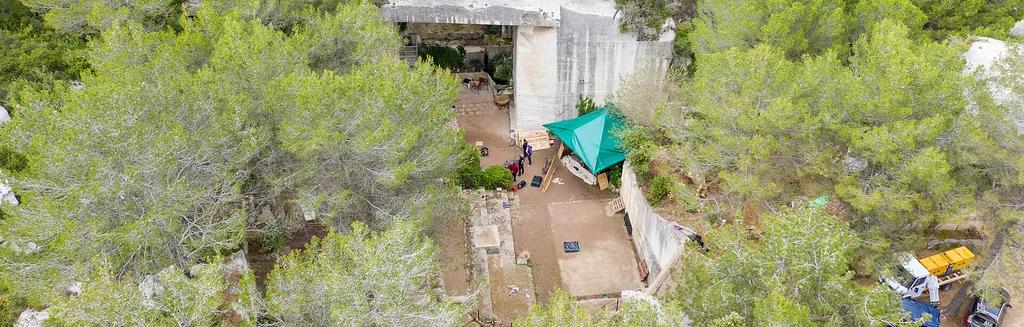
About fifty minutes from Gordes lies a range quite unlike the Luberon: the Alpilles. Smaller, drier, bristling with limestone crests of an almost blinding white, they trace a cinematic landscape between Saint-Rémy-de-Provence and the Baux valley. This is where Van Gogh painted his tormented olive trees, where the Romans built the city of Glanum, and where a village clings to a rocky spur so tightly that it seems to grow out of it. From Le Clos de Manon, we regularly send our guests off to explore this neighbouring land, which pairs beautifully with the hilltop villages of the Luberon.
The beauty of the Alpilles lies in how much they pack in: Saint-Rémy-de-Provence and Les Baux-de-Provence are only ten kilometres apart. In a single day you can string together one of the liveliest Provençal markets in the region, the asylum where Van Gogh painted his Wheatfield with Crows, striking Greco-Roman ruins, a village ranked among the most beautiful in France, and an immersive show inside former quarries. Here's how we suggest our guests organise this escape, without rushing and without missing a thing.
The Alpilles, wild sisters of the Luberon
Leaving Gordes to the south, you first cross the Calavon plain, then the Durance, before a line of jagged crests rises into view: the Alpilles. The range peaks at just 498 metres at Les Opies, but its bare rock makes it spectacular. There are no deep forests here as on the Grand Luberon, but garrigue, thyme, umbrella pines and olive trees as far as the eye can see. The light is harsher still, which explains why so many painters lingered here.
The area has been protected since 2007 within the Alpilles Regional Natural Park, which safeguards its farmland, its olive groves and its biodiversity — Bonelli's eagle and the eagle owl still nest here. For walkers it is a superb playground, but be warned: in summer the hills are often closed to visitors between 11 a.m. and late afternoon because of the fire risk. Always check the day before.
For our guests, the Alpilles have a special virtue: they offer a setting radically different from the Luberon while staying within easy reach of a morning's drive. It is one of the finest cards to play among our day trips from Gordes: 12 escapes across Provence, and surely the one most steeped in history and art.
Saint-Rémy-de-Provence: historic centre and Wednesday market
We begin the day in Saint-Rémy-de-Provence, a garden town nestled at the foot of the Alpilles. Its old centre, ringed by boulevards lined with plane trees, can be explored on foot in an hour. You wander between Renaissance townhouses, moss-covered fountains and antique shops. It is the birthplace of Nostradamus, born here in 1503, and the cradle of a certain Provençal art of living — elegant without ever being stiff.
If you can, plan your visit for a Wednesday morning: the Saint-Rémy market is one of the most renowned in Provence. It spills through the lanes and squares from 8 a.m., a feast for the senses:
- stalls of olives, tapenades and oils from the Baux valley;
- Alpilles goat cheeses, Arles sausage, seasonal fruit;
- Provençal fabrics, basketry, lavender and Marseille soap;
- a few producers of Alpilles and Baux wine offering tastings.
Our advice: arrive early, park in one of the outlying car parks, and treat yourself to a coffee on a terrace on Place de la République before diving into the crowd. It's the perfect moment to buy the makings of a midday picnic, to enjoy in the Alpilles or near Glanum.
Van Gogh at Saint-Paul-de-Mausole
On the southern edge of town, on the road to Glanum, lies the most moving spot in Saint-Rémy: the Saint-Paul-de-Mausole monastery. It was in this former convent, turned into a mental health clinic, that Vincent van Gogh committed himself voluntarily from May 1889 to May 1890, after the episode of the severed ear in Arles. There, in a modest room overlooking a field and a walled garden, he experienced an extraordinary creative outpouring.
In a single year the painter produced nearly 150 canvases here, among them The Starry Night, the Irises, and the blazing olive trees and cypresses that made his legend. Today you can visit the Romanesque cloister, the lavender garden and a reconstruction of his room. Along the path, reproductions placed at the very spot of each motif let you compare reality with the painter's brushstroke — a striking dialogue between landscape and canvas.
This stop echoes the region's other great Van Gogh chapter, that of Arles, which we tell in our article Arles, Van Gogh and the Camargue. The two towns complement each other: Arles for the creative fever and the colour, Saint-Rémy for the calm and the nature. Allow about an hour for the monastery visit, ideally in late morning when the light plays across the cloister.
The Glanum archaeological site
A stone's throw from the monastery, you step nineteen centuries back in time. Glanum is one of the most remarkable ancient sites in France. Even before entering the paid enclosure, you come upon "Les Antiques", two Roman monuments freely accessible and superbly preserved: a mausoleum from the 1st century BC, nearly 19 metres high, and a municipal arch, the oldest in Roman Gaul. They alone are worth the stop.
The site itself, excavated since the 1920s, reveals a city born of a Celto-Ligurian sanctuary around a sacred spring, later deeply Romanised. You stroll among:
- the thermal baths and their hypocaust heating system;
- the forum, the twin temples and the House of the Antes;
- the sacred spring at the foot of the Alpilles, the city's origin;
- the paved streets where you can still make out the ruts left by chariots.
Admission costs around €9 (free for under-18s), and the site is managed by the Centre des monuments nationaux. Allow an hour to an hour and a half, and good shoes: the ground is rocky and exposed. It's the perfect time for a picnic in the shade before heading on to Les Baux.
Les Baux-de-Provence, one of France's most beautiful villages
Ten kilometres further south, the road climbs towards one of the most spectacular sites in Provence. Les Baux-de-Provence, ranked among the most beautiful villages in France, clings to a rocky outcrop overlooking the valley. From a distance you can no longer tell carved stone from natural rock: the village and its castle seem to spring from the cliff. The very word "bauxite" — the aluminium ore discovered here in 1821 — comes from this place.
You leave the car in the car parks below (traffic is banned inside the village) and walk up through cobbled lanes lined with Renaissance houses, craft workshops and small shaded squares. Right at the top, the Château des Baux spreads its dramatic ruins across a windswept plateau: a keep, life-sized siege engines, and a 360° view over the Alpilles, the Crau and, on a clear day, all the way to the Camargue.
The village has only around twenty permanent residents but welcomes more than a million and a half visitors a year: it's best to arrive before 10 a.m. or after 4 p.m., especially in summer. You'll find opening times, prices and skip-the-line tickets on the official Les Baux-de-Provence tourist office website. Once the midday crowds have passed, the village settles into an almost unreal calm, bathed in golden light.
The Carrières des Lumières, an immersive show
Just below the village, in former limestone quarries with walls more than twenty metres high, hides one of the most striking experiences in Provence: the Carrières des Lumières. In this vast mineral vessel, hundreds of video projectors clothe the walls, floor and ceiling with animated artworks set to music. You wander freely, wrapped in colour, as though inside the paintings themselves.
Each year a major immersive exhibition is devoted to one or several masters — Van Gogh, Klimt, Vermeer, Cézanne, Picasso or Frida Kahlo, depending on the programme. The natural coolness of the quarries (around 14°C) also makes them a perfect refuge during the hottest hours of summer. Allow about 45 minutes for a screening, more if you let the show loop. An adult ticket is around €15; we strongly recommend booking your tickets on the official Carrières des Lumières website, as slots fill up fast in high season.
To our mind, it's the loveliest way to round off a day in the Alpilles: after the raw stone of the village and the history of Glanum, you treat yourself to a moment of pure art, out of time and out of the heat.
Olive oil and the vineyards of Les Baux (PDO)
The Baux valley is not merely a backdrop: it is also an exceptional terroir. The olive oil of the Baux-de-Provence valley holds a PDO (Protected Designation of Origin) that safeguards local varieties such as salonenque, béruguette and grossane. The nearby mills — around Maussane, Mouriès or Les Baux — offer tastings and visits, and you rarely leave empty-handed.
The wines of Les Baux-de-Provence, also PDO, are largely grown organically — remarkable for an entire wine region. Structured reds and delicate rosés go beautifully with Provençal cuisine. Several estates open their cellars for tastings along the road between Les Baux and Saint-Rémy: an ideal gourmet stop in late afternoon.
If the world of the olive tree fascinates you, we've devoted a whole guide to it: Provence olive oil, from mill to table. There you'll find how to recognise a good oil, when to visit the mills and which vintages to bring home from your stay. The table below sums up the essentials of a day in the Alpilles.
| Stop | Suggested duration | Indicative price | Best time |
|---|---|---|---|
| Saint-Rémy market (Wednesday) | 1 hr | Free | 8 a.m. – 9.30 a.m. |
| Saint-Paul-de-Mausole (Van Gogh) | 1 hr | ~ €7 | Late morning |
| Glanum site | 1 hr – 1 hr 30 | ~ €9 | Midday |
| Village & Château des Baux | 1 hr 30 – 2 hr | ~ €11 (castle) | 2 p.m. – 4 p.m. |
| Carrières des Lumières | 45 min – 1 hr | ~ €15 | 4 p.m. – 5 p.m. |
A suggested one-day itinerary from Gordes
Here is the plan we recommend to our guests for a smooth, complete day, setting out from Le Clos de Manon. The drive to Saint-Rémy takes about 50 minutes (around 45 km via the D900 then the A7 or the back roads), and the distance between Saint-Rémy and Les Baux is no more than a quarter of an hour.
- 8.30 a.m. — leave Gordes, coffee on the way;
- 9.15 a.m. — arrive in Saint-Rémy, market (on Wednesdays) and old centre;
- 11 a.m. — Saint-Paul-de-Mausole monastery, in Van Gogh's footsteps;
- 12.15 p.m. — picnic or lunch, then the Glanum site;
- 2.15 p.m. — drive to Les Baux, climb to the village and the castle;
- 4.15 p.m. — screening at the Carrières des Lumières;
- 5.30 p.m. — oil or wine tasting on the way back.
Outside Wednesdays, simply swap the market for a longer wander through Saint-Rémy or a morning tasting. In high season (July–August), reverse the order and start with Les Baux at opening time to beat the crowds, keeping the cool Carrières for the hottest hours. To place this excursion among all the possible escapes, see our pillar guide, Day trips from Gordes: 12 escapes across Provence.
Where to have lunch in the Alpilles
Food is an integral part of the experience. Depending on your pace and your budget, several options await you at midday:
- The picnic: put together at the Saint-Rémy market and enjoyed in the shade of an olive tree near Glanum — our favourite option in fine weather;
- The bistros of Saint-Rémy: shaded terraces around Boulevard Mirabeau, market cuisine and Provençal dishes at reasonable prices;
- The Baux valley: around Maussane and Le Paradou you'll find excellent regional tables, as well as Michelin-starred addresses for a special occasion.
An insider tip: book your restaurants ahead between May and September, especially for weekend lunch. And save a little room for the calissons, candied fruit and nougat found in the confectioners of Saint-Rémy — perfect for stretching the day out once you're back at the villa.
Making the Alpilles an escape from Le Clos de Manon
What makes this day so precious is the contrast: in the morning you leave the wooded gentleness of the Luberon for the raw stone of the Alpilles, and in the evening you return with your head full of images — a cloister where Van Gogh painted, a Roman arch in the midday light, a village suspended over the void, shifting frescoes in the belly of a quarry. This is exactly what we love to offer our guests: a central base, calm and comfortable, a ten-minute walk from Gordes, from which to radiate out across all of Provence without ever being back on the road for long.
To enjoy both the hilltop villages of the Luberon and the treasures of the Alpilles, we suggest a stay of five to seven nights. If this day appeals to you, you can already check our availability at Le Clos de Manon and build your own itinerary between art, stone and light. To plan your walks in the range, the Luberon Regional Natural Park website also remains a treasure trove of information on the trails and nature of the region.