There are days, in the Luberon, when you long to leave the hilltop villages and dry-stone paths behind for a moment and rediscover the bustle of a real town, its cafés beneath the plane trees and the elegance of a boulevard where time seems to stand still. Aix-en-Provence is exactly that interlude. Just an hour's drive from Gordes, the former capital of Provence unfurls its fountains, its grand mansions and its gourmet markets with a thoroughly southern nonchalance. It is the town outing we most often suggest to our guests when they want to vary the pleasures of a stay at Le Clos de Manon.
Aix is perfect to explore in a single day, without rushing. The historic centre is pedestrian, compact and full of light: you wander from one fountain to the next, from a painter's studio to a shaded terrace, and you come home in the evening with the sense of having tasted another Provence, more urban and refined than the one of the hills. Here, from experience, is how we suggest you go about it.
Aix-en-Provence, the historic capital of Provence
Founded by the Romans in 122 BC under the name Aquae Sextiae, "the waters of Sextius", Aix owes its very existence to its thermal springs. This vocation as a town of water shaped its face: the fountains that punctuate its squares are beyond counting, so much so that the town is nicknamed "the town of a thousand fountains". The golden stone, the ochre façades and the tall plane trees give the whole a gentleness that is immediate and unmistakable.
In the Middle Ages and the Renaissance, Aix became the capital of the County of Provence and the seat of the Parlement. It is from that golden age that its splendid private mansions date, with their sculpted portals and their stone atlantes. The town was also a great intellectual and artistic centre, and it has kept that scholarly atmosphere: an ancient university, bookshops, festivals and a dense cultural life for a town of its size. To delve deeper into the city's history, the Wikipedia page devoted to Aix-en-Provence offers a thorough and well-documented overview.
What strikes you on arrival is the balance. Aix has neither the sprawl of Marseille nor the frozen quaintness of a postcard village. It is a town on a human scale, lively and elegant, where you pass without transition from a market buzzing with voices to the quiet of a cloister. For anyone staying in the Luberon, it is the perfect counterpoint to the nature and silence of the hilltop villages.
The Cours Mirabeau and its plane trees
If Aix has a backbone, it is surely the Cours Mirabeau. This broad avenue, laid out in the 17th century and about 440 metres long, separates old Aix from the Mazarin quarter and concentrates the entire Aix art of living in one place. Four rows of century-old plane trees form a vault of foliage that filters the light in summer; below, café terraces, bookshops and ice-cream parlours follow one another in a cheerful jumble.
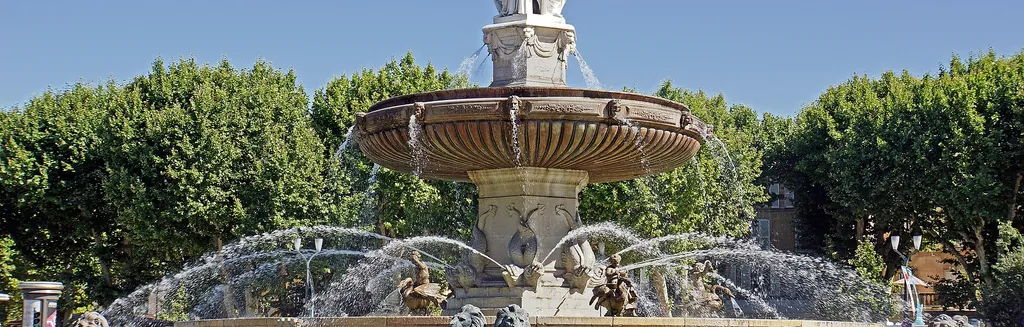
It is here, on the Cours, that Aix locals and visitors alike come to sit and watch the world go by. The famous brasserie Les Deux Garçons, once frequented by Cézanne and Zola, long embodied this tradition. The Cours is dotted with fountains, the most monumental of which, the Rotonde fountain, marks its western entrance: an imposing basin from 1860 crowned with three allegorical statues, and the natural meeting point of the whole town.
A few fountains stand out along the Cours and are well worth a look:
- the Rotonde fountain, at the western entrance, the very picture postcard of Aix;
- the mossy fountain, covered in moss and fed by a warm spring, halfway along;
- the King René fountain, which pays tribute to the Count of Provence and his love of muscat, at the eastern end.
Our tip: begin your day with a leisurely stroll up the Cours, coffee in hand, before the bustle is in full swing. It is the loveliest possible introduction to the town.
In the footsteps of Paul Cézanne: the studio and the Terrain des Peintres
Aix is inseparable from Paul Cézanne, born here in 1839 and who painted here until his death in 1906. The town and its surroundings were his open-air studio, and the Sainte-Victoire mountain, which he depicted dozens of times, has become its pictorial emblem. To walk through Aix is to follow, often without realising it, in the footsteps of the father of modern painting.
The most moving place remains the Lauves studio, on the hill north of the centre. Cézanne had it built in 1902 and worked there in his final years. The studio has been preserved almost intact: the great glass roof, the familiar objects, the skulls, the bottles and the draperies that made up his still lifes are still there, as if the painter had just stepped out. The visit, intimate, lasts a good hour and must be booked in advance. You will find opening times and tickets on the Aix-en-Provence tourist office website.
A few minutes' walk from the studio, the Terrain des Peintres is a landscaped terrace from which Cézanne set up his easel to capture the Sainte-Victoire. The view, on a clear day, is striking: the limestone mass of the mountain stands out against the sky, exactly as he painted it. Admission is free, and it is one of our favourite stops for understanding, on the spot, the painter's eye. Enthusiasts can carry on to the Bibémus quarries, another great Cézanne site with spectacular ochres, reachable by shuttle from the centre.
The old town, the fountains and the Mazarin quarter
North of the Cours Mirabeau lies Old Aix, a maze of pedestrian lanes, little squares and fountains where it is a pleasure to lose yourself. You emerge onto the Place d'Albertas, a delightful 18th-century setting with its central fountain, one of the most photographed in town. Further on, the Place de l'Hôtel de Ville, dominated by the clock tower and its belfry, hosts the flower market and sums up, all on its own, the grace of Aix.
On the other side of the Cours, the Mazarin quarter offers a striking contrast. Laid out to a strict grid in the 17th century, it lines up its private mansions and quiet streets around the delicate Fountain of the Four Dolphins, another emblematic image of Aix. It is the quarter of collectors and art lovers, more hushed, ideal for a late-morning walk. You will also find several remarkable museums and mansions there.
A few must-see stops along the way:
- the Place d'Albertas and its fountain, a jewel of the 18th century;
- the Place Richelme, where a lively food market is held every morning;
- the Fountain of the Four Dolphins, at the heart of the Mazarin quarter;
- the sculpted portals of the private mansions on Rue Mazarine and Rue du 4-Septembre.
The markets of Aix: Provençal, flowers and flea market
If there is one moment when Aix is at its best, it is on the morning of a market day. On Tuesdays, Thursdays and Saturdays, the great Provençal market spreads across the Place des Prêcheurs and the Place de la Madeleine: olives, goat's cheeses, tapenades, seasonal fruit, herbs of Provence and soaps vie for space on the stalls in a gourmet hubbub. It is the dream spot to put together a picnic basket before heading back into the Luberon.
On those same days, the Place de l'Hôtel de Ville turns into a flower market, splashes of colour at the foot of the belfry. Every morning, the Place Richelme hosts a smaller food market, in the shade of the plane trees, perfect for sampling local produce. And on Saturdays, bargain-hunters keep an eye on the flea market on the Cours Mirabeau and the Place de Verdun, where you can unearth faience, antique linen and Provençal furniture.
Our insider tip: arrive around 9 am, as the producers are finishing setting up their stalls and the light is still soft. You will avoid the midday crowds and enjoy the market in the best conditions. If you love Provençal markets, know that other nearby villages have superb ones too: we list them in our guide to day trips from Gordes: 12 escapes in Provence.
Museums and heritage: Granet, Saint-Sauveur cathedral
Aix boasts a first-rate museum heritage. The Granet museum, housed in a former priory in the Mazarin quarter, holds a remarkable collection ranging from the primitives to the moderns, with several Cézannes and works by Giacometti, Picasso and Léger from important donations. Painting lovers will easily spend one to two hours there. Its annexe, the Chapelle des Pénitents blancs (Granet XXe), presents part of the Planque collection, rich in modern art.
As for religious heritage, the Saint-Sauveur cathedral is a veritable book of architecture in its own right: under a single roof you can read Romanesque, Gothic and Baroque elements, as well as a 5th-century early Christian baptistery and a Romanesque cloister of great refinement. The famous triptych of the Burning Bush by Nicolas Froment, a 15th-century masterpiece, is kept there. Admission is free, and the calm of the cloister offers a welcome pause after the bustle of the markets.
For families or science enthusiasts, the Hôtel de Caumont – Art Centre, a magnificently restored private mansion, puts on high-quality temporary exhibitions each year, in a setting that is worth the visit in itself. Plenty to round off a day in Aix without ever growing bored.
Where to lunch and what to bring home (calissons)
Lunch is part of the pleasure of a day in Aix. For a quick, sunny break, the terraces of the Cours Mirabeau and the Place Richelme are perfect; for a more refined meal, the Mazarin quarter and the lanes around the Place des Cardeurs are full of quality bistros. Expect to pay around €18 to €28 for a main course in a good restaurant in the centre, more for a gourmet table. If you are after excellence on your return to the Luberon, we have gathered our favourite addresses in our selection of the best restaurants in the Luberon.
You cannot leave Aix without bringing home its famous calissons. This shuttle-shaped confection, made of candied melon, almonds and almond paste, finished with a fine royal icing, has been the town's emblematic speciality since the 15th century. Several historic houses compete for them in the centre, and most offer factory tours nearby. It is the ideal gourmet souvenir, which keeps well and always brings pleasure.
A few treats and products to slip into your basket:
- some calissons d'Aix, in their traditional box;
- olive oil and tapenades from the Provençal market;
- a bar of Marseille soap or a scented soap, the perfect souvenir;
- a bottle of Coteaux d'Aix-en-Provence wine or a Provence rosé.
How to get to Aix from Gordes and where to park
From Gordes, Aix-en-Provence can be reached in about an hour's drive, for some 75 kilometres. You have two options: the quickest route goes through Cavaillon and then the motorway (A7 then A51); the prettiest takes the country roads through the Durance valley, slower but dotted with Provençal landscapes. Either way, the journey is comfortable and well signposted.
Since the historic centre is entirely pedestrian, it is best to give up on driving into it. The simplest solution is to park in one of the centre's multi-storey car parks (Rotonde, Mignet, Carnot, Pasteur) or to use a park-and-ride on the outskirts, connected to the heart of town by a regular shuttle. Expect to pay around €2 to €3 an hour in a covered car park. Once parked, everything is a few minutes away on foot.
| Route from Gordes | Distance | Approximate time |
|---|---|---|
| By motorway (A7 / A51) | ≈ 75 km | ≈ 1 hr 00 |
| By country roads (Durance) | ≈ 65 km | ≈ 1 hr 15 |
| Covered car park | — | ≈ €2–3 / hour |
To set Aix back in its natural setting, the town lies at the gateway to the Sainte-Victoire massif and close to the Luberon Regional Nature Park, part of which you cross on the way from the villa. A lovely way to measure the variety of landscapes you can take in over a single day.
Combining Aix with other escapes
Aix is more than enough on its own for a day, but its position in the southern Luberon also makes it an excellent gateway towards the coast. About thirty minutes south, you reach the sea: the perfect chance to follow up, on another day, with a trip to Cassis and the Calanques from the Luberon, where the turquoise waters and white cliffs offer a complete contrast to the golden stone of Aix.
To stay in the register of beautiful Provençal towns, we also recommend a day around Saint-Rémy-de-Provence and Les Baux, to the west, which share with Aix the same art of living, between heritage, markets and light. And to plan all your day trips, our pillar guide to day trips from Gordes: 12 escapes in Provence details distances, times and the best seasons for each destination.
A final word on the season. Spring (April to June) and early autumn (September) are our favourite times for Aix: the light is beautiful, the terraces pleasant and the crowds quieter than in high summer, when the famous lyric art festival enlivens the town in July. Winter, quieter still, also has its charm for wandering the lanes and enjoying the museums.
| Season | Atmosphere | Our take |
|---|---|---|
| Spring (Apr–Jun) | Soft light, terraces, lively markets | Ideal |
| Summer (Jul–Aug) | Heat, lyric festival, crowds | Lively but busy |
| Autumn (Sep–Oct) | Mildness, grape harvest, golden light | Excellent |
| Winter (Nov–Mar) | Calm, museums, the authentic town | Peaceful |
Making Aix an escape from Le Clos de Manon
Aix-en-Provence is, for us, the perfect urban breather in the middle of a stay in the Luberon. You set off from the villa in the morning, stroll along the Cours, follow in Cézanne's footsteps, lunch on a terrace and come back in the evening, market basket and box of calissons under your arm, to rediscover the calm of Gordes and the cool of the heated pool. That is the whole appeal of a central base like ours: you can roam all over Provence without ever spending long on the road.
To make the most of Aix and all the escapes around it, we recommend a stay of five to seven nights, which leaves time to alternate between towns, hilltop villages, markets and coast. If this Provençal day appeals to you, you can check our availability at Le Clos de Manon right now and plan your escape.