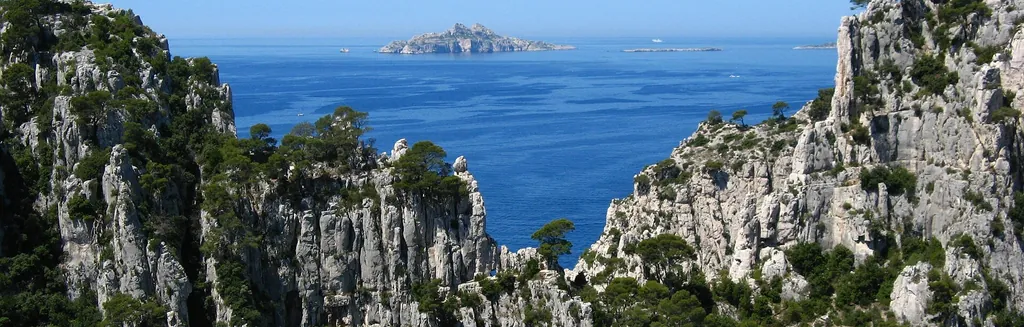
There comes a moment, on any Luberon holiday, when the longing for the sea becomes impossible to resist. You have wandered the hilltop villages, tasted the local wines, walked between vineyards and lavender, and then one morning the sky is so blue that your thoughts turn to the Mediterranean. The good news is that it is never far away: from Le Clos de Manon, a ten-minute walk from Gordes, it takes just 1 hr 15 by road to plant your parasol facing the Calanques of Cassis and Marseille, those white limestone fjords that plunge into water of an almost unreal turquoise.
We regularly take our guests out to this spectacular stretch of coast, and over the seasons we have learned how to enjoy it without enduring the crowds or the crushing heat of high summer. So let's head south: here is our complete guide to discovering Cassis, its fishing harbour, its legendary calanques – Port-Miou, Port-Pin, En-Vau – and the great city of Marseille, with its Old Port, its Bonne Mère and its bouillabaisse, all by setting off in the morning and returning to Provençal calm in the evening.
Heading south: the Mediterranean from the Luberon
From Gordes, the road runs south on the A7 then the A50, and in under an hour and a quarter the landscape shifts: the ochre hills give way to maritime pines, to denser cicadas and to that scent of sea air that announces the coast. This is one of the great privileges of a Luberon stay: you enjoy the calm of the back country while keeping the coast within a half-day's reach. For many of our guests, it turns out to be the finest day of the whole holiday, the one that pairs garrigue with a swim.
The Calanques area stretches for almost twenty kilometres between Marseille and Cassis, within the Calanques National Park, created in 2012 and the first peri-urban national park in Europe. That status protects an extremely fragile coastline under considerable pressure – close to three million visitors a year. It also means strict access rules in high season, which we set out further down, because they are well worth knowing before you set off.
This seaside escape fits naturally into our guide to day trips from Gordes: 12 escapes across Provence, which brings together all our ideas for days out from the villa. The Calanques feature there as the quintessential "big blue" outing, one to save for a beautiful day in spring or early autumn.
Cassis, fishing harbour and AOC vineyard
Even before the calanques, there is Cassis. This little harbour, tucked between Cap Canaille – one of the highest sea cliffs in France, rising to 394 metres – and the entrance to the massif, is one of the prettiest fishing ports on the Provençal coast. You stroll along the quay, between brightly painted boats and restaurant terraces, watch the fishermen bring in their nets, and quickly understand why so many painters, from Matisse to Dufy, came here to set up their easels.
Cassis is also one of the oldest AOC vineyards in France, classified as early as 1936. Its dry, mineral whites, made from marsanne, clairette and ugni blanc, go beautifully with seafood. Several estates, clinging to the amphitheatre of slopes above the town, offer tastings with a sea view. It's a stop we love to slip in late in the morning, before or after the calanques.
Here, in practical terms, is what we recommend you not miss in Cassis:
- the harbour and its quays, perfect for a coffee or a lunch of grilled fish;
- the Grande Mer beach, right in the centre, handy for a quick dip;
- the Route des Crêtes towards La Ciotat, which hugs Cap Canaille with dizzying views over the coast;
- a tasting at one of the estates of the Cassis appellation.
To plan your visit, the Cassis tourist office publishes shuttle timetables, the open or closed status of the massifs and harbour webcams – invaluable information in peak season.
The Calanques: Port-Miou, Port-Pin, En-Vau
The three calanques closest to Cassis form a natural progression, from the most accessible to the wildest. You can link them on foot along the trail that starts at the end of the harbour, provided you have good shoes and plenty of water.
Port-Miou is the first, the longest and the gentlest. It's a former stone-quarrying fjord, now a natural harbour where hundreds of boats lie at anchor. The path is flat and shaded, and you reach it in around twenty minutes from Cassis. It isn't really a swimming calanque, but the mineral setting, with its streaked white walls, already sets the tone.
Port-Pin comes next, after another half-hour of walking. More intimate, fringed with Aleppo pines that run right down to the water, it shelters a small beach of pebbles and sand where the shallow water takes on emerald hues. It's our favourite for a family swim, as it stays accessible without any technical difficulty.
En-Vau, finally, is the star, the one on every postcard: a narrow cleft framed by cliffs more than a hundred metres high, closed off by a beach of pale pebbles and water of a striking turquoise. It has to be earned: allow around 1 hr 30 of walking from the Gardiole car park, with a steep, slippery descent at the end. The effort is repaid a hundredfold. If swimming in crystal-clear water appeals to you more widely during your stay, our article on the most beautiful swimming spots in the Luberon is the ideal complement to this day by the sea, with inland bathing spots.
Exploring the calanques by boat, by kayak or on foot
There isn't one right way to discover the calanques, but several, each with its own merits. The choice depends on your fitness, the season and how keen you are to swim.
By boat is the most relaxing and the most panoramic option. Leaving from Cassis harbour, guided excursions take you along 3, 5, 8 or 9 calanques depending on the package, in 45 minutes to 2 hours. You admire the cliffs from the water and slip into the inlets, but these boats generally don't land: it's a visual discovery, perfect in fierce heat or with young children. Reckon on around €18 to €30 per adult depending on the length.
By sea kayak, the experience is more active and more free. You paddle at the foot of the cliffs, stop to swim in a deserted inlet, land on En-Vau beach from the water. Rental outfits offer guided half-day trips. To our mind, it's the finest way to experience the calanques when the sea is calm.
On foot, finally, is free and immersive, but demanding. The trails are stony, with little shade and sometimes closed in summer for wildfire risk. A few golden rules:
- set off early in the morning, before the heat and the crowds;
- carry at least 1.5 to 2 litres of water per person;
- wear proper walking shoes, never flip-flops;
- check the massif opening status the day before, as it depends on the weather and the wildfire risk.
All the official information – maps, daily risk levels, safety rules – is published by the Calanques National Park, which should always be checked before a summer hike.
Marseille in a day: the Old Port, Notre-Dame-de-la-Garde, the MuCEM
If the sea is calling but you prefer the city to the trails, Marseille is worth a whole day in its own right. France's oldest city, founded by the Greeks 2,600 years ago, gives off a unique energy, Mediterranean and cosmopolitan. Its heart is the Old Port, where every morning you can watch the little fish market beneath the mirror canopy designed by Norman Foster.
From there you climb – on foot, by little tourist train or by bus – up to the basilica of Notre-Dame-de-la-Garde, the "Bonne Mère" who watches over the city from her hill. The 360° view over the bay, the Frioul islands and the Château d'If is one of the most beautiful in all of Provence. It's an absolute must, ideally at the end of the afternoon for the golden light.
Below it, the MuCEM (Museum of European and Mediterranean Civilisations), opened in 2013, has become the emblem of the city's renewal. Linked to Fort Saint-Jean by an elevated walkway, its latticework concrete building converses with the sea. Even without going into the exhibitions, the free walk across the rooftops and gangways is worth the detour. Marseille is easy to explore in a day if you focus on a few key sights rather than trying to see everything.
Le Panier and a proper bouillabaisse
No Marseille day is complete without a wander through Le Panier, the city's oldest quarter. Sloping lanes, colourful façades, washing strung from windows, street-art murals and small shaded squares: you lose yourself there with delight. La Vieille Charité, a 17th-century former almshouse turned cultural centre, is its architectural jewel.
At the table, Marseille means bouillabaisse, the fishermen's dish that became a legend. The real thing, served in two stages – the saffron broth with rouille and croutons, then the rockfish – takes time and a certain budget. Best to book it at a serious restaurant that has signed the bouillabaisse charter, where it often has to be ordered the day before. Here are a few budget benchmarks for a day in Marseille or Cassis, as a guide:
| Item | Indicative budget (per person) |
|---|---|
| Calanques boat excursion | €18 to €30 |
| Kayak rental (half-day) | €30 to €45 |
| Fish lunch, Cassis terrace | €25 to €40 |
| Traditional bouillabaisse in Marseille | €55 to €75 |
| Parking (all-day car park) | €15 to €25 |
To dig deeper into the history and geography of the calanques, the encyclopaedic article on the Calanques National Park on Wikipedia gives an excellent overview of their geological formation and protected wildlife.
Access, shuttles and parking (National Park rules)
This is the most important thing to plan for, because the rules have changed a great deal in order to protect the massifs. In summer (June to September), access to the calanques on the Marseille side is tightly controlled: the Sormiou and Morgiou roads are closed to cars, and some massifs close completely on days of high wildfire risk, graded according to an alert map updated each evening for the following day.
On the Cassis side, the paid Gardiole car park, the starting point for Port-Pin and En-Vau, fills up quickly by mid-morning in season. Our concrete recommendations:
- arrive very early (before 9 am) or opt for a boat trip that does away with parking altogether;
- favour the sea shuttles and park-and-ride sites where they exist;
- in Marseille, use the metro and bus rather than the car in the city centre;
- always check the massif access map the day before your hike.
Out of season, from early autumn to spring, access is much simpler: the roads are open, parking is easier and the trails are rarely closed. It's one of the reasons we so often advise our guests to avoid the height of summer.
Best season and tips for beating the crowds
The calanques can be visited almost all year round, but not every season is equal. Here is our reference table, based on our guests' experience:
| Period | Water temperature | Crowds | Our take |
|---|---|---|---|
| April – May | 15 to 18 °C | Moderate | Flowering garrigue, open trails, ideal light |
| June | 19 to 22 °C | Rising | Excellent compromise before high season |
| July – August | 23 to 25 °C | Very heavy | Heat, crowds, massifs often closed |
| September | 22 to 24 °C | Easing | The best month: mild sea, calm restored |
| October | 18 to 21 °C | Light | Swimming still possible, peaceful trails |
Our most precious advice comes down to two words: early and off-season. Arriving in Cassis before 9 am transforms the day: the harbour is peaceful, the trails empty, and the low light sublimates the white cliffs. By contrast, a Saturday in August at midday can turn into an obstacle course. By choosing May, June, September or weekday mornings, you'll rediscover the wild spirit of the calanques that the very first hikers were already seeking.
Heading back to Gordes in the evening
One of the pleasures of this escape is the return. After a day of salt and sun, you take the road north again, and the landscape reverses once more: the sea disappears, the pines give way to vineyards and cypresses, and at dusk you find again the gentleness of the Luberon. In 1 hr 15 you're back at Le Clos de Manon, where the heated pool soothes legs tired by the trails.
If you love these "by the sea" days out from the villa, know that other towns in the South lend themselves to the same game. Our article on visiting Aix-en-Provence from Gordes offers a more urbane, refined variation, halfway between the Luberon and the coast – a lovely alternative on mistral days, when the sea is too rough for the calanques.
Making the Calanques an escape from Le Clos de Manon
Setting off to discover the Calanques of Cassis and Marseille means treating yourself to the best of both Provences: the turquoise sea of the limestone fjords and the calm of the back country where you come back to sleep. From Le Clos de Manon, a ten-minute walk from Gordes, this big-blue day slips naturally between two explorations of hilltop villages, without ever having to pack your bags.
That is the whole point of a central, peaceful base: you range far by day and come home to quiet in the evening. To live this mosaic of Provençal experiences, we recommend a stay of five to seven nights. If the idea tempts you, you can already check our availability at Le Clos de Manon and start planning your getaway between garrigue and Mediterranean.