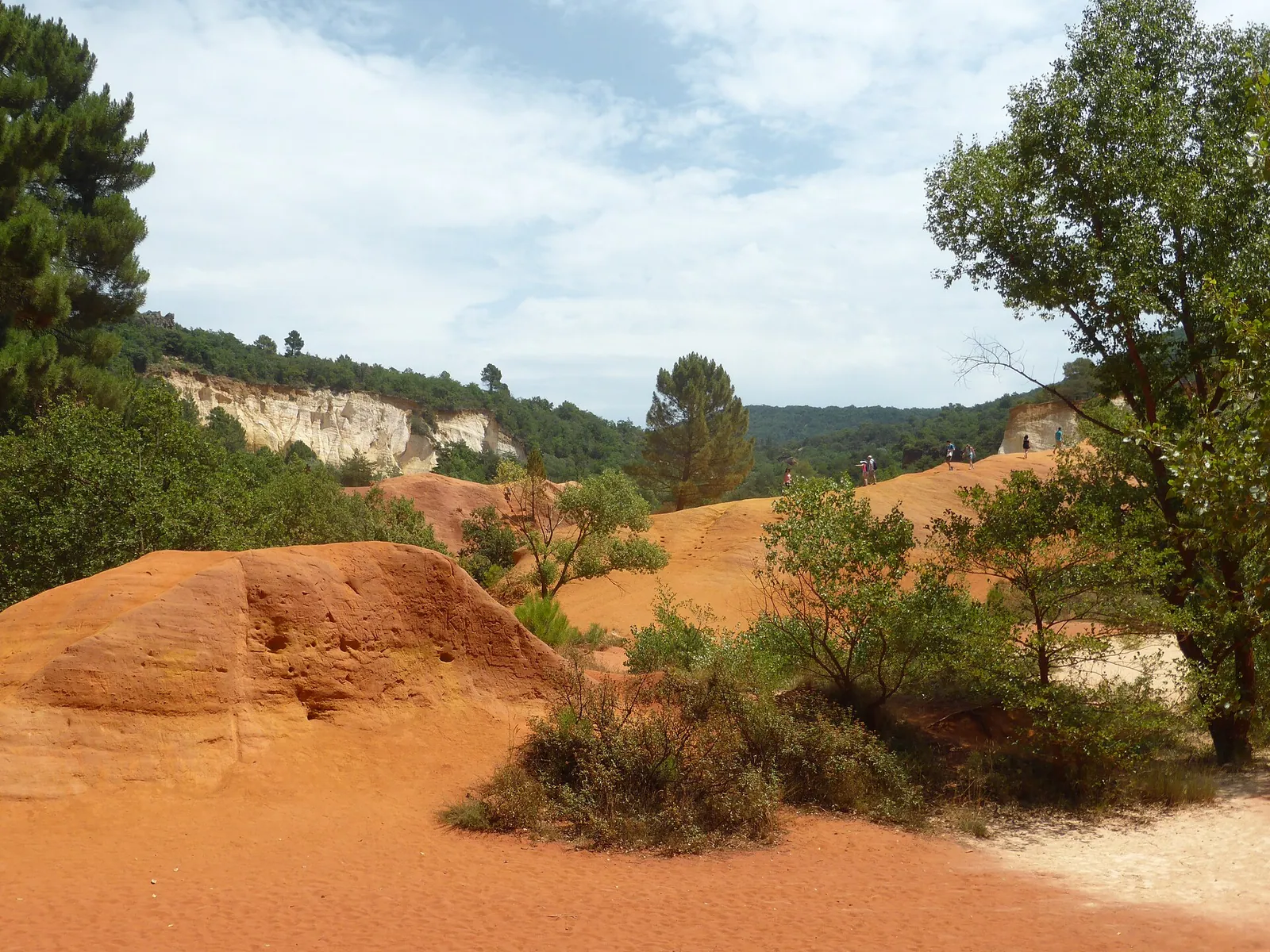
It is known as the "Colorado Provençal," and the nickname is well earned. In the eastern Luberon, in the village of Rustrel, former ochre quarries have shaped a landscape that seems to have wandered in from the American West: fairy chimneys, cliffs edged with white, red sands, miniature canyons and pine groves clinging to the ridges. Here there are no longer just a few shades of ochre but a full palette, from chalky white to blood red, taking in every yellow and violet in between. Just a thirty-minute drive from Gordes, it is one of the loveliest family walks we recommend to our guests. Here is how to make the most of it.
An ochre desert made by human hands
Contrary to what you might imagine on arrival, this almost unreal scenery is not the work of nature alone. The Colorado Provençal is a former mining site: for nearly a century, until the mid-twentieth century, ochre was extracted here to make pigments, which were washed and then shipped all over the world. Workers dug, carved and shifted whole mountains of coloured sand. Rain, wind and runoff did the rest, sculpting what we see today.
The result spans some thirty hectares and is made up of several spectacular settings: the Sahara, a vast amphitheatre of golden sand; the fairy chimneys, slender columns each capped with a hat of stone; and the area known as the White Desert, where the ochre fades into pale, lunar tones. It is this contrast between deep red and white that sets Rustrel apart from the other ochre sites in the region.
The waymarked loops: short or long
The site is explored along laid-out, waymarked trails starting from the main car park. Two main loops shape the visit, and you can tailor your route to your mood as much as to the ages of the walkers.
- The short loop (often called the "Sahara loop") takes about 45 minutes to 1 hour. It heads straight for the great sand amphitheatre and the first fairy chimneys. It is ideal with young children or for a quick visit.
- The long loop (the "Belvédères loop") amounts to roughly 1.5 to 2 hours of walking. It climbs onto the ridges, links viewpoint after overlooking viewpoint and lets you take in the whole site, from the red cliffs to the white expanses.
- A few climbs and narrow passages punctuate the long loop, but nothing technically difficult. Good walking shoes are more than enough.
Our hosts' tip: if you can, take the long loop. The upper viewpoints offer the most striking perspectives, the spots where a single glance takes in the full sweep of this colourful chaos. Allow a good half-day so you are not rushing.
Shoes that don't mind a little ochre
A word of warning that every regular knows: ochre stains, and it lasts. The red sand works its way into soles, seams and the bottoms of trouser legs. Steer clear of pristine white trainers and any light-coloured clothing you care about. Better to wear shoes you don't mind seeing turn red: they will keep a little souvenir of Rustrel for a long time. In wet weather the ground turns slippery and the clay clings to your soles, so it is best to put the walk off for another day.
Practical info: parking, hours and seasons
You reach the site through a paid car park laid out at the entrance, where the waymarked trails begin. Parking along the surrounding roads is forbidden and often ticketed, so use the official car park, which is also where everything is organised.
- When to come. Spring and autumn bring soft light and mild temperatures. In summer, set off early in the morning or late in the afternoon: shade is scarce and the heat reflected off the sand can be intense.
- The light. As everywhere in the ochre lands, the low, raking light of morning and evening sets the colours ablaze. These are the hours when photographers capture their finest shots.
- Bring water, a hat and sunscreen. There is almost no shade at all along the sandy stretches.
- Stay on the trails. The site is fragile and erosion threatens the fairy chimneys. The waymarking protects the landscape as much as the visitors.
The Colorado Provençal slots naturally into a day devoted to the outdoors. To help you plan yours, we have gathered our ideas for outdoor activities in the Luberon, from ochre trails to cool rivers.
Making more of your day around Rustrel
Rustrel lies in the eastern part of the massif, near Apt and the Pays d'Aigues. The area lends itself wonderfully to active days, and the ochre desert is only a starting point. For those who love to pedal, the Luberon by bike along the Calavon cycle route links Apt and the neighbouring villages on a gentle, shaded greenway. Anyone after a touch of freshness might prefer a canoe and kayak descent on the Sorgue, perfect for hot days. And climbers will be in their element on the climbing cliffs of Buoux, one of the region's legendary sites.
If you would rather stay on the theme of coloured lands, Rustrel pairs beautifully with a visit to Roussillon and the Ochre Route, further to the west. You can put together a whole day around the pigment, from the blazing cliffs of Roussillon to the lunar desert of Rustrel.
Your ideal base for exploring the ochre lands
The beauty of a stay in Gordes is setting down your bags in the heart of the Luberon and roaming freely. From Le Clos de Manon, the Colorado Provençal is barely thirty minutes away: enough to set off early in the morning for the golden light, walk through the Provençal Sahara, then come back to cool off in the heated pool during the hottest hours. It is this unhurried rhythm — wide-open spaces in the morning and ease in the afternoon — that makes our stays so restful. If a week spent exploring the ochre lands and hilltop villages tempts you, check our availability and book your stay: Rustrel will be just one stop among many right outside your door.