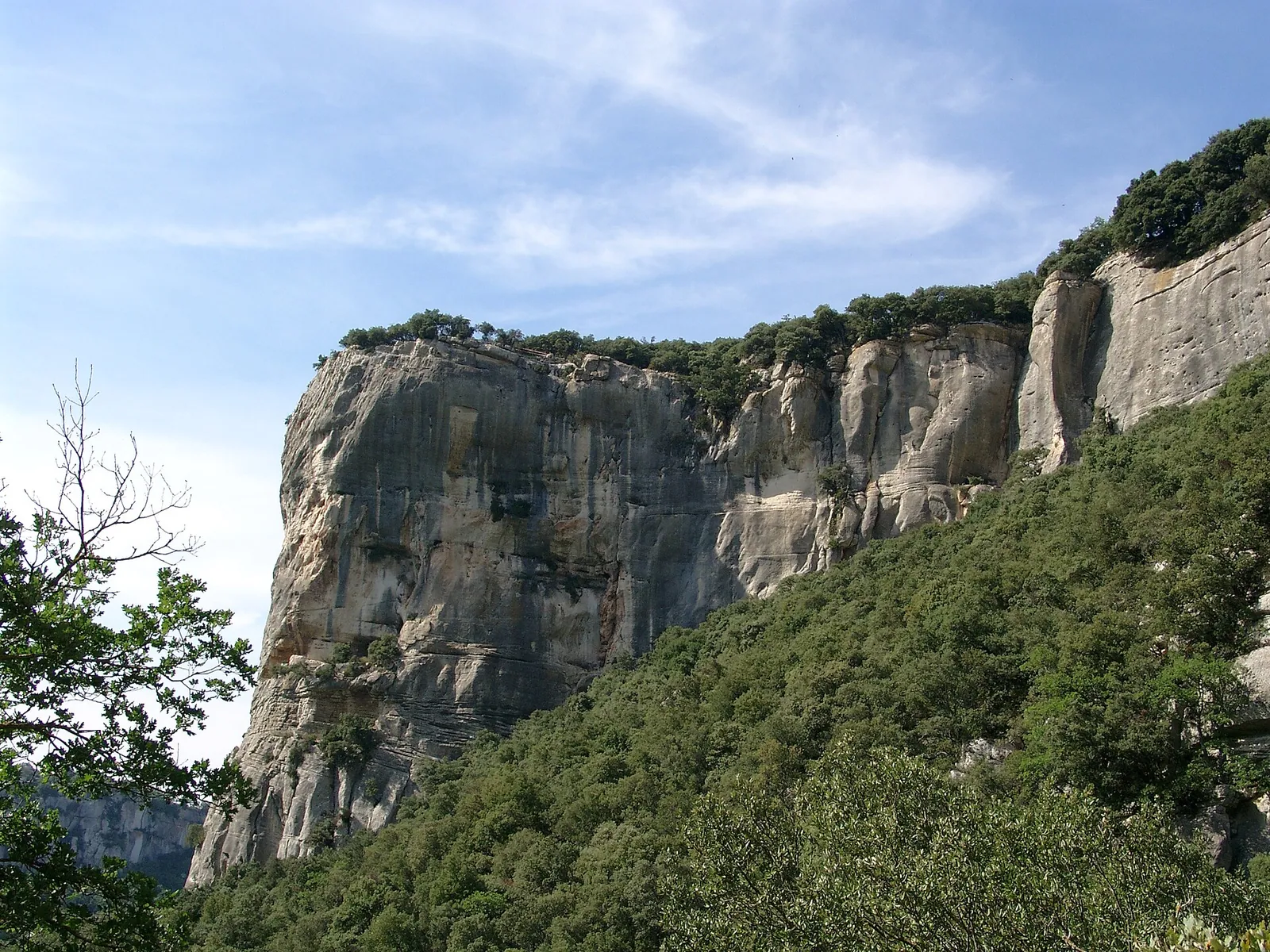
Some names make climbers' eyes light up the world over, and Buoux is one of them. Tucked into a fold of the Luberon, about forty minutes' drive south of Le Clos de Manon, this wild valley is home to one of the most legendary cliffs in French climbing. It was here, in the 1980s, that an entire generation of climbers rewrote the limits of what was possible and pushed difficulty into the realm of the very highest level. But Buoux is not only a shrine for the elite: you'll also find accessible routes, a one-of-a-kind atmosphere and a breathtaking rock setting. Here's what our climbing guests should know before slipping their shoes into the chalk bag.
Why Buoux is a legendary crag
The cliff rises above the Aiguebrun valley, the only permanent watercourse in the massif, in a setting of golden limestone walls that stand amid the holm oaks and the garrigue. This limestone is special: compact, sculpted with water droplets, tiny crimps, clean pockets and the long overhangs that built the site's reputation. It was on this rock that some of the most famous routes in climbing history were born, including the celebrated "La Rose et le Vacherin," first climbed in 1985 and long regarded as an absolute benchmark of the extreme grades.
Beyond the performance, it's the atmosphere that stays with you. Buoux is a place steeped in history, almost an open-air museum of climbing, where you still meet enthusiasts who have come from all over Europe to touch the rock their heroes once climbed. The silence of the valley, the cool shade at the foot of the walls, the light sliding across the stone at the end of the day: you quickly understand why so many climbers return here year after year.
The sectors and the grades
The cliff stretches over several hundred metres and breaks down into numerous sectors, each with its own character. On the famous historic side, you'll find the great overhangs and hard routes that built the legend of the place — demanding and technical. But other stretches of cliff offer more vertical, more welcoming pitches, perfect for anyone who wants to climb without chasing pure performance.
- For beginners and intermediate climbers: there's plenty of fun to be had at accessible grades, on short, well-bolted routes. It's a great place to discover pocketed limestone, very different from indoor gyms.
- For seasoned climbers: the heart of the site, with its overhangs and endurance routes, remains an exceptional playground where you can spend entire days working a project.
- Climbing style: crimps, pockets, precise moves and careful reading of the rock. Buoux rewards technique and finesse more than brute strength.
A recent guidebook is essential to find your way around: the bolting evolves, some routes are re-equipped, and knowing the sectors in detail will save you hours of searching. If climbing is just one string to your outdoor bow, take a look at our ideas for outdoor activities in the Luberon to put together a varied week.
The Fort de Buoux, just above
Even if you're not a climber, the valley is worth the trip for the Fort de Buoux, a troglodyte fortress perched on a rocky spur overlooking the Aiguebrun. Inhabited since prehistoric times, fortified in the Middle Ages and then dismantled under Louis XIV, the site combines staircases carved into the rock, silos, dwellings hollowed out of the stone and a striking panorama over the valley. It's a short but spectacular visit, ideal for the non-climbers in the family while the others are at the foot of the cliff. Bring good shoes: the access climbs and some passages are carved straight into the rock.
The right season to climb at Buoux
This is probably the most important piece of advice we give our climbing guests: Buoux is best climbed in the shoulder seasons and in winter. The cliff is mostly exposed to the sun and the limestone heats up quickly; in the height of summer, conditions soon become stifling and the holds turn slippery with sweat.
- Spring and autumn: the prime time. Mild temperatures, cool rock in the morning, magnificent light. March–April and October–November are our favourite windows.
- Winter: on dry, sunny days, conditions can be ideal, with cold rock that "grips" well. It's a season prized by experienced climbers.
- Summer: save it for the very first hours of the day, or skip it altogether. Better then to swap your climbing shoes for a swim in a Luberon river or lake, far more refreshing.
Keep the regulations in mind too: from June to September, access to the Vaucluse's forested massifs may be restricted depending on the wildfire risk, and some stretches of cliff are subject to seasonal closures to protect nesting birds of prey. We always brief our guests on current conditions before they set off.
Our hosts' tips for a great day out
- Access: the car park sits at the end of a small road from the hamlet of Buoux; allow a short approach walk to the foot of the sectors, about a 35-minute drive from Le Clos de Manon.
- Gear: a rope of at least 70 metres and a good dozen quickdraws for the longest routes. As the rock has been polished by decades of traffic, check your equipment.
- Water and a picnic: there are no supplies on site. Bring enough to last the day; the hamlet of Buoux and the neighbouring village stay modest.
- Respect for the site: Buoux is fragile and busy. Stay on the paths, take your litter home and avoid cleaning out the holds.
And if you're looking to mix things up between two days of climbing, the Luberon is full of ideas: from the air, a hot-air balloon flight over the Luberon offers an unforgettable perspective on the cliffs and the hilltop villages.
Your climber's base camp
What makes Buoux so convenient from our place is the distance: a ten-minute walk from Gordes, set between the Monts de Vaucluse and the Luberon, Le Clos de Manon puts the Aiguebrun valley just half an hour's drive away. After a day of crimps and chalk, nothing beats coming back to the private heated pool and the silence of the garrigue to ease your forearms. To string together several days on the cliff in step with the conditions, we recommend a stay of five to seven nights: check our availability and build your tailor-made climbing week.