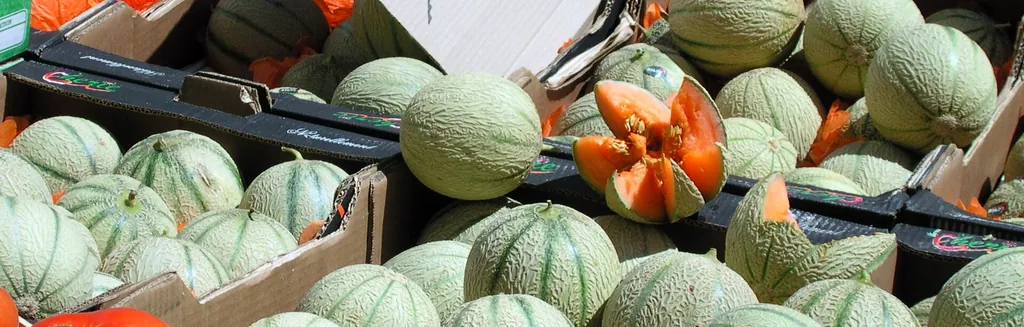
There is, in the Provençal summer, a scent that never lies: that of a Cavaillon melon cut open on a shaded table, at the hour when the cicadas fall quiet for a moment. This round, golden, fleshy, almost musky fruit has become the symbol of an entire region. But it would be unfair to reduce Provence to its melon alone: around it revolves a whole procession of sun-ripened fruit — the dazzling cherries of June, the melting apricots of July, juicy peaches, late-summer figs and September grapes. From Le Clos de Manon, a ten-minute walk from Gordes, we watch this gourmet calendar unfold at the markets and at the growers' stalls, week after week.
In this article, we share what we suggest to our guests: when to taste what, where to buy, how to recognise a fruit at its peak, and how to make the orchards of Provence a delicious thread running through your stay. Because here, eating a piece of fruit is no ordinary gesture: it is a way of touching the terroir, the climate and the know-how of an entire region.
Fruit, the pride of the Provençal terroir
Provence is one of the great orchards of France, and the Vaucluse is its beating heart. The Mediterranean climate — hot, dry summers, mild winters, more than 2,700 hours of sunshine a year — gives fruit a concentration of sugars and aromas that few regions can match. The soils, a mix of pebbles, clays and alluvial terraces along the Durance and the Calavon, drain well and release their warmth at night, which encourages ripening.
The Vaucluse is thus France's leading cherry-producing département, a major player for apricots, and the historic cradle of the melon. This abundance is not just a matter of figures: it shapes the landscape. Driving down from Gordes towards the plain, you pass tightly planted apricot orchards, cherry trees clinging to the hillsides of Venasque, and vineyards as far as the eye can see. In spring, the blossom turns the countryside into a watercolour of pink and white.
To better understand this generosity, you have to place it within its ecosystem. A large share of these orchards lies within the boundaries of the Luberon Regional Nature Park, which supports quality farming and the preservation of heritage varieties. You can learn more about this commitment on the official website of the Luberon Regional Nature Park, which also lists growers and short supply chains. This philosophy of "producing well" comes through on the plate, and that is why fruit holds such a place in our gourmet guide to Luberon cuisine.
The Cavaillon melon, a gourmet legend
If we had to crown a king, it would be this one. The Cavaillon melon is not merely a variety: it is a reputation, forged over the centuries. The town of Cavaillon, less than thirty minutes from Gordes, owes its fame to this fruit from the 19th century onwards, when the arrival of the railway made it possible to ship melons to Paris in a matter of hours. Alexandre Dumas, a notorious gourmand, loved them so much that he traded his works to the town library in exchange for an annual rent paid in melons. The encyclopaedia entry devoted to the Cavaillon melon recounts this delicious history in detail.
Today, "Cavaillon melon" refers above all to a type of Charentais melon grown in the Cavaillon basin, with orange flesh that is sweet and fragrant. A brotherhood, founded in 1988, champions its image, and every July the town devotes a great popular festival to it, with tastings, a market and entertainment. It makes the perfect gourmet morning for our guests who love living traditions.
What sets a truly successful melon apart is balance: flesh that is neither mealy nor too firm, abundant juice, and that famous musky finish on the palate. Growers play with varieties and harvest dates to spread out the season. Here are the key markers:
- Mid-June: the first open-field melons, sometimes preceded by early greenhouse harvests;
- July–August: peak season, best value for money and maximum fragrance;
- September: the last melons, often very sweet thanks to the still-warm nights.
Our travel host's tip: buy the melon on the very morning you plan to eat it, and leave it at room temperature for an hour before serving — the cold dulls its aromas. A few slices of cured ham, a splash of muscat, and summer is on the plate.
Cherries from Venasque and the Monts de Vaucluse
Before the melon comes the cherry, the first great fruit of the Provençal summer. The hilltop village of Venasque, about thirty minutes from Gordes, has given its name to a renowned collective brand: the Venasque cherry, grown on the slopes of the Monts de Vaucluse between 200 and 500 metres in altitude. The altitude and the temperature swings produce firm, crisp fruit of a deep red, both sweet and tart.
The season is short and precious: it generally runs from late May to early July, depending on the variety (early Burlat, then Folfer, Summit, Belge…). It is a fast-moving harvest, done by hand, which explains the fruit's relatively high price. But what a reward: biting into a Venasque cherry warmed by the sun, freshly picked, remains one of the simplest and most vivid pleasures of a stay in June.
Several growers open their orchards for pick-your-own or sell directly at the farm. It makes an ideal family outing, one we love to suggest at the start of a stay. And to extend the experience, there is nothing to stop you turning your haul into something more: clafoutis, jam, or cherries in vinegar to go with charcuterie. You will find these everyday gestures in our roundup of Provençal specialties to bring home and to cook.
Apricots, peaches and the summer calendar
As the cherry fades, the apricot takes over. The Roussillon around Apt — not to be confused with the South-West region — and, more broadly, the orchards of the Vaucluse produce renowned apricots, of which the emblematic variety remains the Bergeron, with orange skin tinged with red, firm and fragrant, perfect raw as well as in a tart or jam. The season runs from late June to mid-August, peaking in July.
Peaches, nectarines and flat peaches accompany this heart of summer. Juicy and fragile, they do not travel well: that is exactly why it pays to buy them here, picked at full ripeness, rather than hard and tasteless elsewhere. The vineyard peach, later and with blood-red flesh, makes its appearance at the end of the season and delights connoisseurs.
To find your way, here is a guide to the main summer fruits and their tasting window around Gordes:
| Fruit | Peak season | Indicative price (from the grower) |
|---|---|---|
| Venasque cherry | late May – early July | €6 to €10 / kg |
| Apricot (Bergeron) | late June – mid-August | €3 to €5 / kg |
| Cavaillon melon | mid-June – September | €2 to €4 / each |
| Peach & nectarine | July – August | €3 to €5 / kg |
| Fig | late August – October | €5 to €9 / kg |
| Table grape | September – October | €3 to €6 / kg |
These prices are indicative and vary with the weather of the year and the point in the season; they almost always remain better value than in the supermarket, for an incomparable freshness.
Figs, grapes and the fruits of autumn
Summer does not end abruptly in Provence: it slides gently into autumn, and with it come darker, more honeyed fruit. The fig, first of all. Present from late August through October, it comes in white and purple varieties, with candied flesh and a honeyed flavour. Sologne, Bourjassotte Noire, Marseillaise: the varieties are many. Fresh, opened over a little soft goat's cheese with a drizzle of lavender honey, the fig sums up the Provençal late season all on its own.
Then comes the table grape, cousin of the one that makes our wines. From September to October, the stalls fill with golden muscat and black bunches. The Ventoux muscat, in particular, enjoys a well-deserved reputation for its crunch and intense fragrance. It is the ideal moment to pair the region's fruit and wines: fresh grapes to end the meal, a sweet wine or a well-chilled rosé as an aperitif.
Autumn also brings quinces, apples and the first chestnuts on the heights. It is a season often overlooked by travellers, and yet a magnificent one: the light softens, the markets grow quieter, and the fruit gains in depth. For those who want to extend the experience, September remains one of our favourite months at Le Clos de Manon — the pool is still warm and the orchards yield their final treasures.
Where to buy: markets and growers
The best way to taste this fruit is to go and meet it. Around Gordes, the network of markets is exceptional, and each has its own character. We always steer our guests towards growers' markets rather than purely touristy ones, for the freshness and the connection to the terroir. Here are our favourite spots and the distances from Le Clos de Manon:
| Market | Day | Distance from Gordes |
|---|---|---|
| Coustellet (farmers' market) | Sunday morning | ~ 15 min |
| Cavaillon | Monday morning | ~ 30 min |
| Apt (large market) | Saturday morning | ~ 30 min |
| L'Isle-sur-la-Sorgue | Thursday & Sunday | ~ 20 min |
| Gordes | Tuesday morning | on site |
Our favourite remains the Coustellet farmers' market on Sunday morning: you will find only local growers there, and it is the perfect place for melon, apricots and the first figs. To go further, we have devoted a full guide to the most beautiful Provençal markets of the Luberon, with the days, the atmospheres and our insider tips.
Away from the markets, don't overlook the roadside stands between Gordes and Cavaillon: these huts run by growers sell melons, fruit and vegetables picked that very day, often at the best price. To plan a wider excursion in the region and spot seasonal festivals and markets, the inter-municipal tourist office offers a wealth of information on the official Destination Luberon website.
Choosing and enjoying a melon
Choosing a melon is almost an art, and it is one of the questions our guests ask us most often. Yet a few simple gestures are all it takes to stop getting it wrong. First, the weight: a good melon should feel heavy for its size, a sign of flesh brimming with juice. Next, the stem: when it begins to come away naturally, the fruit is ripe. At the opposite end, the small scar left by the flower should give slightly under the pressure of your thumb.
Scent is the final arbiter: a melon at its peak gives off a sweet, clear aroma through the rind. If it smells of nothing, it will have no flavour. Finally, look at the ribs: on a Charentais, well-defined ribs are often a good sign. Here is our little tasting checklist:
- Weigh it: heavy = juicy;
- Smell it: clear scent = ripe;
- Press gently at the base: slightly soft = at its peak;
- Serve at room temperature, never ice-cold, to release the aromas;
- Ask the grower for advice: they know their fruit better than anyone.
As for serving, the melon stands on its own, but it enjoys a few companions: cured ham, basil, mint, a splash of muscat or port, or even a pinch of Espelette pepper for the bold. To go further and learn to pair these products, some of our guests love to extend the experience with a programme of summer activities in the Luberon set to the rhythm of the markets and the shaded tables.
Season by season: what to taste and when
To plan your stay around the fruit, keep this simplified calendar in mind. It will help you choose the right month according to your gourmet cravings.
- May – June: the cherry reigns. It is also the very start of the melon and just after the orchards' full bloom;
- July – August: the high point. Cavaillon melon, apricots, peaches, the first figs: everything is here, and the markets are overflowing;
- September – October: figs in abundance, table grapes, the last very sweet melons, and the renewed gentleness of the markets and the light.
Whatever the month, the golden rule stays the same: buy local, buy ripe, buy the same day. That is the whole advantage of a stay here, right next to the orchards. And if a craving takes hold, know that the Vaucluse is not limited to fruit: when winter comes, it is the truffle that takes over at the markets, as we tell in our article devoted to the Luberon truffle.
Living the fruits of Provence from Le Clos de Manon
Making the fruits of Provence the guiding thread of a stay means slowing down and savouring the region's rhythm. At Le Clos de Manon, a ten-minute walk from Gordes, we love to start the day with a breakfast of melon and apricots bought the day before at the market, then fan out towards the villages, the wine estates and the shaded tables. The private heated pool does the rest: there is nothing like a chilled slice of melon at the water's edge, at the hour when the sun beats down.
To make the most of this gourmet season, we suggest a stay of five to seven nights, ideally between June and September. If the urge to taste Provence takes hold of you, you can check our availability at Le Clos de Manon right now and build your escape around the markets, the orchards and the southern light. We would be delighted to share our insider addresses with you, market after market.