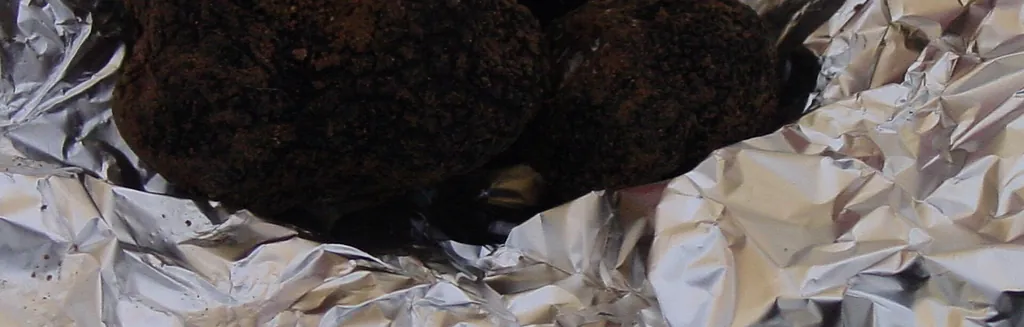
Some flavours sum up an entire season all on their own. In the Luberon, winter has a scent, and that scent is the black truffle. From mid-November, when the vines have shed their leaves and mist clings to the foot of the hilltop villages, a quiet buzz spreads across the markets of the Vaucluse. Beneath the bare plane trees, men open old wicker baskets, lift a cloth, and the air suddenly fills with a deep, earthy, almost animal aroma. It is the sign that the Tuber melanosporum is back.
From Le Clos de Manon, a ten-minute walk from Gordes, every winter we watch our guests set off in the morning to hunt for this underground treasure and return in the evening, a truffle wrapped in paper and stars in their eyes. For the truffle is far more than a luxury product: it is a culture, a ritual, a whole season lived out in the markets, in the oak woods and around the table. Here is everything you need to discover it like an insider, far from the clichés.
The black truffle, treasure of winter
It is known as the black diamond, and the name is well earned. Rare, fickle and impossible to cultivate entirely at will, the black truffle concentrates an unmatched aromatic intensity into just a few grams. The Vaucluse, which the Luberon belongs to, is by far the leading black-truffle-producing department in France: the Provence-Alpes-Côte d'Azur region alone is thought to supply a major share of the national harvest. Around Gordes, Apt and Mont Ventoux, the truffle groves — those plantations of mycorrhized holm oaks and downy oaks — number in the hundreds.
What makes the truffle so fascinating is its element of mystery. No one knows exactly where or when it will decide to grow. It is born of a symbiosis between a fungus and the roots of a tree, a few centimetres below ground, hidden from view. It takes a dog's nose — or once a pig's — to track it down. This alliance between nature, animal and peasant know-how makes every truffle a small victory. And that is precisely the story we love to share with our guests: behind the product lies a season, age-old gestures and a living terroir.
Winter in the Luberon is therefore anything but a dead season. On the contrary, it is the moment when the region shows its true self, free of the summer crowds and humming with a culinary life that many visitors never suspect. For anyone who loves to eat, it is surely the most rewarding time to come.
Tuber melanosporum: what is the Luberon truffle?
The truffle harvested here goes by a scholarly name: Tuber melanosporum, better known as the black Périgord truffle — a misleading label, since Provence is today its leading land of production. It is a hypogeous fungus, meaning it grows entirely beneath the surface of the soil, in symbiosis with the roots of certain trees: holm oak, downy oak, hazel, sometimes lime or pine. To understand its biology in detail, its reproductive cycle and its thousand-year history, the encyclopaedic entry on the black Périgord truffle makes excellent reading as you plan your stay.
Recognising a genuine black truffle takes a little practice. When ripe, its flesh — the gleba — is a deep black, finely veined with white, and its skin, the peridium, is warty, hard, almost scaly. But it is above all the aroma that never lies: powerful, lingering, blending notes of undergrowth, humus and cocoa. Beware of imitations, especially the Chinese truffle (Tuber indicum), visually similar but virtually odourless, and sold for far less.
A few useful markers so you don't confuse the main truffles you'll come across in the Luberon markets:
- Black truffle (Tuber melanosporum): the queen of winter, harvested from November to March, intense aroma;
- Musky truffle (Tuber brumale): harvested at the same time, milder, often cheaper;
- Summer truffle (Tuber aestivum): harvested in May–August, light aroma, not to be confused with the black truffle;
- Chinese truffle (Tuber indicum): imported, barely fragrant — best avoided if you're after the real thing.
The season: from mid-November to mid-March
The black truffle season officially runs from mid-November to mid-March. But not every month is equal. The first truffles of November, still a little young, gain in power over the following weeks. The heart of the season — when the truffle reaches its full aromatic ripeness — falls between late December and late February. This is when the markets are at their fullest, prices steady and quality at its peak.
Here is a simple guide to planning your visit according to the time of season:
| Period | Truffle quality | Market atmosphere |
|---|---|---|
| Mid-November to mid-December | Young truffles, aroma building | Markets coming alive, prices variable |
| Mid-December to late February | Full ripeness, peak aroma | In full swing, more choice |
| March (until mid-March) | Fine truffles, end of season | Quieter markets, good deals |
This winter season coincides with other regional pleasures. It is also the time of the year-end festivities, when the villages light up: we cover it in our article on Christmas in Provence, its markets, its santons and its thirteen desserts. To capture the region's overall mood at this time of year — low, raking light and empty villages — also read our guide to the Luberon in winter.
The great truffle markets (Apt, Carpentras, Richerenches)
To truly live the truffle, nothing beats an early-morning truffle market. Three appointments shape the season around the Luberon, each with its own character, and all within reach of Le Clos de Manon. They sit alongside the more general stalls found at our Provençal markets of the Luberon throughout the year.
- Apt — on Saturday mornings, this is the market closest to us (about a 35-minute drive). The truffle market is woven into Apt's large Provençal market: ideal for a first taste, with a friendly, accessible atmosphere.
- Carpentras — on Friday mornings from November to March, this is one of the most important wholesale truffle markets in France. The dealings here are serious, sometimes hushed, between brokers and restaurateurs. Allow 45 minutes from Gordes.
- Richerenches — about an hour and a quarter's drive away, this small village in the upper Vaucluse is nicknamed the world capital of the black truffle. Its Saturday-morning market, from mid-November to late March, is an institution. It makes for a morning's outing for true enthusiasts.
| Market | Day | Distance from Gordes | Who is it for? |
|---|---|---|---|
| Apt | Saturday morning | ≈ 35 min | First discovery, village atmosphere |
| Carpentras | Friday morning | ≈ 45 min | Wholesale market, serious buyers |
| Richerenches | Saturday morning | ≈ 1 hr 15 | Enthusiasts, the truffle capital |
An insider's tip: arrive early, around 8.30 am, because the best truffles sell fast and the wholesale markets can be over within the hour. Bring cash, watch before you buy, and don't hesitate to ask to smell the goods. The price per kilo of fresh black truffle varies sharply by year and month, typically ranging between €600 and €1,200 per kilo. For a tasting for two, 15 to 30 grams is plenty.
Watching a truffle hunt with a truffle dog
If the market is the stage of the truffle, the truffle grove is the wings — and it is surely the most moving experience to be had in the Luberon in winter. The truffle hunt is the search for the truffle, traditionally guided by the nose of a trained dog (the pig, long used, has all but vanished from the practice). To watch a dog freeze, scratch gently at the ground, and its handler then free a buried truffle by hand: there is something magical about it.
Many truffle growers around Gordes, Apt and Mont Ventoux open their estates in winter to offer truffle-hunting demonstrations. The format is often the same: a walk through the grove, the grower's explanations on truffle biology and the dog's role, the harvest before your eyes, then a convivial tasting — truffled scrambled eggs, toasts, sometimes a glass of Luberon wine. Expect to pay generally €25 to €45 per person for one to two hours, and book ahead, as groups are deliberately kept small.
It is an outing we particularly recommend to families and the curious. It gives meaning to everything else: after a hunt, you look at a truffle on a market stall with a different eye. For general information on the area, its protected landscapes and its activities, the official website of the Luberon Regional Nature Park is a valuable resource for planning your excursions.
How to choose and store a truffle
Buying a truffle is a small art. At the market, trust your nose first: a good black truffle perfumes the air immediately, with no need to hold it to your face. Choose one that is firm to the touch — a soft truffle is past its best — and insist that it be weighed in front of you, cleared of soil. A truffle that feels too heavy for its size may be hiding earth packed into its crevices: a classic trick.
A few golden rules we pass on to our guests:
- Buy as close to the tasting as possible: the truffle loses its aroma day after day. Ideally, buy it the day or two before the meal;
- Store it in the fridge, wrapped in absorbent paper, in an airtight jar, and change the paper every day;
- Perfume your eggs: place the truffle with whole eggs in a sealed box for 24 to 48 hours — the shell is porous, so they will take on its aroma;
- Don't freeze it unless necessary: freezing alters the texture and part of the aroma.
Cooking and tasting the truffle
The great lesson of cooking with truffle comes down to one word: simplicity. The black truffle is generous but fragile to heat. So you work it with neutral, fatty ingredients that catch and carry its aroma: egg, butter, cream, potato, fresh pasta, fresh cheese. There is no point layering flavours: the truffle must be the star.
A few essential preparations, easy to pull off in the villa's kitchen:
- Truffled scrambled eggs: eggs scrambled very gently, truffle grated in at the end of cooking. The signature dish of truffle-country Provence;
- Fresh pasta with butter and grated truffle, a drizzle of Luberon olive oil;
- The baked jacket potato, cream and shavings of truffle;
- The simple toast of country bread, salted butter and thin slices of truffle, set out on the table at apéritif time.
The secret: grate or slice the truffle raw, at the very last moment, over a hot dish. The heat releases the aromas without destroying them. To go further into pairings and local produce, our food lover's guide to Luberon gastronomy details the olive oils, cheeses and wines that pair so beautifully with truffle.
Where to savour it
If you'd rather leave it to the professionals, winter is also the season of truffle menus in the region's restaurants. Many tables, from the village bistro to the starred house, put together special menus from December to February, sometimes around a menu devoted entirely to the black diamond. It's the chance to discover bolder preparations: risotto, poultry truffled under the skin, subtly perfumed desserts.
Around Gordes, you'll find fine addresses at every price point. For an exceptional experience, several renowned establishments give the truffle pride of place: we round up the best of them in our selection of starred restaurants of the Luberon. Be sure to book well ahead for truffle menus, as they are often fully booked several weeks before the weekend. We'll be delighted to point our guests towards the table that matches their mood and their budget.
Coming in low season: a well-kept secret
People come to the Luberon in summer for the lavender and the heat. But those who truly know it come back in winter. And for good reason: between November and March, the region offers a rare face. The hilltop villages empty out, the light turns crystalline, accommodation rates are gentler, and you enjoy the most famous sites in a calm unthinkable in high season. The truffle is simply the most delicious of the reasons to come off-season.
At Le Clos de Manon, winter has a charm all its own: the heated pool we keep warm for a few lengths under a clear sky, evenings by the fire after a morning at the market, and the luxury of having Gordes almost to yourself, a ten-minute walk away. It is the season we most love to share with travellers in search of authenticity — those who want to experience the Provence of its residents rather than the one on the postcards.
Living the truffle season from Le Clos de Manon
Picture it: a winter Saturday morning, you leave the villa for the Apt market, you come back with a truffle of a few grams and a bottle of Luberon, and that evening, in the house's kitchen, you make truffled scrambled eggs while the heated pool steams in the cold night air. That is exactly what a stay at Le Clos de Manon offers in the heart of truffle season: a central, peaceful base camp from which to fan out to every market and every truffle grove in the Vaucluse.
To make the most of the Luberon's gourmet winter, we suggest a stay of four to six nights, between mid-December and late February. If the adventure tempts you, you can check availability at Le Clos de Manon right now, and we'll gladly tell you where to find, that very week, the finest truffle and the best hunt. The Provençal winter is waiting for you.