There is a Provence few travellers know: the Provence of December, when the lavender sleeps, the hilltop villages empty of their tourists and the windows glow warmly from within. A dry cold drops down from the Monts de Vaucluse, snow whitens Mont Ventoux, and in the kitchens cardoon and salt cod simmer away. This is the season when Provence stops being a postcard and becomes once more a land of living traditions, handed down from one generation to the next around the table and the nativity scene.
From Le Clos de Manon, a ten-minute walk from Gordes, we watch our guests rediscover this intimate Provence every winter. The Christmas markets, the santon fairs, the gros souper and its thirteen desserts, Saint Barbara's wheat, the pastorales performed in Provençal: a whole calendar of customs we invite you to explore here, month by month and village by village, so you can experience an authentic and delicious Provençal Christmas.
Christmas in Provence, a living tradition
What strikes you first, when you spend the holidays in Provence, is that the traditions are not a backdrop for visitors but a part of family life. In most Luberon homes, people still set up a nativity scene at the start of Advent, sow Saint Barbara's wheat on 4 December, and gather the family for the gros souper on the 24th. We owe much of this continuity to Frédéric Mistral and the Félibrige movement, who, from the 19th century onward, recorded and celebrated Provençal customs.
The Provençal festive calendar traditionally runs from 4 December, Saint Barbara's day, all the way to Candlemas on 2 February. Here they say Christmas lasts forty days: "de la Santo Barbo i Calèndo", from Saint Barbara to Candlemas. This long season shapes the winter and gives the Luberon — usually so turned toward the summer light — a new depth that our travellers do not always expect.
To understand how this season fits into the Provençal rhythm, we often point our guests to our guide "When to visit Provence? A guide to the seasons", which places winter within the great cycle of lavender, the grape harvest and the truffle. December holds a place all its own: neither the summer crowds nor the dreaded grey skies, but a gentle, warm interlude.
The Christmas markets of the Luberon and Avignon
From late November, Christmas markets spring up across the squares of Provence. The largest in the region is the one in Avignon, around fifty minutes from Gordes: some thirty wooden chalets line the Place de l'Horloge and the Rue de la République, around the illuminated Palais des Papes. Here you will find local crafts, Marseille soaps, lavender honey, spiced mulled wine and, of course, the first santons. The full Advent programme can be found on the official Avignon tourist office website.
Closer to the villa, the Luberon villages hold their own markets, often over a single weekend: L'Isle-sur-la-Sorgue (25 min) pairs its Christmas market with an antiques fair, Cavaillon (25 min) puts the spotlight on local produce, and Gordes itself, just a short stroll from us, takes on the air of a greetings card when its lanes light up. These village markets are our favourites: fewer crowds, producers we know by name, and that rare feeling of being right at home on a winter evening.
Here is a handy guide to December's main gatherings, with distances from Gordes:
| Market / fair | Distance from Gordes | Approximate dates | Not to be missed |
|---|---|---|---|
| Avignon Christmas market | ~50 min | late Nov. – 31 Dec. | Chalets on Place de l'Horloge |
| L'Isle-sur-la-Sorgue | ~25 min | mid-Dec. (weekend) | Christmas antiques fair |
| Cavaillon | ~25 min | Dec. | Local produce |
| Aubagne santon fair | ~1 h 15 | late Nov. – late Dec. | Capital of the santon makers |
| Carpentras truffle market | ~40 min | Nov. – Mar., on Fridays | Fresh black truffle |
The Luberon's winter climate lends itself perfectly to these wanderings: cool, bright days, morning frosts, but some of the most generous sunshine in France. We cover this little-known season in our article "The Luberon in winter", well worth reading before you plan your December wardrobe.
Santons and the santon fairs
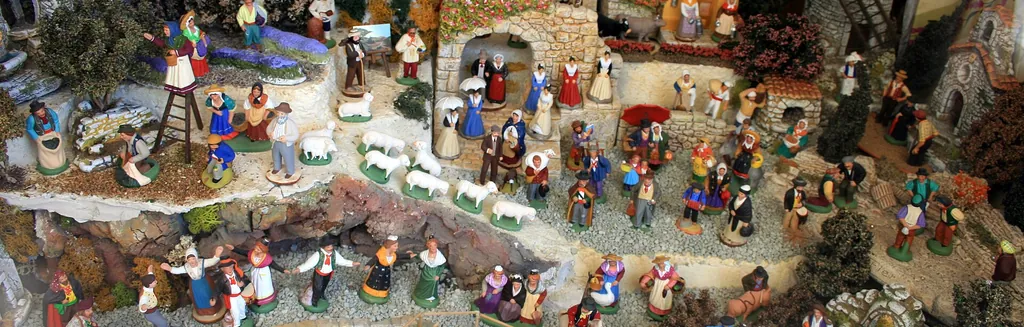
You cannot talk about Christmas in Provence without mentioning the santons, those little hand-painted clay figurines that populate the nativity scenes. The word comes from the Provençal santoun, "little saint". Born in the late 18th century, when the Revolution closed the churches and the Provençals set up their nativity scenes at home, the santons gradually welcomed a whole miniature village: not only the Holy Family and the Three Wise Men, but also the miller, the washerwoman, the shepherd, the ravi (the simpleton who raises his arms to the sky) and the boumian, the gypsy.
The capital of the santon remains Aubagne, near Marseille, whose fair is the most renowned in Provence. But our travellers needn't go that far: santon fairs and markets are held each December in Avignon, Cavaillon and several Luberon villages, 30 to 50 minutes from the villa. There you'll meet santon makers who shape and fire their figurines themselves, and who take the time to explain each character.
- painted clay santons, sold from the tiny "puce" to collector's pieces of 15 cm and more;
- dressed santons, made of fabric, heirs to an older and rarer tradition;
- nativity-scene settings: mills, fountains, bridges, moss and cork to recreate the Provençal hillside.
For families, it's the ideal December activity: each year you choose a new character, and the nativity scene grows with the memories of your travels. Several santon makers' workshops in the region can be visited year-round by appointment, a lovely way to carry the Christmas spirit beyond the season.
The gros souper and the 13 desserts
At the heart of the Provençal Christmas is the table. On the evening of 24 December, before midnight Mass, families share the gros souper: a so-called "lean" meal, without meat, traditionally made up of seven dishes in memory of the Virgin's seven sorrows. The table itself follows a code: three white tablecloths layered one over another, three candlesticks and three saucers of Saint Barbara's wheat, in reference to the Trinity.
Depending on the family and the locale, you'll find salt cod (with aïoli or in a raïto sauce), snails, cardoon gratin, winter vegetables, spinach, celery and anchoïade. Nothing heavy: the gros souper is a solemn prelude that builds toward the most anticipated moment of all — the arrival of the desserts.
The famous 13 desserts symbolise Christ and the twelve apostles. They stay on the table for three days, until 27 December, and everyone must taste each one to ensure a happy year ahead. Their composition varies from one village to the next, but the foundation never changes. Here are the essentials:
| Dessert | Symbol / origin |
|---|---|
| Dried figs | Franciscan order (mendicant) |
| Almonds | Carmelite order (mendicant) |
| Walnuts or hazelnuts | Augustinian order (mendicant) |
| Raisins | Dominican order (mendicant) |
| Pompe à l'huile | Sweet olive-oil fougasse |
| White nougat | Good, purity |
| Black nougat | Evil, the contrast |
| Dates | Echo of the East and the Three Wise Men |
| Fresh fruit (apples, pears, oranges) | The season's abundance |
| Green melon / fruit jellies | Summer's preserved sweets |
The pompe à l'huile deserves a special mention: this brioche-like flatbread scented with orange-blossom water and olive oil is broken by hand, never with a knife — or you risk going broke that year. You dip it in a glass of cooked wine. To go further into the local food culture that fills this table, we point you to our guide to Provençal specialties, from the olive oil of the Vallée des Baux to the goat's cheeses of the plateau.
Nativity scenes and pastorales
Beyond the home, Christmas is also lived in public. Many villages of the Luberon and the Vaucluse install nativity scenes in their churches, sometimes enormous, with hundreds of santons and settings that change right up to Epiphany. The living nativity scenes, in which villagers and animals re-enact the Nativity, draw large crowds on the evening of 24 December, especially in the Alpilles and the Apt countryside.
The pastorale is winter's other great Provençal event. This popular play, performed in Provençal and punctuated with songs, tells of the shepherds' journey to the stable in Bethlehem, with its cast of colourful characters. The most famous, the Pastorale Maurel written in Marseille in 1844, is still staged each year throughout the region between December and February. To track down performances and remarkable nativity scenes near you, the regional portal Provence-Alpes-Côte d'Azur Tourisme lists the winter cultural calendar.
The festival of Saint Barbara's wheat
It all begins, in fact, on 4 December, Saint Barbara's day. On that day, the Provençals sow grains of wheat (or lentils) in three saucers lined with damp cotton wool. Placed on the mantelpiece or near a window, they sprout within a few days and then adorn the gros souper table, and later the nativity scene.
The tradition is also a divination of the harvest to come: "Quand lou blad vèn bèn, tout vèn bèn" — when the wheat grows well, all goes well. Thick, green, upright wheat heralds a prosperous year; yellowed or sparse wheat, less so. It's a simple, almost childlike gesture that we love to offer our younger guests: it anchors the stay in the Provençal rhythm from the very start.
- 4 December: the wheat is sown in three saucers;
- around 20 December: the wheat has sprouted, and it is placed on the table;
- 24 December: it decorates the gros souper, a symbol of abundance.
The truffle, queen of winter tables
If the Provençal summer has its lavender, winter has the black truffle, the famous Tuber melanosporum. Its season runs from mid-November to mid-March, and it graces every fine Christmas table: scrambled eggs, truffled poultry, or simply a slice of warm bread rubbed with garlic and drizzled with olive oil. The Vaucluse is one of France's great producers.
For our travellers, the experience to seek out is the truffle market. The liveliest is in Carpentras, 40 minutes from Gordes, held every Friday morning from November to March. More discreet and more authentic, the wholesale market in Richerenches, in the Enclave des Papes, is regarded as the European capital of the black truffle. There you can watch the brokers, noses buried in canvas sacks, haggling under their breath — an unforgettable sight.
We devote an entire article to this winter treasure: "The Luberon truffle and its markets", with our market recommendations, buying tips and partner restaurants. It is, by far, one of the finest culinary reasons to stay here in December. For those who want to understand the truffle's ecosystem and the garrigue that shelters it, the Luberon Regional Nature Park offers resources and events on the local natural heritage.
Spending the holidays at Le Clos de Manon
To spend Christmas at Le Clos de Manon is to swap the bustle of the season for the calm of a Provençal villa, a ten-minute walk from Gordes. While outside the mistral makes the cypresses creak, you can enjoy the heated pool, come home from the market with your arms full of truffle and pompe à l'huile, and lay out, if the mood takes you, your own table of thirteen desserts in front of the fireplace.
The villa's central location makes it easy to roam: Avignon and its Christmas market in under an hour, Carpentras and its truffle 40 minutes away, the santon fairs of neighbouring villages half an hour off. And when evening comes, you return to the quiet, far from the crowds. To plan your visit at its best, this overview of the cold season is the perfect complement to our cornerstone guide "When to visit Provence? A guide to the seasons". Feel free to check our availability at Le Clos de Manon as soon as your dates start to take shape.
December is still a quiet season in the Luberon: it's also the best time to find availability and enjoy a Provence all to yourself. If the idea of a Provençal Christmas appeals to you, you can check our availability at Le Clos de Manon right now and picture your festive evening among santons, truffle and thirteen desserts.