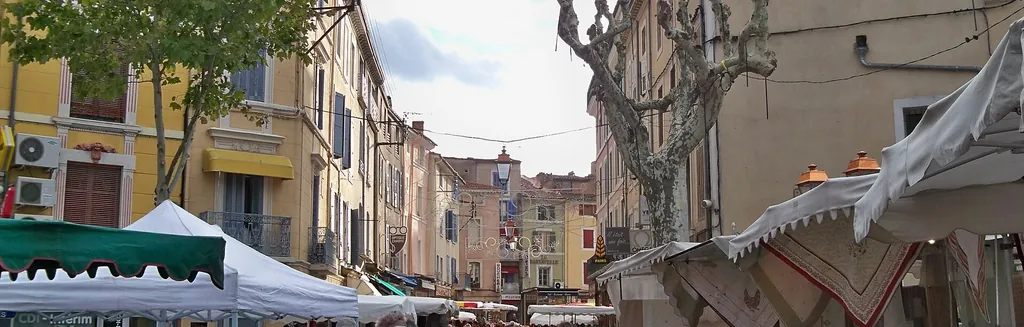
There are the perched villages you photograph, and then there is Apt, the one you taste. Set in the Calavon valley, at the foot of the Luberon and the great Claparèdes plateau, this sub-prefecture of the Vaucluse lacks the dramatic silhouette of its neighbours clinging to their rocky spurs. It has something else: daily life, scents, the buzz of a market, century-old confectioners and an undisputed role as the true capital of the Luberon. This is the town where you come to fill your basket, not just your camera.
From Le Clos de Manon, a ten-minute walk from Gordes, we send our guests off to Apt on a Saturday morning almost without fail. Its market is one of the largest in Provence, and the town packs into a tiny space everything that makes up the region's gourmet soul: candied fruit, honey, olive oil, pottery and the ochres close by. Here, as regulars, is how we suggest you discover Apt.
Apt, the beating heart of the Luberon
Apt has just under 12,000 inhabitants, which makes it the largest town in the inner Luberon. As a sub-prefecture of the Vaucluse, it is the administrative, commercial and economic centre of an essentially rural area. Where Gordes, Roussillon or Ménerbes live to the rhythm of tourism and the light, Apt lives all year round, with its shops, its cafés, its courthouse, its hospital and its schools. That is precisely what makes it such an endearing stop: here you cross paths with locals doing their shopping, not just with visitors.
The town stretches along the Calavon, framed by the Luberon massif to the south and the Monts de Vaucluse to the north. This crossroads position explains its ancient calling as a place of meeting and exchange. As far back as Antiquity, Apta Julia was a prosperous Roman city on the Via Domitia, the great road linking Italy to Spain. Beneath the modern town you can still find remains from that era: a partly excavated ancient theatre, thermal baths and a rich archaeological heritage preserved in the museum.
For travellers, Apt is above all an ideal base from which to explore. It lies at the foot of the Luberon's two great ochre sites, within easy reach of the perched villages and the lavender of the Sault plateau. It is also an excellent stopover on the trail of Provençal markets, of which it is surely the most impressive instalment. Apt is not an open-air museum: it is a living town, and that is its whole charm.
The Saturday market, vast and award-winning
If you were to remember only one thing about Apt, it would be its Saturday morning market. Held every week, all year round, from roughly 8am to 1pm, it literally takes over the town centre: place de la Bouquerie, cours Lauze de Perret, the lanes of the old town and the banks of the Calavon fill up with hundreds of stalls. It is one of the largest markets in Provence, and it carries the official "exceptional market" label, a national distinction awarded to only a handful of French markets.
You will find absolutely everything the region produces here. Local growers rub shoulders with travelling traders, in a whirl of colours and accents. To help you find your bearings, here is what we suggest you seek out first:
- seasonal fruit and vegetables: Cavaillon melons in summer, squash and cardoons in autumn, the first asparagus in spring;
- the goat's cheeses from the plateau, fresh or matured, and farmhouse cheeses from the surrounding area;
- olive oil, tapenade and anchoïade, to taste straight from the stall;
- the candied fruit and confectionery of Apt, sold loose or in pretty gift boxes;
- Provençal honey, lavender, soaps and Provençal fabrics;
- the glazed pottery, a long-standing speciality of the town.
Our insider tip: arrive early. Before 9am, you can park easily in the outer car parks, you enjoy the cool of the morning and you watch the traders set up their stalls in a golden light. After 10:30am, the centre is heaving, especially in summer. The Apt market deserves a good part of the morning, basket on your arm and appetite awakened. It is the headline experience of our guide to the Provençal markets of the Luberon, and the best possible introduction to the flavours of the region.
World capital of candied fruit
Apt holds a title that few towns can claim: that of world capital of candied fruit. It is not a tourist slogan but an industrial and historical reality. The town has been candying fruit since the Middle Ages — it is said that the Avignon papacy was already fond of its "dry preserves" in the 14th century — and to this day it still accounts for a considerable share of the world's candied-fruit production.
The principle is ancient and exacting: the water in the fruit is patiently replaced with sugar, through several successive baths, until the fruit keeps well while retaining its shape and colour. Cherries, apricots, melons, pears, figs, clementines, angelica, citrus peel: nothing is left out. The result turns up both in the famous glacé fruits given at Christmas and in pastry, where the candied fruits of Apt flavour cakes, kings' brioches and calissons.
Several confectioners keep this craft alive and can be visited or have a shop. There you can watch the copper pans, understand the stages of candying and, of course, taste. It is a gourmet stop we particularly recommend to families: children are fascinated by the mountains of glistening fruit. To understand the place of candied fruit within the wider panorama of local flavours, we refer you to our feature on the Provençal specialities to bring home, where the candied fruit of Apt holds pride of place alongside nougat and tapenade.
Sainte-Anne cathedral and the old town
In the heart of the old centre, Sainte-Anne cathedral is well worth pushing the door open for. The former cathedral of the diocese of Apt, it is a major place of pilgrimage dedicated to Saint Anne, the mother of the Virgin Mary. Tradition holds that the saint's relics are kept here, which earned Apt great renown in the Middle Ages and even drew Anne of Austria, who came on pilgrimage in the 17th century to obtain an heir — the future Louis XIV.
The building blends eras, from Romanesque to Gothic, and houses a remarkable Sainte-Anne chapel, a treasure of religious goldsmithery and two superimposed crypts of great antiquity, one of which probably dates back to the Carolingian period. Even for visitors with little taste for sacred art, descending into these silent crypts, beneath the town, is a striking experience.
Around the cathedral, the old town is best discovered on foot, wandering through narrow lanes, shaded squares and fountains. There you will find the clock tower, a remnant of the former ramparts, discreet private mansions and an authentic neighbourhood life. Take the time to stroll on a non-market day: Apt then reveals a more peaceful, almost secret face, which the Saturday crowd tends to hide.
The House of the Luberon Regional Nature Park
Apt is home to the headquarters of the Luberon Regional Nature Park, and its Park House, set in a fine private mansion in the centre, is a stop we warmly recommend, especially at the start of a stay. It is the ideal place to understand the area you are about to explore: its geology, its fauna, its flora, its landscapes shaped by people over thousands of years.
The Park House serves several purposes useful to the traveller:
- an information point on hiking trails, natural sites and good practice in a protected environment;
- a surprising palaeontology museum, which displays spectacular fossils from the Luberon's subsoil, including ancient fish and imprints millions of years old;
- exhibitions and a specialist bookshop, perfect for planning your walks.
The Luberon Regional Nature Park, created in 1977 and classified as a biosphere reserve by UNESCO, covers nearly 185,000 hectares. It is the body that maintains the balance between human activity and the preservation of the landscapes, and that waymarks the countless trails we recommend to our guests. You will find all the practical information, maps and events on the official website of the Luberon Regional Nature Park, an invaluable resource for organising your days.
Ochres and geology: the gateway to the Provençal Colorado
Apt is also, geographically, the gateway to the ochres of the Luberon. The town sits at the centre of a triangle that brings together the two largest ochre sites in Provence, which makes it the natural starting point for a day devoted to these blazing landscapes. The region's subsoil holds old ochre quarries that were worked intensively in the 19th and 20th centuries, and the colours that result — from pale yellow to blood red — have no equivalent in Europe.
Two sites share the spotlight around Apt:
- the Ochre Trail of Roussillon, about ten minutes away, which winds between coloured cliffs and fairy chimneys at the foot of the famous perched village;
- the Provençal Colorado of Rustrel, larger and wilder, a quarter of an hour from Apt, where waymarked trails cross a veritable ochre canyon, often compared to the American Colorado.
A well-planned Saturday can therefore string together the Apt market in the morning and a walk through the ochres in the afternoon, when the low light of late day sets the cliffs ablaze. Bring sturdy shoes and clothes that won't mind the red dust, stubborn but harmless. This mineral wealth makes Apt and its surroundings one of the most spectacular chapters of our guide to the most beautiful perched villages of the Luberon (2026), where geology and heritage constantly echo one another.
Specialities to bring back from Apt
Apt is undoubtedly the town in the Luberon where you can most easily fill your suitcase with treats. Here are the must-haves we recommend our travellers bring home, with an indicative budget for 2026:
| Speciality | Why bring it back | Indicative price |
|---|---|---|
| Candied fruit | The emblematic craft of Apt, loose or in a gift box | €10–25 per box |
| Artisanal jams | Apricot, fig, Luberon cherry, flavours found nowhere else | €5–8 per jar |
| Provençal honey | Lavender, scrubland, wildflower, harvested on the plateau | €7–12 per jar |
| Olive oil | Produced in the valley's mills, fruity and fragrant | €15–25 per litre |
| Boiled sweets and nougat | Provençal confectionery for young and old alike | €4–8 per bag |
| Glazed pottery | A long-standing craft tradition of the town | from €12 |
The Saturday market is of course the best place to stock up, but the town-centre shops and confectioners stay open all week. Remember to taste before you buy: it is both the custom and the local pleasure. A practical tip: candied fruit travels very well and keeps for a long time, which makes it the perfect souvenir to give on your return.
Getting there and parking from Gordes
Apt is easily reached from our corner of the Luberon. Here are the practical pointers we give our guests setting out from Le Clos de Manon, a ten-minute walk from Gordes:
| From | Distance | Drive time |
|---|---|---|
| Gordes | ≈ 23 km | ≈ 30 min |
| Roussillon | ≈ 12 km | ≈ 15 min |
| Rustrel (Colorado) | ≈ 12 km | ≈ 15 min |
| Avignon | ≈ 55 km | ≈ 50 min |
From Gordes, take the D2 and then the D900 towards Apt: the road runs through vineyards and orchards, following the Calavon valley. Allow around thirty minutes for some thirty kilometres, with a few winding but pleasant stretches. On Saturdays, market day, plan ahead: the approaches to the centre fill up quickly.
As for parking, forget any idea of parking right in the centre on a market day. Favour the outer car parks (notably along the Calavon and near the bus station), free or inexpensive, just a few minutes' walk from the heart of town. On weekdays, parking is much simpler. All the practical information, opening hours and town events are regularly updated on the official website of the Pays d'Apt Luberon tourist office.
Making Apt a getaway from Le Clos de Manon
For us, Apt is the quintessential Saturday outing. We set off early from Gordes, stroll the market until mid-morning, lunch on a slice of tart and a few candied fruits, then round off the afternoon with the ochres of Roussillon or the Colorado of Rustrel, barely a quarter of an hour away. In the evening, we return to the calm of the villa, the boot full of provisions and our skin golden from the southern light. It is exactly the kind of day we love to put together with our guests.
And because the Luberon is never limited to a single town, Apt pairs wonderfully with the perched villages nearby. South of the massif, Cucuron and Ansouis, the southern Luberon offer another, more secret and gentler side of the region. For a day trip, you can easily combine market, ochres and one or two villages, without ever being long on the road from our central starting point.
If this gourmet, light-filled Provence appeals to you, the best thing is still to settle in the heart of the Luberon to enjoy it without constraint. We recommend a stay of five to seven nights to explore markets, ochres and perched villages at leisure. Feel free to check our availability at Le Clos de Manon and start planning your Provençal escape right now.