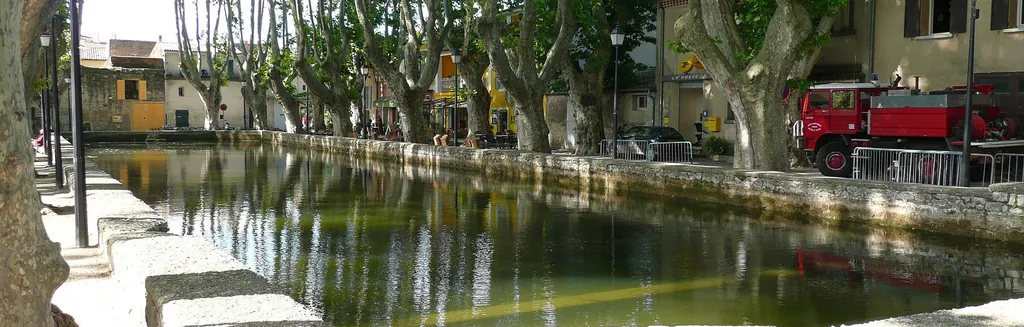
There are two Luberons. The one everyone knows by heart — Gordes, Roussillon, Ménerbes — clinging to the northern slope, and another, more discreet, hidden away on the far side of the mountain. This is the southern Luberon, the southern slope, reached by crossing the Combe de Lourmarin. There, the villages are less crowded, the terraces less besieged, and the light, perhaps, gentler still. From Le Clos de Manon, this is the outing we recommend to guests in search of the real Provence: one day, you cross the mountain, and you discover Cucuron and Ansouis.
Cucuron is a great pool of water bordered by century-old plane trees, a film set — quite literally — where time seems to have stopped around a coffee and a game of pétanque. Ansouis, barely eight kilometres away, unfurls its spiralling lanes up to a château that is still lived in, ranked among the most beautiful villages in France. Two villages, a single day, and the feeling of having found the Luberon that the guidebooks so often forget to mention. Here is how we suggest you discover them.
The southern Luberon, the other slope
The Luberon mountain splits the region in two. To the north, the Apt country and the perched villages that everyone photographs; to the south, the Pays d'Aigues, more rolling, planted with vines and olive trees, with the Durance river running in the distance. Between the two, only one road truly links the two slopes: the Combe de Lourmarin, a narrow and spectacular gorge that the D943 follows through cliffs and pines. To cross it is already to enter another world.
The southern Luberon was long more rural, more agricultural, and that is precisely what gives it its charm today. You find fewer soap shops and more wine estates, fewer coachloads of tourists and more markets where locals genuinely do their shopping. The Luberon Regional Nature Park, which protects the whole massif, watches over this balance between tourism and local life — and you will find a wealth of information on trails and biodiversity on the official website of the Luberon Regional Nature Park.
To place the southern Luberon within the region as a whole, and to understand how it complements the villages of the north, we invite you to read our complete guide to the most beautiful perched villages of the Luberon (2026). It is the best starting point for building an itinerary that goes beyond the obvious highlights.
Cucuron and its Étang basin
You arrive in Cucuron without quite knowing what to expect, and you come straight upon one of the loveliest water squares in Provence. The Étang basin — a large rectangular reservoir dug in the Middle Ages to supply the village and its mills — is ringed by a double row of century-old plane trees whose huge trunks are mirrored in the dark water. At the foot of the trees, cafés, terraces, pétanque players: this is the beating heart of Cucuron, and one of the most striking images you bring home from the southern Luberon.
Beyond the basin, the village rewards a climb through its lanes. Cucuron is dominated by the Saint-Michel keep, a remnant of its medieval castle, and by the church of Notre-Dame-de-Beaulieu, whose Romanesque silhouette can be made out from afar. As you climb toward the upper village, you discover:
- handsome Renaissance houses with sculpted doorways, witnesses to the town's past prosperity;
- the Marc-Deydier museum, a small museum of local history set in a private mansion;
- viewpoints over the plain of the Pays d'Aigues and, in the distance, the Luberon range.
Cucuron is to be savoured slowly. It is a village where you sit down, order a coffee in the shade of the plane trees, and watch life go by. On Tuesday mornings, a Provençal market brings the square and the edges of the basin to life — one of the most authentic in the region, far from the crowds of the northern markets.
Cinema in Cucuron (Ridley Scott, A Good Year)
If the basin of Cucuron looks strangely familiar, it may be because you have already seen it on the big screen. In 2006, Ridley Scott shot several scenes here for A Good Year, the romantic comedy with Russell Crowe and Marion Cotillard, adapted from a novel by Peter Mayle — the very writer who had made the Luberon famous with A Year in Provence. The film tells the story of a London financier who inherits a Provençal wine estate and, despite himself, rediscovers the sweetness of life.
The Étang basin, with its plane trees and terraces, provides the backdrop for several memorable sequences. But this was not Cucuron's first screen role: as far back as 1995, the village had appeared in The Horseman on the Roof, Jean-Paul Rappeneau's adaptation of Jean Giono's novel, with Olivier Martinez and Juliette Binoche. Two prestigious shoots that have lastingly inscribed Cucuron in the imagination of Provençal cinema.
For our film-loving guests, it is an added pleasure to find, on the spot, the exact angles of a shot. The café at the water's edge, the perspective beneath the plane trees, the golden late-afternoon light: it is all there, and the experience is all the more delightful because the village has stayed true to itself, with no touristy staging.
Ansouis, one of the most beautiful villages in France
Eight kilometres from Cucuron, a quarter of an hour by road through the vines, Ansouis rises like a vision. The village coils in a spiral around its hill, crowned by its château, and rightly counts among the most beautiful villages in France, that demanding label which singles out exceptional rural heritage. If the village's history intrigues you, the encyclopaedic entry on Ansouis on Wikipedia traces in detail its medieval origins and its famous Sabran family.
You leave the car at the bottom and climb on foot — it is the only way. The lanes of Ansouis are among the most photogenic in the Luberon: cobbled calades, vaulted passages, old doors, wisteria spilling over the walls. The silence is almost total. As you climb, you come across:
- the church of Saint-Martin, the château's former guardroom turned into a sanctuary, clinging to the rock;
- shaded little squares where you long to linger;
- the surprising Musée Extraordinaire of Georges Mazoyer, devoted to the underwater world and to art, set in vaulted cellars.
Ansouis has something more intimate, more confidential than the great villages of the north. You come here for the pure beauty of the stone, for the calm, for that rare feeling of having a village almost to yourself. It is one of the best-kept secrets of the southern Luberon, and one of our own favourites to recommend.
The château of Ansouis
Crowning the village, the château of Ansouis is one of the few châteaux in the Luberon to have been continuously inhabited, from the Middle Ages to the present day. Cradle of the powerful Sabran family — from which descends Saint Delphine of Sabran, a fourteenth-century figure — it blends the eras: a feudal base from the thirteenth century, a façade and classical interiors from the seventeenth and eighteenth centuries. Listed as a Historic Monument, it can usually be visited by reservation, on a guided tour, from April to October.
The visit reveals furnished drawing rooms, old kitchens, an armoury, and above all magnificent terraced gardens suspended above the village and the plain. The contrast between the austerity of the fortress on the north side and the elegance of the residential château on the south side sums up the whole history of Ansouis: a stronghold turned country residence.
We always advise our guests to check the visiting days and opening times before going up, as they vary with the season and with private events. The reward, from the château's terraces, is one of the finest views in the southern Luberon, taking in the rooftops of the village, the vines of the Pays d'Aigues and the distant silhouette of Mont Sainte-Victoire on a clear day.
Markets, vines and good tables
The southern Luberon is a land of good eating, and Cucuron and Ansouis are no exception. Cucuron has even had the honour of hosting a renowned gastronomic restaurant beside its basin, a sign that the region draws chefs. To go further into the culinary scene of the massif, we recommend our selection of the best Michelin-starred restaurants in the Luberon, which covers both slopes.
As for wine, you are right in the heart of the Luberon appellation. The estates of the Pays d'Aigues, around Ansouis, La Tour-d'Aigues and Cadenet, produce supple reds, fresh whites and remarkable rosés. Many offer tastings and direct sales at the cellar door: an ideal late-afternoon stop to come away with a few bottles. Here are the markets worth knowing in the area:
| Village | Market day | Speciality |
|---|---|---|
| Cucuron | Tuesday morning | Provençal market, farm produce |
| Ansouis | Sunday morning (summer) | Small producers' market |
| Lourmarin | Friday morning | Large, renowned Provençal market |
| La Tour-d'Aigues | Tuesday morning | Pays d'Aigues market |
Settling in at a Cucuron terrace for lunch — between two plane trees of the basin — you will taste that sweetness of life the cinema captured so well. Tapenade, sun-ripened vegetables, lamb from Sisteron, goat's cheeses from the Ventoux: the cooking of the southern Luberon is simple, generous and deeply rooted in its terroir.
A one-day itinerary in the southern Luberon
To make the most of Cucuron and Ansouis, here is the itinerary we suggest to our guests. It fits comfortably into a single day and leaves room to wander, without racing against the clock:
- 9.30 am — Cucuron. Arrival via the Combe de Lourmarin. A coffee at the edge of the Étang basin, then up through the lanes to the keep and the church.
- 12.30 pm — Lunch. On a terrace in the shade of the plane trees, facing the basin. This is the highlight of the day.
- 2.30 pm — Ansouis. A quarter of an hour by road. Climb on foot through the village, lanes and little squares.
- 3.30 pm — Château of Ansouis. Guided tour (by reservation) and terraced gardens.
- 5.00 pm — Tasting. A stop at a wine estate in the Pays d'Aigues before crossing back over the mountain.
This loop can be extended by adding Lourmarin, the best known of the southern villages, on the way back. Here is a summary of distances and times from Gordes, to help you plan:
| Trip from Gordes | Distance | Driving time |
|---|---|---|
| Gordes → Cucuron | ≈ 40 km | ≈ 45 min |
| Gordes → Ansouis | ≈ 42 km | ≈ 45 min |
| Cucuron → Ansouis | ≈ 8 km | ≈ 15 min |
| Cucuron → Lourmarin | ≈ 7 km | ≈ 12 min |
To compare this southern slope with the historic capital of the massif, on the northern side, take a look too at our article on Apt, capital of the Luberon: between the two, you will gain a complete and nuanced picture of the region.
Getting there from Gordes
From Gordes and Le Clos de Manon, reaching the southern Luberon takes a little more driving than the neighbouring villages to the north — about forty to forty-five minutes — but the journey is part of the pleasure. You drop down toward Apt, then enter the spectacular Combe de Lourmarin, the only road that crosses the Luberon mountain. This winding gorge, cut into the rock between cliffs and pine forests, marks the symbolic passage from one slope to the other.
A few practical tips for this outing:
- Set off in the morning to enjoy Cucuron in a beautiful light and avoid the hottest hours in summer;
- Park on the outskirts of the villages, which can only be explored on foot through narrow, steep lanes;
- Bring good shoes, as the cobbled calades can be slippery;
- Book your visit to the château of Ansouis in advance and check the opening days.
The best time for this escape runs from April to October, when the terraces are open and the château accessible. Spring brings the budding vines and the wisteria in bloom; autumn, the grape harvest and an incomparable golden light. In summer, favour the morning and the late afternoon, the edge of the Cucuron basin staying cool beneath the plane trees even in the hottest hours.
Making the southern Luberon a getaway from Le Clos de Manon
What makes the southern Luberon so precious is precisely that it asks for a little detour. You do not stumble upon it by chance: you choose to go, and you return with the sense of having seen a more secret, more genuine Luberon. From our villa, a ten-minute walk from Gordes, you are ideally placed to range across both slopes: the perched villages of the north in the morning, the Pays d'Aigues and its vines in the afternoon.
That is the whole appeal of a peaceful stay, with a private heated pool, from which you explore the region without ever being long back on the road. To make the most of this diversity — from the basin of Cucuron to the château of Ansouis, by way of Gordes and Roussillon — we recommend a stay of five to seven nights. If the longing for Provence takes hold of you, you can now check our availability at Le Clos de Manon and start planning your escape to the southern Luberon.