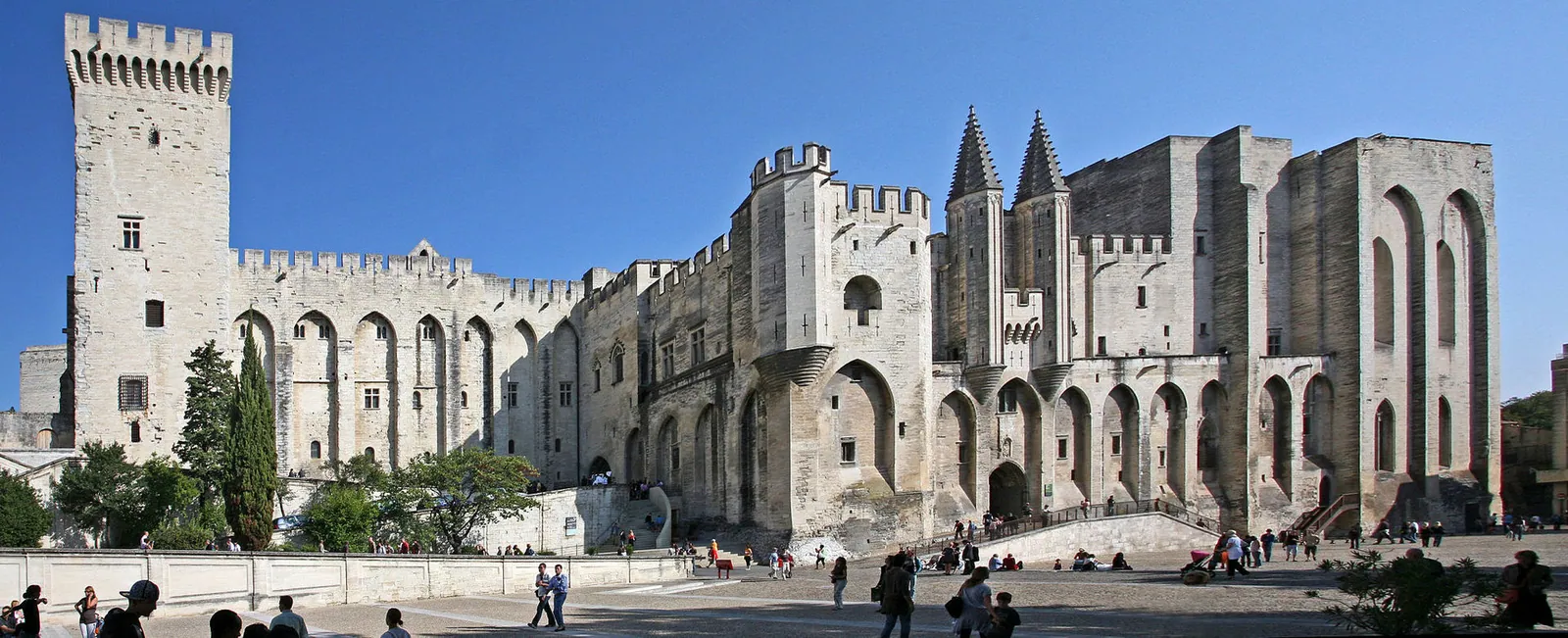
There are towns we feel we know before we ever set foot in them, so famous is their outline. Avignon is one of them. Its intact walls, its monumental palace looming over the Rhône and its half-broken bridge make up one of the most recognisable images of Provence. And yet it is only by wandering its narrow streets, looking up at the cardinals' façades and settling in on the Place de l'Horloge that you truly grasp what, in the 14th century, it meant to be the capital of Christendom. About 45 minutes' drive from Gordes, Avignon is one of the finest days out we recommend to our guests. Here is how to take it all in without rushing.
The Palais des Papes, heart of the city
It all begins with the palace. The Palais des Papes is the largest Gothic palace in the world, a fortress as much as a residence, built in under twenty years when the papacy left Rome to settle in Avignon between 1309 and 1377. Nine popes succeeded one another here, and the sheer scale of the place tells the story of the Church's power at that time better than any words could.
You pass through the Champeaux gate to discover a succession of courtyards, chapels and ceremonial halls of dizzying proportions. The Grand Tinel, the Stag Room with its hunting frescoes, the Clementine Chapel: each room unfolds a chapter of history. Allow at least an hour and a half for the visit, more if you take the time to climb up to the terraces, where the panorama takes in the Rhône, the bridge and Mont Ventoux in the distance.
- Arrive early. The palace opens in the morning; the first hours are the quietest, especially in high season.
- Take the digital visit device often offered on site: it restores the rooms to their original splendour, furniture and hangings included.
- Save some time for the Rocher des Doms, the hilltop garden just behind the palace, which offers the finest view over the river without spending a penny.
The Saint-Bénézet bridge, the famous "Pont d'Avignon"
"Sur le pont d'Avignon, l'on y danse…" The nursery rhyme has travelled the world, but few know that it celebrates a very real structure: the Saint-Bénézet bridge. Built in the 12th century, nearly nine hundred metres long and originally boasting twenty-two arches, it once spanned the Rhône all the way to Villeneuve-lès-Avignon. The river's repeated floods got the better of it: people stopped rebuilding it in the 17th century, and only four arches remain today, reaching proudly out over the water.
You can walk to its broken-off end and visit, along the way, the little Saint-Nicolas chapel built on one of the piers. It is short, but the spot is striking, especially at the end of the day when the light turns the stones golden. Together with the palace, the bridge and the whole historic centre, Avignon is listed as a UNESCO World Heritage Site.
Wandering the walled city
Avignon is far more than its two great monuments. The entire town is encircled by 14th-century ramparts, nearly four kilometres of crenellated walls punctuated by towers and gates, one of the best-preserved medieval enclosures in France. To pass through them is to enter a maze of narrow streets, shaded squares and grand townhouses.
The beating heart remains the Place de l'Horloge, lined with terraces, the town hall and its belfry, and the lovely opera house. It's the ideal place for a mid-day break. All around, the Rue des Teinturiers and its canal edged with paddle wheels, the Place Pie and its covered market — a paradise for food lovers — and the antiques quarter all invite you to amble without any set route.
A gourmet interlude
The covered market of Avignon, Les Halles, is a stop we love to recommend: behind its plant-clad façade, the stalls overflow with local produce, goat's cheeses from the Ventoux, tapenade, candied fruits and wines from the neighbouring Côtes du Rhône. You can grab a quick lunch there or put together a basket for the drive home. A few steps away, the terraces serve generous Provençal cooking, where daube and sun-ripened vegetables take pride of place.
Avignon in July: the city in festival mode
If you are staying in Provence in the heart of summer, you should know that Avignon transforms every July. The Avignon Festival, founded in 1947 by Jean Vilar, is one of the world's great theatre events. The Court of Honour of the Palais des Papes becomes an open-air stage, while the sprawling "Off" festival takes over every hall, every cloister and every street in town.
The atmosphere is one of a kind: actors in costume handing out flyers, posters plastered everywhere, performances from morning to night. It's an exhilarating experience, but the town is then crowded and hot. If you are after a peaceful discovery of the monuments, choose spring or the shoulder season; if it's the theatrical buzz you're chasing, July is unrivalled.
Avignon within a Luberon stay
Avignon is the grand gateway to the Vaucluse, and its closeness to Gordes makes it an easy day to slot in. We love to suggest pairing the city of the popes with other gems nearby, each within easy driving distance, to build your own circuit. If you are planning several days, find all our detailed routes in our itineraries starting from Gordes.
For short stays, Avignon pairs beautifully with a day of villages and markets: see Gordes and its surroundings in a day to explore closest to the villa, or build a 2-day weekend in the Luberon that alternates between major sites and hilltop villages. And if you're lucky enough to stay longer, a week in the Luberon: the ideal plan will give you the perfect tempo to see everything without ever hurrying.
Practical tips for visiting Avignon
- Parking. The area inside the ramparts is cramped and tightly regulated. The easiest option is to park in one of the large park-and-ride lots on the outskirts, such as Île Piot or Les Italiens, from which free shuttles reach the centre in just a few minutes.
- Everything is walkable. Once inside the walled city, forget the car: the monuments, the squares and the market are all just a few minutes' walk from one another.
- Avoid July for a peaceful visit. During the festival, accommodation and parking are saturated; off season, the town is far more enjoyable.
- Allow a full day to combine the palace, the bridge, the ramparts, a wander through the narrow streets and a lunch at the market.
Your ideal base 45 minutes from Avignon
The joy of a stay in Gordes is being able to set off in the morning to explore the city of the popes, then return at the end of the day to cool off in the heated pool, in the shade of the cypresses, far from the urban bustle. From Le Clos de Manon, Avignon is just three-quarters of an hour away, and it's only one outing among so many right from your doorstep. If the idea of a week spent roaming the Luberon, at the gentle pace of Provence, appeals to you, check our availability and book your stay: the Palais des Papes will be waiting, unchanging above the Rhône.